 2-6
2-6R ROSENSTOCK
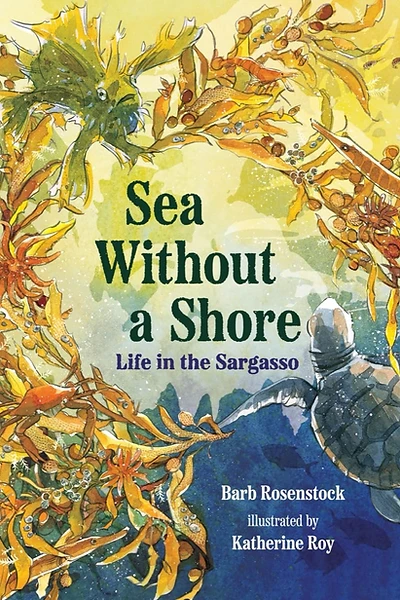
Sea Without a Shore: Life in the Sargasso
by Barb Rosenstock
Pacing MaterialA vivid exploration of the Sargasso Sea — a unique ocean ecosystem with no shoreline — and the remarkable creatures that call it home.
Big Idea
Even a sea without a shore teems with life — every ecosystem is connected.
Discussion Questions
- 1.What makes the Sargasso Sea unique?
- 2.How do the creatures depend on the sargassum seaweed?
- 3.Why is this sea called 'without a shore'?
- 4.What can we do to protect ocean ecosystems?
Classroom Activity
Sargasso Sea Diorama
Create an ecosystem diorama showing the Sargasso Sea and its creatures, then label each animal and plant.
Lesson Plan
Learning Goals
- Understand ecosystem interdependence
- Explore nonfiction narrative techniques
- Connect science and storytelling
Standards Connections
- ELA: RI.2.1 — Ask and answer questions about key details
- ELA: RI.2.2 — Identify main topic and retell key details
- ELA: RI.2.3 — Describe connection between events
- ELA: RI.6.6 — Acknowledge differences in characters' points of view
- ELA: SL.2.1 — Participate in collaborative conversations about the text
- ELA: W.2.3 — Write narratives recounting events with descriptive details
- SEL: Responsible Decision-Making
Pace-Write-Read Study with Pace-Write It!
Focus question: How can a nonfiction writer make science feel like movement, story, and discovery? Sea Without a Shore: Life in the Sargasso follows one piece of sargassum seaweed as it supports a whole floating ecosystem in the Sargasso Sea, from tiny organisms to larger animals. The book moves through a widening scope of interdependence, with fluid and rhythmic language shaped by currents. Roy's watercolor-like art shows scale, movement, and hidden creatures, with a visual focus on sargassum as a floating home.
| Element | How to notice or teach it in the novel |
|---|---|
| Pace | Read: The book begins small, with one piece of seaweed, then widens into a whole ecosystem. Classroom Activity: Start with one tiny natural object. Expand outward in 5 steps. |
| Plot | Read: The "plot" is ecological growth: seaweed floats, shelters life, feeds life, connects life. Classroom Activity: Write a nonfiction chain: "Because of ___, ___ can ___." |
| Prosody | Read: The language is made for read aloud, with punchy phrasing and sound play. Kirkus notes its "energy" and alliteration. Classroom Activity: Read your draft aloud and mark where your voice speeds up, slows down, or lifts. |
| Word pause | Read: Short phrases let readers stop and look closely. Classroom Activity: Break one long science sentence into three short image lines. |
| Concept | Read: The big idea is interdependence: one plain looking seaweed supports many lives. Classroom Activity: Write a title or subtitle that reveals your central science idea. |
| Voice & World View | Read: The voice treats the ocean as active, connected, and full of hidden life. Classroom Activity: Choose a worldview sentence: "In this place, everything…" |
| Setting & Place | Read: The setting is the Sargasso Sea, shaped by Atlantic currents and floating sargassum. Classroom Activity: Describe a habitat using motion words before naming it. |
| Point of View | Read: The book uses nonfiction observer point of view, guiding readers from close view to wide view. Classroom Activity: Write from the viewpoint of a careful explorer: "Look closer…" |
| Original Characters | Read: There are no invented fictional characters; the "cast" is real marine life. Classroom Activity: Make a cast list of real organisms in your topic. |
| Dialogue | Read: The book does not depend on dialogue; it uses narration and visual action. Classroom Activity: Add one labeled "imagined thought" from an animal only if it teaches a fact. |
| Details | Read: Specific creatures create credibility: bryozoans, hydroids, tube worms, shrimp, eels, turtles, whales. Classroom Activity: Add three exact nouns from research. |
| Descriptions | Read: Descriptions help readers picture texture, motion, and scale. Classroom Activity: Use one color detail, one movement detail, and one size detail. |
| Strong First Lines | Read: The opening concept is simple and surprising: one piece of seaweed can hold a world. Classroom Activity: Begin with a small object doing a big job. |
| Immediacy & Engagement | Read: The book pulls readers into a hidden ecosystem by starting with something findable on a beach. Classroom Activity: Start your page with something readers could see, touch, or notice. |
| Story scenes, summaries, unique structures | Read: The structure moves like a zoom lens: beach, seaweed, small life, larger life, whole system. Classroom Activity: Draft your piece as a "zoom out" sequence. |
| Flashback, flash forward, cliffhangers | Read: The book uses sequence and growth more than flashback or flash forward. Suspense comes from "what depends on this next?" Classroom Activity: End one section with a question that makes readers turn the page. |
| Tension, suspense, surprise | Read: Surprise comes from scale: a humble plant supports a complex ocean community. Classroom Activity: Reveal your most surprising fact after two smaller facts. |
| Page turns and chapter breaks | Read: Picture book page turns can shift scale, introduce a new organism, or widen the scene. Classroom Activity: Mark three page turns: tiny, medium, huge. |
| Performance | Read: The alliteration and triplet creature lists invite expressive read aloud. Kirkus highlights triplet lines and sound play. Classroom Activity: Perform one paragraph twice: once flat, once with ocean movement. |
| Personality | Read: The book's personality is curious, energetic, and wonder filled. Classroom Activity: Give your nonfiction voice one clear trait: curious, urgent, playful, amazed. |
| Humor | Read: Humor is subtle, found in odd creatures and surprising behaviors. Classroom Activity: Add one light, factual surprise without making fun of the animal. |
| Pause | Read: Pauses let the reader notice small life before the next expansion. Classroom Activity: Put a line break before your most important fact. |
| Poetry and poetic devices | Read: The book uses alliteration, rhythm, repetition, and image based phrasing. Classroom Activity: Add one alliterative phrase that still sounds natural. |
| Repetition | Read: Repeated patterns build the ecosystem chain. Classroom Activity: Repeat a sentence frame three times with changing creatures. |
| Rhythm | Read: The rhythm mimics currents, drifting, swirling, and building. Classroom Activity: Use verbs that move: drift, swirl, cling, shelter, feed. |
| Punctuation | Read: Periods and fragments can control read aloud speed. Classroom Activity: Revise one sentence using a dash, colon, or fragment for emphasis. |
| Questions | Read: Curiosity drives the book's research path; Rosenstock said her interest began with questions about dried seaweed on a beach. Classroom Activity: Begin your research notes with three "I wonder…" questions. |
| Compare-Contrast | Read: The book contrasts small seaweed with huge ecological importance. Classroom Activity: Use a contrast: "It looks ___, but it…" |
| Objects | Read: Sargassum is the central object that holds the structure together. Classroom Activity: Pick one object that can carry your whole nonfiction piece. |
| Threes | Read: Triplet lists create rhythm and help organize information. Classroom Activity: Write a three-part list of organisms, actions, or details. |
| Whitespace & negative space | Read: Picture book spacing gives readers time to study the art and absorb facts. Classroom Activity: Leave one line alone on the page for emphasis. |
| Art & graphics | Read: Katherine Roy's watercolor-like art shows scale, movement, and hidden creatures. Reviews note the swirling, vibrant illustrations. Classroom Activity: Sketch a page plan: close-up, middle view, wide view. |
| Interactives & gamification | Read: The book invites "find it" reading: readers can search the art for organisms and connections. Classroom Activity: Create a mini "ecosystem hunt" with 5 things for classmates to find. |
Pace-Write It!
20-minute classroom workshop: 1. Read (5 min) — Read one spread closely. Students listen for sound, rhythm, and movement words. Then they look at the art and name what their eyes notice first, second, and third. 2. Notice (5 min) — Students identify how the page controls pace: short phrases, repeated structures, exact creature names, page turn surprise, close-up to wide-view movement. 3. Write (7 min) — Write a nonfiction "small thing, big world" piece using this frame: (1) Begin with one small natural object. (2) Show where it is. (3) Name three living things connected to it. (4) Use one repeated phrase. (5) End by widening the view. Example frame: One ___ floats/stands/rests in ___. It gives ___ a place to ___. It gives ___ a place to ___. It gives ___ a place to ___. Small as it seems, ___ holds ___ together. 4. Share (3 min) — Students read aloud and classmates listen for: one strong science detail, one rhythmic phrase, one place where the pacing slowed down well. Exit ticket: What pacing move made Sea Without a Shore feel alive: sound, repetition, page turns, art, or the zoom from small to large? Write one sentence explaining your choice.