 3-7
3-7R GUILA
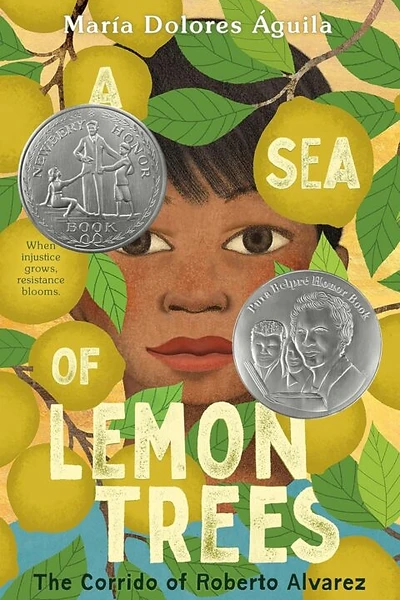
A Sea of Lemon Trees
by María Dolores Águila
Pacing MaterialThe true story of Roberto Alvarez and the Lemon Grove Incident, told through the corrido tradition — a young person's fight for justice in a segregated California town.
Big Idea
When injustice grows, resistance blooms — one voice can spark a movement.
Discussion Questions
- 1.Who was Roberto Alvarez and what did he fight for?
- 2.How does the author use the corrido form to tell this story?
- 3.What does the title 'A Sea of Lemon Trees' symbolize?
- 4.How do individuals create change in their communities?
Classroom Activity
Corrido of Courage
Research a folk song or corrido and write your own verse about someone who stood up for what's right.
Lesson Plan
Learning Goals
- Understand narrative nonfiction
- Explore themes of justice and resistance
- Learn about Mexican American history
Standards Connections
- ELA: RI.3.1 — Ask and answer questions about key details
- ELA: RI.3.2 — Identify main topic and retell key details
- ELA: RI.3.3 — Describe connection between events
- ELA: RI.7.6 — Acknowledge differences in characters' points of view
- ELA: SL.3.1 — Participate in collaborative conversations about the text
- ELA: W.3.3 — Write narratives recounting events with descriptive details
- SEL: Social Awareness
- SEL: Relationship Skills
Pace-Write-Read Study with Pace-Write It!
Focus question: How does an author control the speed of a true story so readers feel the unfairness, courage, and hope in each moment? In A Sea of Lemon Trees by María Dolores Águila, the true story of Roberto Alvarez and the Lemon Grove Incident is told with the energy of a corrido, blending history, emotion, and resistance. The pacing moves between quick, urgent moments of injustice and slower, reflective moments filled with family, community, and place, helping readers feel both the pressure of segregation and the power of standing up for justice.
| Element | How to notice or teach it in the novel |
|---|---|
| Pace | Read: Notice how the story speeds up when Roberto Alvarez and the Lemon Grove families face segregation, then slows down to linger on the lemon groves, family pride, and the meaning of justice. Classroom Activity: Write two short paragraphs about the same event from Roberto’s story—one fast-paced and one slow-paced—to show how pacing changes the feeling. |
| Plot | Read: Track how María Dolores Águila builds the real events from everyday life in Lemon Grove to the school segregation crisis and the community’s resistance. Classroom Activity: Create a 5-step plot ladder for Roberto Alvarez’s fight for justice, then add one sentence explaining where the pace becomes most intense. |
| Prosody | Read: Listen for the musical, corrido-like flow of the language and how its sound helps carry the true story forward. Classroom Activity: Write 4-6 lines about standing up for fairness using a chant-like or song-like rhythm inspired by the book’s storytelling style. |
| Word pause | Read: Notice where a single important word or short phrase makes you stop and feel the weight of segregation, courage, or resistance in Roberto’s story. Classroom Activity: Write three sentences about an unfair moment, each using one powerful word or short phrase set apart for emphasis. |
| Concept | Read: Think about the big idea that young people and communities can challenge injustice, just as Roberto Alvarez and the Lemon Grove families did. Classroom Activity: Write a short response explaining how the concept of justice grows stronger as the story moves forward. |
| Voice & World View | Read: Notice how the book’s voice honors Mexican American history, community dignity, and resistance while telling a child-centered true story. Classroom Activity: Write 5 sentences in a respectful, proud voice about a community standing together against unfair treatment. |
| Setting & Place | Read: Pay attention to Lemon Grove, California, the sea of lemon trees, and the school setting, and notice how place shapes both the beauty and the conflict of the story. Classroom Activity: Describe a place that looks peaceful on the outside but holds a problem underneath, using details like Águila does. |
| Point of View | Read: Notice how the story centers Roberto Alvarez and helps readers experience the Lemon Grove Incident through a young person’s perspective. Classroom Activity: Rewrite one key moment from the point of view of Roberto, a parent, or another student, and show how that perspective changes the pacing. |
| Original Characters | Read: Notice how real historical people such as Roberto Alvarez are presented as vivid, memorable individuals rather than distant facts from history. Classroom Activity: Choose one real person from the story and write a short character sketch showing what makes that person brave and believable. |
| Dialogue | Read: Listen for moments when spoken words would carry tension, fear, or determination during the school segregation conflict, even in a lyrical retelling. Classroom Activity: Write a brief dialogue between Roberto and a family member the night before an important decision, showing worry and courage. |
| Details | Read: Notice the small historical and sensory details that make the Lemon Grove Incident feel immediate and real. Classroom Activity: List 6 details from the book or summary of the event, then use at least 3 of them in a paragraph about resistance. |
| Descriptions | Read: Study how descriptions of lemon trees, streets, classrooms, and people slow the reader down and deepen the emotional impact of the true story. Classroom Activity: Write a descriptive snapshot of Lemon Grove before the conflict begins, hinting that change is coming. |
| Strong First Lines | Read: Notice how the opening draws readers into a real story about justice and quickly sets the tone of memory, place, and struggle. Classroom Activity: Write three possible first lines for a true story about a child facing unfairness, and make one line lyrical like a corrido. |
| Immediacy & Engagement | Read: Notice how the author makes a historical event feel present and urgent so readers care about Roberto Alvarez right away. Classroom Activity: Write 4-5 sentences that make a past event feel like it is happening now by using vivid action and emotion. |
| Story Scenes & Summaries & Unique Structures | Read: Watch how some parts feel like close-up scenes while other parts summarize history, and notice how the corrido tradition gives the book a unique structure. Classroom Activity: Write one detailed scene from the Lemon Grove Incident and one 2-sentence summary of the larger event. |
| Flashback & Flash Forward & Cliffhangers | Read: Notice whether the story reaches back to history, hints ahead to consequences, or ends sections with emotional tension connected to the fight for justice. Classroom Activity: Write a short passage that ends with Roberto wondering what will happen next, creating a cliffhanger. |
| Tension & Suspense & Surprise | Read: Pay attention to how segregation creates tension and how the community’s response builds suspense about whether fairness will win. Classroom Activity: Write a suspenseful paragraph about waiting to hear an important decision in the Lemon Grove case. |
| Page Turns and Chapter Breaks | Read: Notice where a page turn or break would make readers pause, worry, or keep reading to see what happens to Roberto Alvarez and the students. Classroom Activity: Draft the end of a page or section that would make a reader urgently want to turn the page. |
| Performance | Read: Because the story is told through the corrido tradition, notice how the words could be spoken or performed aloud with feeling and rhythm. Classroom Activity: Choose 3-4 lines you wrote and mark where to slow down, speed up, or stress words for an oral performance. |
| Personality | Read: Notice the personality in the storytelling—proud, serious, warm, and determined—as it honors Roberto, his family, and the Lemon Grove community. Classroom Activity: Write a paragraph that gives your narrator a strong personality while telling about a moment of standing up for what is right. |
| Humor | Read: Notice whether lighter moments or warm human touches balance the serious subject of segregation and help show the full life of the community. Classroom Activity: Add one gentle, natural moment of humor or family warmth to a serious scene without taking away from the main conflict. |
| Pause | Read: Notice where the story invites readers to pause and reflect on unfairness, bravery, or the cost of resistance. Classroom Activity: Write a short paragraph about a pause before action—when Roberto or another character stops to think before speaking up. |
| Poetry and Poetic Devices | Read: Look for imagery, repetition, sound, and line-like phrasing that connect the story to the corrido tradition and make history feel lyrical. Classroom Activity: Write 6 lines about justice in Lemon Grove using imagery and repetition. |
| Repetition | Read: Notice if key ideas, phrases, or images—such as lemon trees, school, fairness, or standing together—repeat to strengthen the message of resistance. Classroom Activity: Write a paragraph that repeats one meaningful phrase three times to emphasize justice. |
| Rhythm | Read: Listen to the rise and fall of the language and how rhythm helps move the true story between sorrow, pride, and determination. Classroom Activity: Write 5 sentences with varied lengths to create a strong rhythm for a scene about protest or courage. |
| Punctuation | Read: Notice how punctuation can speed up action, slow down reflection, or add emotional force in a story about segregation and protest. Classroom Activity: Rewrite a sentence about the Lemon Grove Incident three ways—using commas, dashes, and exclamation points—to change the pace. |
| Questions | Read: Notice the questions the book raises about fairness, who belongs, and what young people can do when rules are unjust. Classroom Activity: Write 4 questions Roberto might ask during the conflict, then answer one in his voice. |
| Compare-Contrast | Read: Compare the peaceful beauty of the lemon groves with the harshness of segregation, and contrast silence with resistance. Classroom Activity: Write a compare-contrast paragraph about Lemon Grove’s beauty and the injustice happening there. |
| Objects | Read: Notice how objects such as school materials, signs, clothing, or the lemon trees themselves can carry emotional and symbolic meaning. Classroom Activity: Choose one object from the world of the story and write how it connects to justice or identity. |
| Threes | Read: Look for patterns of three in ideas, images, or descriptions that make the language memorable and strong. Classroom Activity: Write a sentence or short stanza using three linked details about Roberto, his community, or the fight for fairness. |
| Whitespace & Negative Space | Read: Notice how space on the page, short sections, or visual pauses can give heavy moments room to breathe and let readers reflect on the Lemon Grove Incident. Classroom Activity: Write a short free-verse passage with intentional line breaks and space to slow the reader down. |
| Art & Graphics | Read: Pay attention to how illustrations or visual elements may deepen the mood of the lemon groves, the school conflict, and the community’s strength. Classroom Activity: Sketch a quick storyboard of 3 moments from the story and label where the pace should feel slow, fast, and most intense. |
| Interactives & Gamification | Read: Think about how readers could engage with the true story by tracking choices, moments of courage, or causes and effects in Roberto Alvarez’s fight for justice. Classroom Activity: Create a simple choice map or timeline game where players follow the Lemon Grove community’s path from segregation to resistance. |
Pace-Write It!
20-Minute Classroom Flow\nRead (5 min): Read aloud a key section of A Sea of Lemon Trees that shows Roberto Alvarez, the Lemon Grove community, and the conflict over school segregation. Ask students to listen for where the story speeds up and where it slows down.\nNotice (5 min): Students turn and talk: Where did María Dolores Águila use lyrical, corrido-like language? Where did description slow the pace? Where did the injustice make the pace feel urgent? Chart student noticings under: Fast, Slow, Pause.\nWrite (7 min): Students write a short true-story-inspired scene about a young person facing unfairness and choosing to act. Writing frame: 'At first, ____________. The place around me was ____________. Then everything changed when ____________. My heart felt ____________, but I knew ____________. So I/We ____________.' Challenge students to include one repeated phrase and one place where the pace slows down with description.\nShare (3 min): Partners read their pieces aloud and point to one sentence that feels fast and one sentence that feels slow. Invite 1-2 volunteers to share how they used pacing to show justice or resistance.\nExit ticket: In one or two sentences, answer: How did pacing help María Dolores Águila make Roberto Alvarez’s true story more powerful for readers?