
 7-12
7-12YA SEPETYS
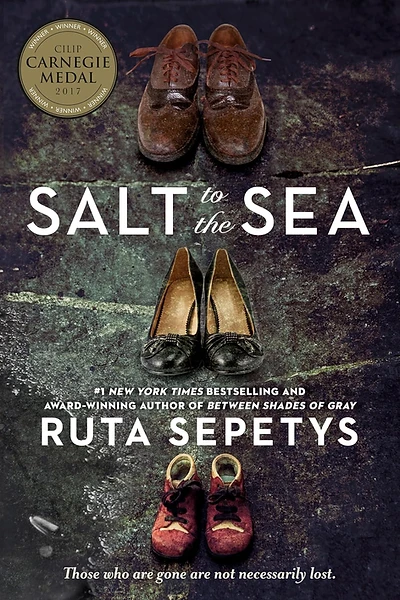
Salt to the Sea
by Ruta Sepetys
Pacing MaterialSet against the backdrop of World War II, this harrowing novel follows four refugees from different backgrounds as they converge on the ill-fated Wilhelm Gustloff. As the Soviet army advances, their desperate journey reveals the hidden scars of conflict and culminates in one of history's most tragic, yet largely forgotten, maritime disasters.
Big Idea
History is not merely a collection of dates and battle outcomes, but a mosaic of individual human experiences, secrets, and resilience amidst the chaos of war.
Discussion Questions
- 1.How does the alternating perspective structure affect your emotional connection to the characters and your understanding of the war?
- 2.In what ways do the characters' secrets shape their identities and influence their decisions as they flee?
- 3.Why is it significant that history often overlooks the stories of civilian victims and refugees compared to military figures?
- 4.How do the concepts of guilt and redemption drive the choices made by Florian and Alfred throughout the story?
- 5.What does the Wilhelm Gustloff represent to the characters at the beginning of their journey versus what it comes to symbolize by the end?
Classroom Activity
The Artifacts of Memory
Students will create a symbolic 'memory suitcase' for one character to analyze how personal possessions reveal hidden motivations and histories during wartime migration.
Lesson Plan
Learning Goals
- Identify the connection between physical objects and character characterization in historical fiction.
- Analyze the impact of displacement and survival on the personal identity of individuals.
- Develop empathetic reasoning by exploring the motivations of characters navigating moral ambiguity.
Activity Steps
- 1.Assign each student one of the four main characters to focus on for their research.
- 2.Identify three specific items mentioned in the text that the character carries or longs for throughout their journey.
- 3.Create a visual representation or sketch of these items inside a simulated paper suitcase.
- 4.Write a brief justification for each chosen item, explaining its symbolic importance to the character's survival or psychological state.
- 5.Engage in a gallery walk where students present their suitcase and discuss how these items reflect the broader human experience of war.
Standards Connections
- CCSS.ELA-LITERACY.RL.9-10.3: Analyze how complex characters develop over the course of a text.
- CASEL Social Awareness: Recognize the diverse perspectives and experiences of others during times of crisis.
- NCSS Theme 2: Time, Continuity, and Change, specifically evaluating the impact of historical events on individual lives.
Pace-Write-Read Study with Pace-Write It!
Focus question: How can four short, alternating chapters make one journey feel urgent? Set during the final months of World War II, Salt to the Sea follows Joana, Florian, Emilia, and Alfred as their paths move toward the Baltic Sea. Sepetys chose four narrators to show how people from different regions experience the same history through different perspectives. The novel's short chapters let a scene stop in one voice and continue—or take on a different meaning—in another.
| Element | How to notice or teach it in the novel |
|---|---|
| Pace, plot & concept | Chart how the journey toward the ship gives the separate stories a shared direction. Mark where a chapter advances the journey and where it reveals why that journey matters to a character. Classroom Activity: Make a four-column timeline, one column per narrator. Mark one fast, one slow, and one turning-point chapter. |
| Voice, worldview & point of view | Compare what two narrators notice about the same person or situation. Ask what each knows—and what each gets wrong or leaves out. Classroom Activity: Describe a harmless classroom mix-up in two 100-word first-person accounts. Give each narrator a distinct concern. |
| Original characters, personality & dialogue | Notice how a character's speech and private thoughts may create different impressions. Track how your view changes as other narrators add information. Classroom Activity: Write a short exchange, then add each speaker's private response in a separate paragraph. |
| Setting, place, details & descriptions | Find details that make the winter journey feel specific. Which details establish place quickly? Which ask the reader to slow down and notice a person? Classroom Activity: Describe a crowded location using three carefully chosen details. Remove any detail that does not affect mood or action. |
| Strong first lines, immediacy & engagement | Compare the openings of the four narrators' first chapters. What concern does each opening place before the reader? Classroom Activity: Write four different opening sentences for four people arriving at the same place. |
| Story scenes, summaries & unique structures | Identify a chapter that stays close to one brief event and another that covers more time. Consider why Sepetys switches narrator at that point. Classroom Activity: Summarize an ordinary event in two sentences; then expand its most important ten seconds into a scene. |
| Flashback, flash forward & cliffhangers | Look for past experiences revealed gradually through memory. Distinguish these from flash forwards, which must actually move the narration into a future event. Notice what a chapter leaves unresolved when the voice changes. Classroom Activity: End a scene with an unanswered question. Begin the next scene from another narrator's viewpoint without answering it immediately. |
| Tension, suspense, surprise, page turns & chapter breaks | Track what readers know that one narrator does not. Ask whether suspense comes from an approaching event, an undisclosed past, or the change of voice itself. Classroom Activity: Cut two short scenes at different points. Have a partner identify which break creates the stronger reason to turn the page. |
| Prosody, word pause, performance, pause & rhythm | Read a short, non-graphic passage aloud. Notice how sentence length and paragraph endings affect breath and speed. Classroom Activity: Mark pauses on an original 80-word passage. Read it twice and revise one sentence to alter the pace. |
| Poetry, poetic devices, repetition & punctuation | Look for recurring images or words across the narrators. Examine how a short sentence or repeated idea gains weight when it returns in a new context. Classroom Activity: Write three brief paragraphs that repeat one image. Change its meaning in the third paragraph. |
| Questions, compare–contrast & threes | Keep a list of questions raised by each narrator. Compare three successive chapters: what does each add, withhold, or revise? Classroom Activity: Create a three-step reveal: a fact, a different interpretation, and a new question. |
| Objects | Follow a carried or exchanged object. Ask what it reveals about its owner and whether its meaning changes when another character sees it. Classroom Activity: Tell an object's journey in three short scenes, each from a different observer's viewpoint. |
| Whitespace, negative space, art & graphics | Look at the space created by short chapters and paragraph breaks. In a prose edition, focus on layout and any actual design features you can see; do not assume the novel uses comic panels or illustrations. Classroom Activity: Set the same original paragraph in two layouts—one dense, one broken into shorter paragraphs—and compare reading speed. |
| Humor & emotional contrast | Notice moments of ordinary conversation or warmth amid the story's serious events. Ask what change of pace they give readers. Classroom Activity: Add one gentle, character-based moment of relief to a serious scene without changing its stakes. |
| Interactives & gamification | Use a class "narrator tracker" to test how the structure works. Classroom Activity: In groups, sort chapter cards by narrator, new information, and question left open. Defend one placement with evidence. |
Pace-Write It!
Exit ticket: Choose one transition between narrators. Explain what the first chapter makes you expect, what the next narrator adds, and how the switch affects your reading pace. Teaching note: The novel deals with war and displacement. Students can analyze its craft using selected passages without reenacting traumatic events.