 3-7
3-7GN JAMIESON
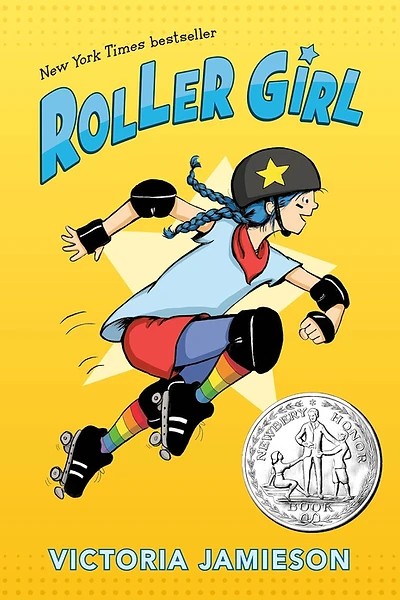
Roller Girl
by Victoria Jamieson
Pacing MaterialTwelve-year-old Astrid discovers roller derby summer camp just as her best friend Nicole is drifting away, and she must navigate friendship changes, athletic challenges, and growing up — all on skates.
Big Idea
Growing up means finding your own path, even when it takes you in a different direction from your friends.
Discussion Questions
- 1.How does Astrid's friendship with Nicole change throughout the story?
- 2.What does roller derby teach Astrid about herself?
- 3.How does Astrid handle making new friends while losing old ones?
- 4.Have you ever grown apart from a friend? What happened?
Classroom Activity
Identity and Friendship Map
Students create a visual map showing how their interests and friendships have changed and grown over time.
Lesson Plan
Learning Goals
- Analyze how friendships evolve during middle school years
- Explore themes of identity, perseverance, and self-discovery
- Understand how trying new things helps us grow
- Develop self-reflection and emotional awareness
Activity Steps
- 1.Discuss how Astrid and Nicole's friendship changes
- 2.Have students think about an interest or hobby that defines them
- 3.Students create a friendship map showing important people and changes
- 4.Share maps and discuss how growing apart can lead to growing up
- 5.Reflect on how challenges make us stronger
Standards Connections
- ELA: RL.3.1 — Ask and answer questions about key details
- ELA: RL.3.2 — Retell stories, including key details
- ELA: RL.3.3 — Describe characters, setting, and events
- ELA: RL.7.6 — Acknowledge differences in characters' points of view
- ELA: SL.3.1 — Participate in collaborative conversations about the text
- ELA: W.3.3 — Write narratives recounting events with descriptive details
- SEL: Relationship Skills
- SEL: Social Awareness
- Art: VA:Re7 — Perceive and analyze artistic work
Pace-Write-Read Study with Pace-Write It!
Focus question: How does Victoria Jamieson control the speed of Astrid’s story so readers can feel friendship changes, skating challenges, and growing-up moments at just the right pace? In Roller Girl by Victoria Jamieson, a graphic novel about Astrid’s summer at roller derby camp while her friendship with Nicole shifts, the pacing moves between fast action on skates and quieter emotional scenes. Jamieson uses panels, page turns, dialogue, expressions, and scene length to help readers feel excitement, disappointment, determination, and kindness.
| Element | How to notice or teach it in the novel |
|---|---|
| Pace | Read: Notice how Roller Girl speeds up during derby practice, falls, and races, then slows down when Astrid feels lonely, embarrassed, or confused about Nicole. Classroom Activity: Write two short scenes about the same character—one fast moment during a sport or game and one slow moment during a friendship problem—using shorter sentences for speed and longer sentences for reflection. |
| Plot | Read: Follow how Astrid’s summer camp experience and her changing friendship with Nicole develop side by side, with each event pushing Astrid to grow. Classroom Activity: Make a mini plot ladder with 5 steps for a realistic story about a friendship changing while the main character learns a new skill. |
| Prosody | Read: Listen to how dialogue and sound effects in Roller Girl create energy, especially in derby scenes with cheers, crashes, and fast reactions. Classroom Activity: Write 6-8 lines of dialogue for a high-energy scene and read them aloud to revise for smooth, lively sound. |
| Word pause | Read: Notice moments when a single word, reaction, or brief line lands heavily because Astrid is hurt, surprised, or determined. Classroom Activity: Write a short comic-style exchange where one one-word panel shows a character’s strong feeling after a friendship disappointment. |
| Concept | Read: Think about the big idea that growing up sometimes means friendships change, but kindness, effort, and self-discovery can lead to new connections. Classroom Activity: Write a theme statement about Roller Girl, then draft a new scene that teaches the same idea through action instead of explanation. |
| Voice & World View | Read: Notice how the story reflects Astrid’s age, emotions, and perspective as a twelve-year-old trying hard, making mistakes, and learning how to handle change. Classroom Activity: Write a first-person paragraph from a middle-grade character who sees a problem only from their own point of view at first. |
| Setting & Place | Read: Pay attention to the roller derby camp, rink, home, and city spaces that shape Astrid’s summer and mood. Classroom Activity: Describe a practice space, playground, or neighborhood setting that affects how your character feels about learning something difficult. |
| Point of View | Read: Notice that readers experience Nicole, Zoey, and the derby world mostly through Astrid’s perspective, which shapes what feels confusing or hurtful. Classroom Activity: Rewrite a small friendship scene from Nicole’s or Zoey’s point of view to show how pacing changes when a different character narrates. |
| Original Characters | Read: Study how Astrid, Nicole, Zoey, and the derby skaters feel distinct through their choices, expressions, strengths, and flaws. Classroom Activity: Create a character sketch for a realistic middle-grade character with one fear, one goal, one friendship challenge, and one surprising strength. |
| Dialogue | Read: Notice how dialogue reveals distance between Astrid and Nicole, and how conversations with Zoey and the skaters help Astrid change. Classroom Activity: Write a dialogue-only scene between two friends who are drifting apart without directly saying, “We are not friends anymore.” |
| Details | Read: Look for small visual and story details—helmets, skates, bruises, facial expressions, camp routines—that make Astrid’s experiences believable. Classroom Activity: List 8 concrete details from a hobby or activity, then use at least 5 in a realistic scene. |
| Descriptions | Read: Notice how Jamieson’s art and concise language describe movement, emotion, and place without long paragraphs. Classroom Activity: Write a brief description of a character learning a physical skill, focusing on body movement, sound, and emotion in 4-6 sentences. |
| Strong First Lines | Read: Notice how the opening quickly introduces Astrid, Nicole, and the event that starts Astrid’s new interest, pulling readers into the story right away. Classroom Activity: Write three possible opening lines for a realistic fiction story that begins with two friends at an event that changes their relationship. |
| Immediacy & Engagement | Read: See how Roller Girl makes readers feel close to Astrid’s embarrassment, excitement, and determination through expressions, close-up panels, and direct action. Classroom Activity: Revise a scene by adding a close, in-the-moment reaction from the main character after something goes wrong. |
| Story Scenes & Summaries & Unique Structures | Read: Notice how some parts are shown as full scenes, like practices and conversations, while other time is compressed to move Astrid’s summer along. Classroom Activity: Write one full scene from a camp or school day, then add a 2-3 sentence summary to skip ahead to the next important event. |
| Flashback & Flash Forward & Cliffhangers | Read: Notice how readers mostly stay in the present, so when tension rises before an outcome, page endings can feel like mini cliffhangers. Classroom Activity: End a short scene with a cliffhanger just before a performance, race, game, or hard conversation. |
| Tension & Suspense & Surprise | Read: Watch how tension builds when Astrid struggles at camp, worries about Nicole, and faces setbacks on skates. Classroom Activity: Write a paragraph that builds suspense before your character finds out whether a friend, coach, or teammate will accept them. |
| Page Turns and Chapter Breaks | Read: In this graphic novel, page turns help deliver emotional reveals, jokes, falls, and important changes in Astrid’s progress. Classroom Activity: Plan a 4-panel comic page and decide what information to hide until the page turn for strongest effect. |
| Performance | Read: Notice that roller derby itself is a kind of performance—public, physical, and emotional—and Astrid must practice before she can shine. Classroom Activity: Write about a character preparing for a public moment such as a game, recital, speech, or competition, showing nerves and effort. |
| Personality | Read: Notice how Astrid’s stubbornness, Nicole’s shifting interests, and Zoey’s confidence shape the speed and energy of scenes. Classroom Activity: Write 5 lines of action or dialogue that reveal a character’s personality without naming the trait. |
| Humor | Read: Look for humor in awkward moments, visual reactions, derby mishaps, and the exaggerated feelings of growing up. Classroom Activity: Add one funny but believable moment to a realistic friendship scene to balance a serious mood. |
| Pause | Read: Notice the quiet pauses after mistakes, arguments, and disappointments, when Astrid processes what happened. Classroom Activity: Write a pause moment in which your character sits silently after a hard event and notices 3 things around them. |
| Poetry and Poetic Devices | Read: Even though Roller Girl is realistic prose in graphic form, it uses repeated images, strong comparisons, and emotional phrasing to make scenes memorable. Classroom Activity: Write 4-6 lines comparing a character’s feelings to motion, weather, or sound during a difficult friendship change. |
| Repetition | Read: Notice repeated practice, repeated falls, and repeated friendship worries that show Astrid’s persistence and growth over time. Classroom Activity: Use repetition of a word, phrase, or action three times in a short piece to show a character trying and improving. |
| Rhythm | Read: Feel the rhythm created by quick panels during skating action and slower panels during emotional reflection. Classroom Activity: Draft a scene with a fast-fast-slow pattern: two quick action sentences followed by one longer reflective sentence. |
| Punctuation | Read: Notice how exclamation points, ellipses, dashes, and speech bubbles shape tone in exciting, awkward, or uncertain moments. Classroom Activity: Rewrite the same 3-line conversation two ways—one excited and one nervous—by changing punctuation. |
| Questions | Read: Pay attention to the questions readers and Astrid keep carrying: Will Astrid succeed at derby? What will happen with Nicole? Where does Astrid belong? Classroom Activity: Begin a story paragraph with a question your main character is silently asking, then show action that connects to it. |
| Compare-Contrast | Read: Compare Astrid and Nicole’s summer interests, and contrast Astrid’s early struggles with her later confidence. Classroom Activity: Write a compare-contrast paragraph about two friends growing in different directions, using one similarity and two differences. |
| Objects | Read: Notice how skates, pads, helmets, and derby gear are not just props—they represent effort, identity, and belonging for Astrid. Classroom Activity: Choose one object that matters to your character and write a paragraph showing how it symbolizes a change in their life. |
| Threes | Read: Look for places where actions, attempts, or emotional beats happen in patterns that help readers feel progress, such as trying, failing, and trying again. Classroom Activity: Write a short sequence of three attempts your character makes to solve one problem. |
| Whitespace & Negative Space | Read: In the graphic novel format, blank space between panels and uncluttered backgrounds can slow readers down and highlight Astrid’s feelings. Classroom Activity: Create a 6-panel comic plan and mark one panel that uses extra space to emphasize loneliness, surprise, or determination. |
| Art & Graphics | Read: Study how Victoria Jamieson’s drawings show speed, falls, crowd energy, and facial expressions so readers feel pace without many words. Classroom Activity: Sketch or storyboard 4 panels of a realistic school or sports moment, then add brief captions that match the mood. |
| Interactives & Gamification | Read: Think about how readers can track Astrid’s progress almost like levels in a game: beginner struggles, practice, setbacks, teamwork, and growth. Classroom Activity: Design a “level-up” writing plan for a character learning a new skill, with 4 stages and a challenge at each stage. |
Pace-Write It!
20-Minute Classroom Flow\nRead (5 min): Read a short section from Roller Girl that includes both derby action and a quieter friendship moment with Astrid and Nicole or Astrid and Zoey. Ask students to notice where the story feels fast and where it feels slow.\nNotice (5 min): Students turn and talk: What made the pacing feel quick or calm? Guide them to name panels, dialogue, expressions, page turns, sound effects, and scene length. Chart two columns: “Fast pacing choices” and “Slow pacing choices.”\nWrite (7 min): Students write their own realistic fiction moment about friendship and growth. Writing frame: “At first, ______ wanted ______. Then ______ happened. Everything seemed to speed up when ______. After that, time felt slower because ______. In the end, ______ realized ______.” Encourage students to include one fast action line, one quiet reflection line, and one meaningful object.\nShare (3 min): Partners read their pieces aloud and identify one sentence that creates fast pacing and one sentence that creates slow pacing. Invite 1-2 students to share how they used pacing to show feelings.\nExit ticket: Write one sentence answering: How can a writer slow down or speed up a scene to help readers understand a character’s friendship problem or challenge?