 3-7
3-7GN BROWN
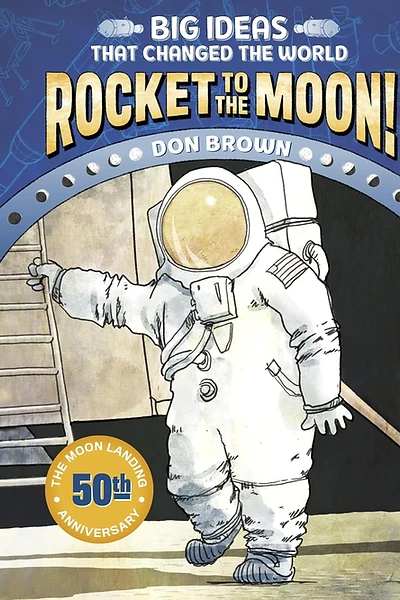
Rocket to the Moon!
by Don Brown
Pacing MaterialA graphic novel history of space exploration and the Apollo 11 moon landing, tracing the journey from early rocket science through the Space Race to Neil Armstrong's first steps on the moon.
Big Idea
The moon landing was the culmination of decades of scientific progress, political determination, and human courage.
Discussion Questions
- 1.How did the Cold War Space Race motivate the Apollo program?
- 2.What scientific and engineering challenges had to be solved to reach the moon?
- 3.How did teamwork contribute to the success of the mission?
- 4.What is the value of space exploration today?
Classroom Activity
Apollo Mission Storyboard
Students create a storyboard of the Apollo 11 mission from launch to splashdown, illustrating each critical phase.
Lesson Plan
Learning Goals
- Understand the historical context of the Space Race
- Identify key figures and milestones in the Apollo 11 mission
- Analyze the scientific challenges of space travel
- Connect historical events to modern space exploration
Activity Steps
- 1.Introduce the Cold War context and the Space Race
- 2.Have students read the graphic novel and identify key mission phases
- 3.Students create storyboards with illustrations and captions for each phase
- 4.Share storyboards and discuss the challenges faced at each stage
- 5.Reflect on how the moon landing changed our understanding of what's possible
Standards Connections
- ELA: RL.3.1 — Ask and answer questions about key details
- ELA: RL.3.2 — Retell stories, including key details
- ELA: RL.3.3 — Describe characters, setting, and events
- ELA: RL.7.6 — Acknowledge differences in characters' points of view
- ELA: SL.3.1 — Participate in collaborative conversations about the text
- ELA: W.3.3 — Write narratives recounting events with descriptive details
- SEL: Responsible Decision-Making
- Art: VA:Re7 — Perceive and analyze artistic work
Pace-Write-Read Study with Pace-Write It!
Focus question: How does Don Brown speed up and slow down the story in Rocket to the Moon! so readers can understand both the science and the drama of getting to the moon? Rocket to the Moon! by Don Brown is a graphic novel biography that follows the history of rocketry, the Space Race, and Apollo 11’s moon landing. Brown uses pacing by moving quickly through big historical events, then slowing down at key moments—like launch, danger, and Neil Armstrong’s first steps—to help readers feel excitement, tension, and discovery.
| Element | How to notice or teach it in the novel |
|---|---|
| Pace | Read: Notice how Don Brown moves quickly across years of rocket history, then slows down during Apollo 11’s most important moments, such as the launch and moon landing. Classroom Activity: Write 4-6 sentences about a big event in history or science, using one sentence to jump forward in time and two sentences to slow down a key moment. |
| Plot | Read: Track how the book builds from early rocket experiments to the Space Race and finally to Neil Armstrong and Apollo 11 reaching the moon. Classroom Activity: Make a short plot ladder with 5 steps showing how one event led to the next, then write a paragraph explaining the turning point. |
| Prosody | Read: Listen to how the wording sounds when read aloud during dramatic scenes about rockets, countdowns, and first steps on the moon. Classroom Activity: Choose one exciting moment from the book and rewrite it to be read aloud with dramatic emphasis, underlining the words you would stress. |
| Word pause | Read: Notice where a short phrase, sound effect, or brief sentence makes you pause and pay attention during tense space scenes. Classroom Activity: Write 3 short lines about a launch or discovery, using very brief sentence breaks to create suspense. |
| Concept | Read: Notice how the book explains the big idea that science discovery takes time, teamwork, risk, and courage. Classroom Activity: Write a short explanation of one concept from the book—such as the Space Race, rockets, or moon landing—and add a sentence about why it mattered. |
| Voice & World View | Read: Notice how Don Brown’s voice is clear, energetic, and interested in both scientific progress and human bravery. Classroom Activity: Write 5 sentences in an informative but excited voice about a modern invention, showing why people should care about it. |
| Setting & Place | Read: Pay attention to how the book moves from laboratories and launch sites to space and the moon, changing the feeling of each scene. Classroom Activity: Write a setting description of either a launch pad, a spacecraft, or the moon’s surface, using details that create mood. |
| Point of View | Read: Notice that the story is mostly told from an outside historical point of view, but it still brings readers close to figures like Neil Armstrong. Classroom Activity: Rewrite one moon-landing moment from Neil Armstrong’s first-person point of view using "I" language. |
| Original Characters | Read: Notice how real historical figures such as Neil Armstrong and other space pioneers are shown as distinct people in a nonfiction graphic novel. Classroom Activity: Create a short character sketch of one real person from the book, including actions, traits, and why that person matters to the story. |
| Dialogue | Read: Look for how spoken words, mission talk, and short exchanges help scenes feel immediate during space missions. Classroom Activity: Write a 6-line dialogue between two astronauts or a scientist and an astronaut before a launch. |
| Details | Read: Notice the specific facts about rockets, missions, and the moon landing that make the history believable and vivid. Classroom Activity: Write an informational paragraph that includes at least 4 precise details from a science or history topic. |
| Descriptions | Read: Notice how Don Brown uses concise description to help readers picture rockets blasting off, astronauts preparing, and the moon’s surface. Classroom Activity: Write 5 descriptive sentences about a machine or vehicle, using strong verbs and sensory details. |
| Strong First Lines | Read: Notice how the opening immediately pulls readers into the story of space exploration and discovery. Classroom Activity: Write 3 different opening lines for a nonfiction narrative about an important achievement, and choose the strongest one. |
| Immediacy & Engagement | Read: Notice how the graphic novel format makes historical events feel like they are happening right now, especially during Apollo 11. Classroom Activity: Write a short scene about a famous event using present-tense verbs to make it feel immediate. |
| Story Scenes & Summaries & Unique Structures | Read: Notice how Brown mixes summary panels about years of history with slower scene-by-scene moments during major events. Classroom Activity: Write one 3-sentence summary of a long period of time, then one 3-sentence close-up scene from that same topic. |
| Flashback & Flash Forward & Cliffhangers | Read: Notice how the book looks back at earlier rocket science before moving toward the moon landing, creating a sense of historical build-up. Classroom Activity: Write a short paragraph that begins with an earlier invention and ends with a cliffhanger before a big success. |
| Tension & Suspense & Surprise | Read: Notice how danger, competition, and uncertainty in the Space Race create suspense before Apollo 11 succeeds. Classroom Activity: Write 5-7 sentences about a risky mission or experiment, building tension before revealing the outcome. |
| Page Turns and Chapter Breaks | Read: Notice how turning the page in a graphic novel can reveal a new stage of the mission, a dramatic image, or an important fact. Classroom Activity: Plan a 4-panel or 4-part page sequence and decide what information to hide until the final panel or page turn. |
| Performance | Read: Notice how the book invites expressive reading, especially in countdowns, announcements, and high-stakes mission moments. Classroom Activity: Practice reading a short section aloud like a mission announcer, then write 3 lines designed for dramatic oral reading. |
| Personality | Read: Notice how real people in the book show determination, bravery, curiosity, and focus as they work toward space exploration. Classroom Activity: Write a paragraph showing the personality of a scientist, astronaut, or inventor through actions instead of just naming traits. |
| Humor | Read: Notice whether Don Brown includes light moments or visual touches that balance the serious history of risk and competition. Classroom Activity: Add one appropriate humorous line or panel idea to a nonfiction scene without taking away from the main event. |
| Pause | Read: Notice where the story slows down so readers can absorb the importance of a launch, a dangerous moment, or Armstrong’s first steps on the moon. Classroom Activity: Write a short paragraph that includes a deliberate pause before the most important action. |
| Poetry and Poetic Devices | Read: Notice how repeated sounds, vivid imagery, and powerful phrasing can make scientific events feel memorable and dramatic. Classroom Activity: Write 4 lines about a rocket launch using imagery, alliteration, or metaphor. |
| Repetition | Read: Notice how repeated ideas—progress, testing, risk, and reaching farther—help unify the history of space exploration. Classroom Activity: Write a paragraph that repeats one key phrase 3 times to emphasize determination or discovery. |
| Rhythm | Read: Notice how short and long sentences combine to create momentum in launch scenes and calm in explanatory parts. Classroom Activity: Write 6 sentences about a journey, alternating short and longer sentences to create rhythm. |
| Punctuation | Read: Notice how punctuation such as dashes, commas, and exclamation points can speed up or slow down action in dramatic mission scenes. Classroom Activity: Rewrite a plain sentence about a launch in 3 different ways using punctuation to change the pace. |
| Questions | Read: Notice what questions the book raises for readers, such as how humans solved problems to reach the moon and why exploration matters. Classroom Activity: Write 4 inquiry questions a reader could ask during the book, then answer one in 2-3 sentences. |
| Compare-Contrast | Read: Notice comparisons between early rocket efforts and Apollo 11’s success, or between Earth and the moon. Classroom Activity: Write a compare-contrast paragraph about two stages of space exploration from the book. |
| Objects | Read: Pay attention to important objects such as rockets, spacecraft, helmets, control panels, and the moon itself, and how they carry meaning in the story. Classroom Activity: Choose one object from the book and write a paragraph explaining both what it is and why it matters. |
| Threes | Read: Notice whether ideas, actions, or details are grouped in threes to make information memorable, such as listing challenges, steps, or achievements. Classroom Activity: Write a sentence or short paragraph that uses a set of three to describe preparation for a mission. |
| Whitespace & Negative Space | Read: Notice how open space on the page and in the art can make the moon, outer space, or a dramatic pause feel larger and more powerful. Classroom Activity: Sketch or plan a page with one moment of empty space, then write 2 sentences explaining how that space affects pacing. |
| Art & Graphics | Read: Notice how Don Brown’s illustrations and panel choices help explain science, show motion, and create drama during the Space Race and moon landing. Classroom Activity: Create a 3-panel mini-comic showing a discovery, a problem, and a success. |
| Interactives & Gamification | Read: Notice how readers can track steps in the mission almost like levels in a challenge—from early experiments to Apollo 11’s success. Classroom Activity: Design a simple mission checklist or "space challenge" with 5 stages based on the book, then write one sentence for each stage. |
Pace-Write It!
20-Minute Classroom Flow\nRead (5 min): Read aloud a short section from Rocket to the Moon! that moves from historical summary into a dramatic Apollo 11 moment, such as launch or moon landing. Ask students to listen for where Don Brown speeds up and where he slows down.\nNotice (5 min): Students turn and talk: Where did the pacing feel fast? Where did it feel slow? Chart student observations under two headings: "Fast summary" and "Slow important moment." Point out how the book covers many years quickly but pauses for danger, discovery, and Neil Armstrong’s first steps.\nWrite (7 min): Students write their own short nonfiction scene about an invention, exploration, or important moment in history using this frame: "First, ________. Over time, ________. Then, everything slowed down when ________. I could see/hear/feel ________. This moment mattered because ________." Encourage students to include one fast summary sentence and one slowed-down scene.\nShare (3 min): Partners read their writing aloud and identify the sentence that speeds up time and the sentence that slows it down. Invite 1-2 volunteers to share with the class.\nExit ticket: In one sentence, explain how pacing helped Don Brown make Rocket to the Moon! exciting and clear for readers.