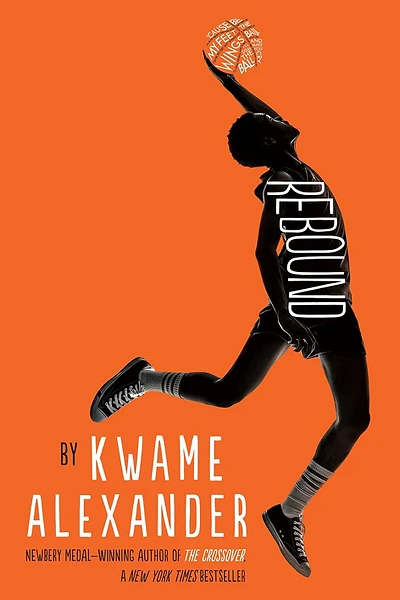
 3-7
3-7V CROSSOVER
Rebound
by Kwame Alexander
Pacing MaterialBig Idea
Resilience is built through the rhythm of life's challenges, where grief and growth intersect like a well-played game of basketball. Through verse, we learn that even when we feel knocked down, we have the power to rebound and redefine our own stories.
Discussion Questions
- 1.How does the format of a novel-in-verse change the way you experience Chuck’s grief compared to a traditional prose novel?
- 2.In what ways does the setting of 1988 and the influence of jazz music shape Chuck’s transformation throughout the summer?
- 3.How do the graphic novel panels and comic book inserts contribute to our understanding of Chuck’s internal world?
- 4.Why does Chuck’s mother decide to send him to his grandparents, and how does this change in environment impact his personal growth?
- 5.What does the title 'Rebound' mean in the context of basketball, and how does it serve as a metaphor for Chuck’s life?
Classroom Activity
The Rhythm of Resilience: A Found Poetry Workshop
Students will create 'found poetry' by selecting powerful lines from the text that represent Chuck’s emotional journey, rearranging them to create a new poem that reflects their own understanding of resilience.
Lesson Plan
Learning Goals
- Analyze how poetic structure and verse contribute to the emotional tone of a narrative.
- Identify and explain the significance of metaphors used throughout the text.
- Synthesize themes of grief and personal growth by creating original poetic responses.
- Evaluate the impact of visual elements (graphic panels) on the reader's interpretation of the story.
Activity Steps
- 1.Review key passages from the book that highlight Chuck’s internal struggle and his eventual growth.
- 2.Have students select 5-10 lines or phrases from the text that resonate with the theme of 'rebounding' from a challenge.
- 3.Instruct students to cut or rewrite these lines to form a new, original poem that captures the essence of resilience.
- 4.Encourage students to add their own 'graphic panel' illustration to accompany their poem, mimicking the book's style.
- 5.Host a 'Poetry Slam' where students perform their poems, focusing on rhythm and pacing.
Standards Connections
- CCSS.ELA-LITERACY.RL.6.5: Analyze how a particular sentence, chapter, scene, or stanza fits into the overall structure of a text.
- CCSS.ELA-LITERACY.W.6.4: Produce clear and coherent writing in which the development, organization, and style are appropriate to task.
- National Core Arts Standard: Creating (Anchor Standard 1) - Generate and conceptualize artistic ideas and work.
Pace-Write-Read Study with Pace-Write It!
The Pace-Write-Read study of 'Rebound' invites students to treat the text not just as a story, but as a musical score. By examining how Kwame Alexander manipulates white space, line breaks, and rhythm, students learn that the speed of reading is dictated by the emotional weight of the words on the page. This approach encourages students to 'pace' their reading to match the intensity of the basketball court or the quiet reflection of grief. By slowing down to notice the structural choices, students gain a deeper appreciation for how verse can accelerate or decelerate the reader's heartbeat, mirroring the protagonist's own journey.
| Element | How to notice or teach it in the novel |
|---|---|
| Pace | Observe how short, staccato lines speed up the action during basketball scenes. |
| Plot | Track how the plot moves from the tragedy of loss to the discovery of self-worth. |
| Prosody | Read aloud to hear the natural musicality and jazz-like cadence of the lines. |
| Word Pause | Notice how single-word lines create a heavy, intentional silence for the reader. |
| Concept | Focus on the concept of the 'rebound' as both a physical and emotional act. |
| Voice & World View | Analyze how Chuck’s 1988 perspective is shaped by his love for comics and his father's memory. |
| Setting & Place | Contrast the urban environment of home with the slower, disciplined life at his grandparents' house. |
| Point of View | Discuss how the first-person perspective makes Chuck’s grief feel immediate and personal. |
| Original Characters | Examine how Roxie and the grandfather act as catalysts for Chuck’s change. |
| Dialogue | Note how dialogue is often sparse, forcing the reader to infer meaning from the surrounding verse. |
| Details | Look for specific references to 1980s culture that ground the story in time. |
| Descriptions | Focus on how the author describes basketball moves as if they were dance or art. |
| Strong First Lines | Analyze the opening lines to see how they immediately establish the tone of loss. |
| Immediacy & Engagement | Notice how the present-tense narration pulls the reader into the heat of the moment. |
| Story Scenes & Summaries & Unique Structures | Identify the shift between traditional verse and comic book panels. |
| Flashback & Flash Forward & Cliffhangers | Track how memories of his father interrupt the present narrative. |
| Tension & Suspense & Surprise | Observe how the threat of the 'tough crowd' creates rising tension. |
| Page Turns and Chapter Breaks | Notice how chapter breaks often occur at moments of emotional realization. |
| Performance | Encourage students to perform poems to feel the rhythm of the language. |
| Personality | Discuss how Chuck’s personality evolves from withdrawn to confident. |
| Humor | Find moments of levity in the banter between cousins. |
| Pause | Use the white space on the page as a literal instruction to pause and breathe. |
| Poetry and Poetic Devices | Identify metaphors related to basketball and jazz. |
| Repetition | Look for repeated phrases that emphasize Chuck’s internal mantras. |
| Rhythm | Clap out the rhythm of a specific poem to feel the 'beat' of the verse. |
| Punctuation | Observe how the lack of traditional punctuation creates a fluid, stream-of-consciousness feel. |
| Questions | Note how Chuck asks himself questions that the reader must also ponder. |
| Compare-Contrast | Compare Chuck’s relationship with his father to his relationship with his grandfather. |
| Objects | Analyze the significance of the comic books as a bridge to his past. |
| Threes | Look for lists or sequences of three that build momentum. |
| Whitespace & Negative Space | Discuss how empty space represents the 'void' left by his father. |
| Art & Graphics | Analyze how the graphic panels provide a visual break and a different narrative layer. |
| Interactives & Gamification | Treat the reading process like a game where students 'score' points for identifying literary devices. |
Pace-Write It!
In a 20-minute 'Speed-Read' session, have students read a high-action basketball scene and a quiet, reflective scene back-to-back. Ask them to map their reading speed on a graph, noting where they slowed down and why, then discuss how the author’s structural choices forced those changes in pace.