
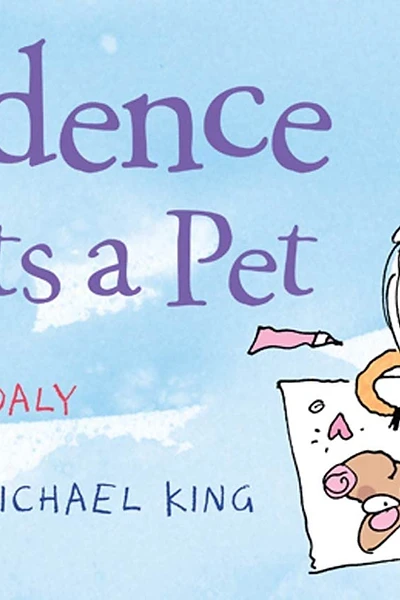
 K-5
K-5P DALY
Prudence wants a pet
by Cathleen Daly
Pacing MaterialPrudence wants a pet so much that she adopts a branch, a twig, a tire, and even a shoe named Formal Footwear, but none is a suitable pet for Prudence.
Big Idea
Prudence Wants a Pet explores the power of imagination and the human need for companionship, showing how we can find joy and connection even in the most unconventional places.
Discussion Questions
- 1.Why do you think Prudence chooses inanimate objects like a shoe or a tire to be her pets instead of asking for a different kind of animal?
- 2.How does Prudence's imagination change the way she sees ordinary objects like a branch or a piece of trash?
- 3.What does it mean to be a 'good' pet, and why do Prudence's choices fail to meet those expectations?
- 4.How do Prudence's parents react to her unusual pets, and how does that influence her behavior?
- 5.If you could adopt an inanimate object as a pet, what would you choose and what would you name it?
Classroom Activity
The 'Adopt-an-Object' Creative Workshop
Students will select an ordinary classroom object, give it a personality and a name, and write a short 'pet profile' explaining why it makes a perfect companion.
Lesson Plan
Learning Goals
- Students will practice creative writing by personifying inanimate objects.
- Students will identify the difference between realistic and imaginative storytelling.
- Students will use descriptive language to justify their creative choices.
- Students will analyze how Prudence's perspective shapes the narrative.
Activity Steps
- 1.Brainstorm a list of ordinary objects found in the classroom (e.g., a stapler, a ruler, a backpack).
- 2.Have each student select one object to 'adopt' as their imaginary pet.
- 3.Students will create a 'Pet Profile' card including a name, a special trick the object can do, and a reason why it is a great pet.
- 4.Students will draw a picture of their object with 'pet-like' accessories (e.g., a leash on a stapler).
- 5.Students will share their pet profiles in small groups, explaining their object's personality.
Standards Connections
- ELA: RL.K.3 (Character analysis)
- ELA: W.K.3 (Narrative writing)
- SEL: Self-awareness (Creative expression)
- Art: Visual literacy
Pace-Write-Read Study with Pace-Write It!
Prudence Wants a Pet is a masterclass in using brevity and deadpan humor to control the reader's experience. Cathleen Daly uses a repetitive, episodic structure that allows the reader to anticipate the next 'failed' pet, creating a rhythmic pacing that builds humor through the contrast between Prudence's high expectations and the absurdity of her choices. By studying this book, students learn how to use 'white space' and simple, declarative sentences to let the illustrations do the heavy lifting. The pacing is dictated by the page turns, where each new object is introduced with a sense of hope, only to be undercut by the reality of the object's limitations. This teaches young writers that pacing isn't just about speed; it is about the strategic placement of information to maximize comedic effect.
| Element | How to notice or teach it in the novel |
|---|---|
| Pace | The story moves quickly through a series of failed adoptions, using a predictable rhythm to build comedic momentum. |
| Plot | The plot follows a simple 'want-try-fail' cycle that repeats until the resolution. |
| Prosody | Read the text with a flat, serious tone to emphasize the humor of Prudence's earnestness. |
| Word Pause | Pause before revealing the name of each new 'pet' to build anticipation. |
| Concept | The core concept is the gap between a child's desire for a pet and the reality of what is available. |
| Voice & World View | Prudence views the world as a place where anything can be a friend if you try hard enough. |
| Setting & Place | The setting is a typical home, which makes the absurdity of the 'pets' stand out more. |
| Point of View | The third-person narrator maintains a respectful distance, allowing the reader to laugh at the situation without mocking Prudence. |
| Original Characters | Prudence is defined by her unwavering commitment to her strange choices. |
| Dialogue | Dialogue is sparse, which keeps the focus on Prudence's internal logic. |
| Details | Specific details like the shoe being named 'Formal Footwear' add layers of humor. |
| Descriptions | Descriptions are brief and understated, letting the reader fill in the gaps. |
| Strong First Lines | The opening establishes the central conflict immediately and clearly. |
| Immediacy & Engagement | The book engages the reader by making them wonder what object will be chosen next. |
| Story Scenes & Summaries & Unique Structures | The book uses an episodic structure where each pet gets a 'scene' of introduction and dismissal. |
| Flashback & Flash Forward & Cliffhangers | The book avoids these, keeping the timeline linear to maintain the comedic rhythm. |
| Tension & Suspense & Surprise | Tension is created by the reader waiting to see how the parents will react to the new 'pet'. |
| Page Turns and Chapter Breaks | The page turn is used to reveal the absurdity of the object Prudence has chosen. |
| Performance | The book is perfect for a dramatic reading where the reader acts out Prudence's 'training' of the objects. |
| Personality | Prudence's personality is shown through her actions rather than descriptions. |
| Humor | The humor comes from the juxtaposition of a child's serious tone with ridiculous objects. |
| Pause | Use pauses to let the reader look at the illustrations of the objects. |
| Poetry and Poetic Devices | The repetition of the 'pet' cycle acts like a refrain in a poem. |
| Repetition | The recurring structure of finding and losing a pet is the engine of the story. |
| Rhythm | The rhythm is steady and predictable, which makes the final resolution feel earned. |
| Punctuation | Simple punctuation keeps the sentences punchy and fast-paced. |
| Questions | The book implicitly asks the reader: 'What makes a pet?' |
| Compare-Contrast | The book invites readers to compare the 'pets' to real animals. |
| Objects | Objects are the central characters of the story, treated as living beings. |
| Threes | The story cycles through several objects, following the rule of three to build the pattern. |
| Whitespace & Negative Space | The layout uses space to highlight the isolation of the objects. |
| Art & Graphics | The art provides the visual punchline for each of Prudence's choices. |
| Interactives & Gamification | The book functions like a game where the reader guesses the 'pet's' name. |
Pace-Write It!
Students have 20 minutes to write a 'Pet Rejection' scene. They must write a short paragraph where a parent discovers their 'pet' (the object from the activity) and explains why it cannot stay, using the same deadpan, understated tone found in the book.