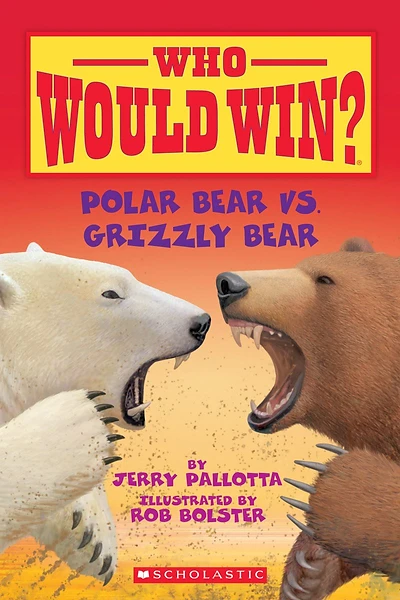
R WHO WOULD WIN
Polar Bear vs. Grizzly Bear
by Jerry Pallotta, illustrated by Rob Bolster
Pacing MaterialIn this nonfiction easy reader, Jerry Pallotta and illustrator Rob Bolster pit two of nature's biggest predators against each other: the polar bear and the grizzly bear. Through side-by-side facts about size, strength, speed, claws, teeth, habitat, and hunting style, young readers build a case for each bear before the book imagines what might happen if the two ever met face-to-face in the wild.
Big Idea
Comparing real facts about two powerful animals helps readers practice evidence-based thinking and form their own reasoned opinions.
Discussion Questions
- 1.What are three facts that make the polar bear a strong competitor, and three that make the grizzly bear strong?
- 2.Why do you think the author chose to compare these two specific bears instead of two other animals?
- 3.How does each bear's habitat affect its body, strength, or hunting style?
- 4.Do you agree with how the book ends? Who do you think would really win, and why?
- 5.How did the illustrations help you understand the facts better than words alone?
Classroom Activity
Who Would Win? Animal Showdown Fact Cards
Students choose two animals to compare (real or from another book) and create a set of 'showdown fact cards' listing size, strength, speed, defenses, and habitat for each. Using the cards, they write a short persuasive paragraph predicting who would win and why, citing specific facts as evidence. Cards can be shared in pairs, with classmates voting on the more convincing argument.
Lesson Plan
Learning Goals
- Compare polar bears and grizzly bears using details about size, strength, speed, claws, teeth, habitat, and hunting style from the book.
- Distinguish nonfiction animal facts from the book’s imagined face-to-face showdown.
- Create animal fact cards that organize comparable information and identify where each fact came from.
- Support a prediction with at least two specific facts, explaining how habitat or circumstances could affect the outcome.
- Listen respectfully to classmates and evaluate the strength of their evidence rather than vote for a favorite animal.
Activity Steps
- 1.Read aloud Polar Bear vs. Grizzly Bear by Jerry Pallotta, illustrated by Rob Bolster. Pause to examine Rob Bolster’s illustrations and identify facts about each bear. Explain that the animal information is nonfiction, while the showdown is an imagined scenario—not a report of an actual fight.
- 2.Build a class comparison chart with columns for polar bear and grizzly bear and rows for size, strength, speed, defenses, habitat, and hunting style. Record details supported by the text or illustrations; mark information that needs further research rather than guessing.
- 3.Have students choose two animals: the book’s bears, another real pair, or animals from another book. Give each student two fact-card templates with matching categories. Students use the read-aloud chart or teacher-selected sources to complete the cards and note the book title or source for their facts. If comparing fictional animals, label their traits as story details.
- 4.Ask students to select a setting for their hypothetical showdown and consider how it might help or hinder each animal. Students write a persuasive paragraph using the frame: 'I predict ___ would win in ___ because ___. Another supporting fact is ___.' K–1 students may draw and dictate a claim with one supporting fact; grades 2–5 should include at least two facts and explain their relevance.
- 5.Pair students to share their cards and arguments. Partners identify the strongest evidence and ask one question. Invite classmates to vote on the more convincing argument—not the animal they like best—and explain their choice using a fact.
- 6.Close with a reflection: 'Could a different habitat change your prediction?' Have students revise or qualify their claims as needed. Emphasize that predictions are uncertain and that students should never approach wildlife or stage animal fights.
Standards Connections
- ELA: RI.K.1–RI.5.1 — Ask and answer questions about informational text, using details and evidence appropriate to grade level.
- ELA: RI.1.7 — Use illustrations and details in a text to describe its key ideas.
- ELA: W.K.1–W.5.1 — Express an opinion or claim and support it with reasons and information, with drawing or dictation options for younger students.
- ELA: SL.K.1–SL.5.1 — Participate in collaborative discussions, listen to others, and respond to their ideas.
- Science: NGSS 3-LS4-3 — Construct an argument with evidence about how well organisms survive in particular habitats; connect bear traits to habitat suitability rather than treating an imagined fight as scientific proof.
Pace-Write-Read Study with Pace-Write It!
This guide breaks down the specific craft and design choices Pallotta and Bolster use to make nonfiction comparison exciting for young readers, and offers a classroom task for each element.
| Element | How to notice or teach it in the novel |
|---|---|
| Pace | Read: Notice how the book moves briskly through short fact-bursts about each bear before slowing down for the imagined battle scene at the end. Classroom Activity: Have students write alternating fact-bursts about two animals, then build to a slower, more dramatic final scene. |
| Plot | Read: Notice how the 'plot' isn't a traditional story arc but a simple structure of introduce, compare, then imagine a battle. Classroom Activity: Have students outline their own compare/battle plot for two animals using the same three-part structure. |
| Prosody | Read: Notice the rhythmic repeated sentence patterns, like 'A polar bear is...' and 'A grizzly bear is...', that create a comparative beat when read aloud. Classroom Activity: Students write a page using the same rhythmic paired-sentence pattern to compare two objects or animals. |
| Word pause | Read: Notice how short, punchy declarative sentences create built-in pauses that help beginning readers process new facts. Classroom Activity: Have students write three short fact sentences with a natural pause after each, then practice reading them aloud with breath breaks. |
| Concept | Read: Notice how the entire book is built around one big question: 'Who would win?' Classroom Activity: Have students brainstorm their own 'who would win' concept question for two real animals and list what facts they'd need to answer it. |
| Voice & World View | Read: Notice the author's enthusiastic, playful voice that treats the animal comparison like a real sports debate. Classroom Activity: Students rewrite one fact page in their own voice, adding personality and opinion phrases. |
| Setting & Place | Read: Notice how each bear's home—Arctic ice versus forest and mountains—is described and illustrated to explain its traits. Classroom Activity: Have students draw and label the habitat of their chosen animal, connecting habitat features to survival traits. |
| Point of View | Read: Notice how the narrator speaks directly to the reader, inviting them to decide who would win. Classroom Activity: Students write a paragraph that directly addresses the reader with a question, inviting them into the decision-making. |
| Original Characters | Read: Notice how the two real bears are treated like rival characters, each given traits that build anticipation for a showdown. Classroom Activity: Have students create a 'character profile' card for a real animal, listing its traits like a stat sheet. |
| Dialogue | Read: Notice how there is little traditional dialogue, but exclamatory captions and rhetorical questions act like a conversation between narrator and reader. Classroom Activity: Students write a short imagined dialogue between the two bears bragging about their abilities. |
| Details | Read: Notice the specific numeric details—weight, height, speed, claw length—used to support each comparison. Classroom Activity: Have students research and list five specific numeric details about their chosen animal. |
| Descriptions | Read: Notice the vivid sensory descriptions of fur, teeth, and claws that help readers picture each bear clearly. Classroom Activity: Students write a descriptive paragraph about an animal's body part using strong sensory words. |
| Strong First Lines | Read: Notice how the book opens with a bold question or statement that immediately sets up the comparison to come. Classroom Activity: Have students draft three possible strong opening lines for their own animal comparison book. |
| Immediacy & Engagement | Read: Notice how exclamation points and direct questions like 'Which one is bigger?' create immediate engagement with the reader. Classroom Activity: Students rewrite a flat fact sentence to include a question or exclamation that pulls readers in. |
| Story Scenes & Summaries & Unique Structures | Read: Notice the unique structure of alternating fact spreads followed by a final imagined battle scene, blending nonfiction summary with narrative scene. Classroom Activity: Have students create a mini book with alternating fact spreads followed by one imagined 'scene' spread. |
| Flashback & Flash Forward & Cliffhangers | Read: Notice how the promise of an eventual battle creates a running forward-looking tension that keeps readers turning pages. Classroom Activity: Students write a short paragraph that hints at an exciting future event to hook readers, without revealing what happens. |
| Tension & Suspense & Surprise | Read: Notice how tension builds page by page as strengths are compared, leading to a dramatic or open-ended climax. Classroom Activity: Have students write a suspenseful buildup sentence using comparative language like 'But wait...' before revealing an outcome. |
| Page Turns and Chapter Breaks | Read: Notice how each page turn reveals a new comparative fact, encouraging readers to keep flipping to see who has the advantage. Classroom Activity: Students design a two-page spread with a page-turn 'reveal' moment about their chosen animal. |
| Performance | Read: Notice how the dramatic imagined battle scene invites readers to perform it aloud with excitement and sound effects. Classroom Activity: Have students perform a read-aloud of the battle scene using expressive voices and sound effects. |
| Personality | Read: Notice how each bear is given personality traits, like toughness or cleverness, beyond just physical facts. Classroom Activity: Students write three personality trait words for their animal and one sentence proving each trait with a fact. |
| Humor | Read: Notice the humorous, cartoonish illustrations and playful asides that keep the tone light despite the 'battle' premise. Classroom Activity: Have students add one funny caption or joke to a fact page they write. |
| Pause | Read: Notice how full-page illustrations create a visual pause between fact-heavy pages, giving readers a moment to absorb information. Classroom Activity: Students design a page layout that includes a 'breathing' illustration pause between two fact blocks. |
| Poetry and Poetic Devices | Read: Notice any alliteration or rhythmic word play used to make facts memorable, such as pairing similar sounds in bear descriptions. Classroom Activity: Have students create an alliterative nickname or phrase for their chosen animal. |
| Repetition | Read: Notice the repeated sentence structure used for both bears on facing pages, reinforcing the compare-contrast format. Classroom Activity: Students write a repeated sentence frame and fill it in for two different animals. |
| Rhythm | Read: Notice how the back-and-forth pattern between polar bear facts and grizzly bear facts creates a steady, predictable rhythm. Classroom Activity: Have students clap out the rhythm of a fact page, then write their own rhythmic fact pair. |
| Punctuation | Read: Notice the heavy use of exclamation points, question marks, and bold text to emphasize exciting facts. Classroom Activity: Students revise a plain sentence by adding punctuation and bold emphasis to make it more exciting. |
| Questions | Read: Notice how questions are used throughout to prompt reader prediction and keep them engaged, like 'Who would win?' Classroom Activity: Have students write three questions they would ask readers about their own animal topic. |
| Compare-Contrast | Read: Notice how compare-contrast is the central structural device, with nearly every fact given for both bears side by side. Classroom Activity: Students create a Venn diagram or T-chart comparing two animals, then turn it into sentences. |
| Objects | Read: Notice how specific body-part 'objects' like claws and teeth are used as focal points for comparison. Classroom Activity: Have students choose three body-part objects of their animal and describe how each helps it survive. |
| Threes | Read: Notice how facts and comparisons are often grouped into small sets, similar to top-three contest categories. Classroom Activity: Students choose three key traits to rank their animal against a rival animal. |
| Whitespace & Negative Space | Read: Notice the clean white space surrounding illustrations that keeps focus on the bear and its key features. Classroom Activity: Have students design a page with one bold illustration and plenty of white space around a single fact. |
| Art & Graphics | Read: Notice how illustrations include size-comparison diagrams and labeled features that support the text's facts. Classroom Activity: Students create a labeled diagram comparing the size or features of two animals. |
| Interactives & Gamification | Read: Notice how the book invites readers to predict and 'vote' on a winner, turning reading into a game. Classroom Activity: Have students create a simple scorecard or bracket where classmates vote on which animal traits are strongest. |
Pace-Write It!
In a classroom workshop, use this book as a mentor text for writing informational compare-contrast pieces with narrative flair. Start by reading the book aloud and charting the repeated compare-contrast sentence pattern on the board. Then walk students through 3-4 pacing elements per session (for example, Details, Compare-Contrast, Questions, and Tension & Suspense), modeling each with a shared class example about two animals before releasing students to apply the same techniques to their own 'Who Would Win?' fact books. Over multiple sessions, students can build a full mini-book incorporating illustrations, a strong first line, a suspenseful build-up, and a final imagined scene, mirroring the structure and craft of Pallotta and Bolster's book.