 K-3
K-3P TOURVILLE
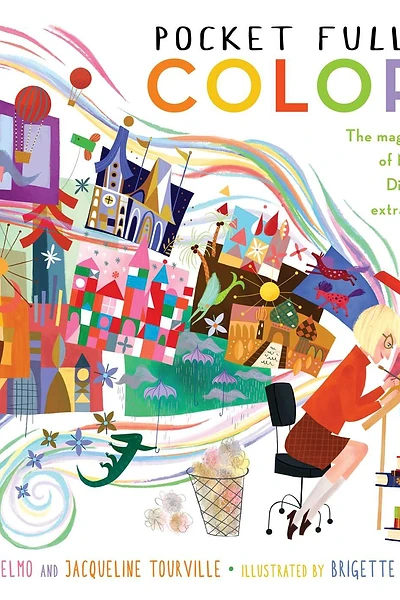
Pocket Full of Colors: The Magical World of Mary Blair
by Amy Guglielmo and Jacqueline Tourville
Pacing MaterialThe story of Mary Blair, the visionary Disney artist whose bold colors and imagination shaped generations of animation and design.
Big Idea
Colors tell stories — Mary Blair showed the world that art can be bold, bright, and full of magic.
Discussion Questions
- 1.How did Mary Blair's use of color make her art unique?
- 2.What challenges did Mary Blair face as a woman artist at Disney?
- 3.How can color change the way we feel about a story?
- 4.What colors would you fill your world with?
Classroom Activity
Color Story Map
Create a color palette inspired by a place you love and paint a scene using only those colors.
Lesson Plan
Learning Goals
- Understand biographical narrative
- Explore the role of color in art and storytelling
- Practice color theory through hands-on art
Standards Connections
- ELA: RL.K.1 — Ask and answer questions about key details
- ELA: RL.K.2 — Retell stories, including key details
- ELA: RL.K.3 — Describe characters, setting, and events
- ELA: RL.3.6 — Acknowledge differences in characters' points of view
- ELA: SL.K.1 — Participate in collaborative conversations about the text
- ELA: W.K.3 — Write narratives recounting events with descriptive details
- SEL: Self-Management
- SEL: Responsible Decision-Making
- Art: VA:Re7 — Perceive and analyze artistic work
Pace-Write-Read Study with Pace-Write It!
Focus question: How does a writer slow down and speed up a true story to show a character’s creativity and courage? In Pocket Full of Colors: The Magical World of Mary Blair by Amy Guglielmo and Jacqueline Tourville, readers follow Mary Blair as she grows from a child who sees the world in bold colors to an artist whose imagination changes animation and design. The authors use pacing by moving quickly through parts of Mary’s life, then slowing down for important artistic moments, big feelings, and vivid descriptions that help readers feel her bravery and vision.
| Element | How to notice or teach it in the novel |
|---|---|
| Pace | Read: Notice how the story moves quickly across years of Mary Blair’s life but slows down when her imagination, artwork, and courage matter most, such as when she chooses bright colors and bold ideas. Classroom Activity: Write 3 sentences about a time you made a brave choice—make the first sentence quick, the second sentence slow and detailed, and the third sentence show what happened next. |
| Plot | Read: Notice the clear plot of Mary Blair’s journey: she is a child who sees color differently, grows into an artist, faces doubt, and helps shape magical worlds through her art. Classroom Activity: Write a simple plot map with beginning, middle, and end for a character who uses creativity to solve a problem. |
| Prosody | Read: Listen to how the language sounds when read aloud; the sentences often flow with a musical feeling that matches Mary’s colorful imagination and the wonder of Disney-inspired art. Classroom Activity: Choose one moment in your writing and revise it so it sounds smooth and expressive when read aloud. |
| Word pause | Read: Notice where the authors use carefully chosen words and sentence breaks to make readers pause and think about Mary’s artistic choices, feelings, or dreams. Classroom Activity: Write 2 sentences about painting a picture, and add a strong pause with a dash or short sentence to make the reader stop and notice. |
| Concept | Read: The big concept is that creativity takes courage; Mary Blair does not simply copy the world, she reimagines it with daring colors and shapes. Classroom Activity: Write a sentence stem and finish it: Creativity is courage when ________. |
| Voice & World View | Read: Notice how the authors present a world view that celebrates imagination, originality, and seeing beauty in unusual ways, especially through Mary’s eyes. Classroom Activity: Write 4 lines in a voice that celebrates something others might overlook, like a puddle, crayon, or shadow. |
| Setting & Place | Read: Notice how places in Mary Blair’s life and artistic world help shape the story, from childhood scenes to creative spaces connected to animation and design. Classroom Activity: Write a setting description of an art room, studio, or dream place using at least 3 color words. |
| Point of View | Read: The story is told in third person, but it stays close to Mary Blair so readers can understand her feelings, ideas, and artistic courage. Classroom Activity: Rewrite one event from the point of view of Mary, using I and my. |
| Original Characters | Read: Mary Blair is presented as an original character in real life—bold, imaginative, and unafraid to see the world differently from others around her. Classroom Activity: Invent a child artist character with one surprising talent, one worry, and one brave choice. |
| Dialogue | Read: Notice how dialogue is used sparingly, so when people question or respond to Mary’s ideas, those moments stand out. Classroom Activity: Write a short dialogue between a young artist and someone who does not understand the artist’s unusual idea. |
| Details | Read: Pay attention to the small details about colors, shapes, and artistic choices that make Mary Blair’s world feel vivid and memorable. Classroom Activity: Write 3 detail sentences about a drawing you wish you could make, naming exact colors and objects. |
| Descriptions | Read: The descriptions help readers see Mary’s bold visual imagination, especially how she notices color and transforms ordinary scenes into magical art. Classroom Activity: Describe one ordinary object, like a chair or tree, as if Mary Blair had painted it. |
| Strong First Lines | Read: Notice how the opening draws readers right into Mary Blair’s unusual way of seeing the world and sets up the theme of creativity. Classroom Activity: Write 3 possible first lines for a story about a child whose imagination changes everything. |
| Immediacy & Engagement | Read: The book keeps readers engaged by making Mary’s artistic choices feel important and alive, as if her colors are happening right now. Classroom Activity: Revise a sentence by changing it from distant and plain to immediate and exciting. |
| Story Scenes & Summaries & Unique Structures | Read: Notice how the authors mix scene and summary—some moments are zoomed in, while other years of Mary Blair’s life move by quickly to keep the biography flowing. Classroom Activity: Write one scene from a character’s life in 3 sentences, then summarize 3 years in 1 sentence. |
| Flashback & Flash Forward & Cliffhangers | Read: While this biography is mostly chronological, readers can notice how memories of Mary’s early way of seeing color connect to her later success, almost like a gentle flash forward of her future talent. Classroom Activity: Write a short biography-style paragraph that includes a clue early on about what the character will become later. |
| Tension & Suspense & Surprise | Read: Notice the tension when Mary Blair’s bold style does not match what others may expect, and the surprise comes when her unusual vision becomes powerful and celebrated. Classroom Activity: Write about a moment when a character worries, “Will they understand my idea?” and then add a surprising outcome. |
| Page Turns and Chapter Breaks | Read: In this picture book, page turns help create anticipation, especially when readers are waiting to see Mary’s next artistic step or a new burst of color. Classroom Activity: Plan a 4-page picture book and decide what big idea or image should happen right after each page turn. |
| Performance | Read: This book invites expressive reading because the language and images call for wonder, excitement, and admiration when talking about Mary Blair’s art. Classroom Activity: Practice reading one paragraph aloud with a voice that sounds amazed, then mark where you will pause and emphasize words. |
| Personality | Read: Mary Blair’s personality shines through as imaginative, brave, persistent, and willing to trust her own artistic instincts. Classroom Activity: Write a character sketch of someone whose personality shows in the way they create something. |
| Humor | Read: The book is more inspiring than laugh-out-loud funny, but readers may notice playful joy in the bright artistic imagination and lively storytelling. Classroom Activity: Add one playful or lighthearted sentence to a serious story about making art. |
| Pause | Read: Notice where a reader naturally pauses to take in a powerful idea, a beautiful illustration, or a turning point in Mary Blair’s artistic journey. Classroom Activity: Write a short paragraph and mark one place with [pause] where you want readers to stop and think. |
| Poetry and Poetic Devices | Read: The language often feels poetic because of rich imagery, color words, and a sense of wonder that matches Mary Blair’s magical way of seeing. Classroom Activity: Write 4 lines about colors using imagery or personification, such as “Blue danced” or “Yellow sang.” |
| Repetition | Read: Notice how repeated ideas about color, imagination, and bravery help build the theme that Mary Blair kept returning to her own artistic vision. Classroom Activity: Write a paragraph that repeats one key phrase, such as “She saw…” or “He dared…,” to build meaning. |
| Rhythm | Read: The sentence rhythm helps carry readers through the story, sometimes quickly through biography and sometimes more slowly through moments of visual wonder. Classroom Activity: Write 3 sentences with different lengths—short, medium, long—to create rhythm in a scene about creating art. |
| Punctuation | Read: Notice how punctuation helps shape pacing, especially commas and periods that slow or stop readers so they can absorb Mary Blair’s bold choices and emotions. Classroom Activity: Take one run-on idea about painting and rewrite it with punctuation that controls the pace. |
| Questions | Read: Readers may ask questions like: Why did Mary see things differently? How did she stay brave? How did her colors change what people saw? Classroom Activity: Write 3 questions a reader might ask Mary Blair, then answer one in a complete sentence. |
| Compare-Contrast | Read: Notice the contrasts between ordinary ways of seeing and Mary Blair’s imaginative way of seeing, and between doubt from others and confidence in her own style. Classroom Activity: Write 2 compare-contrast sentences about a plain picture and a bold, imaginative picture. |
| Objects | Read: Important objects in this book include colors, paint, sketches, and artwork—objects that represent Mary Blair’s imagination and identity. Classroom Activity: Choose one object from an artist’s life and write how it could symbolize courage. |
| Threes | Read: Notice how ideas can be grouped in threes to sound strong and memorable, such as color, imagination, and courage in Mary Blair’s story. Classroom Activity: Write a sentence that lists 3 qualities of a creative hero. |
| Whitespace & Negative Space | Read: In a picture book about art, space on the page matters; readers can notice how open space gives time to think and helps the illustrations and words breathe, much like design itself. Classroom Activity: Create a mini page layout with one sentence and a sketch, leaving empty space on purpose to guide the reader’s eye. |
| Art & Graphics | Read: The art and design are essential in this book because they echo Mary Blair’s bold visual style and help tell the story of her creativity even beyond the words. Classroom Activity: Draw or collage a background for one sentence from your writing using bright colors inspired by Mary Blair. |
| Interactives & Gamification | Read: Readers can interact with this book by hunting for color patterns, noticing favorite illustrations, and tracking moments when Mary Blair shows courage. Classroom Activity: Make a “Color Courage Hunt” chart with 3 boxes: color moment, brave moment, and my own idea inspired by it. |
Pace-Write It!
20-Minute Classroom Flow\nRead (5 min): Read aloud a section of Pocket Full of Colors: The Magical World of Mary Blair by Amy Guglielmo and Jacqueline Tourville that shows Mary seeing the world in her own bold way and later using that vision as an artist. Ask students to listen for where the story moves quickly and where it slows down.\n\nNotice (5 min): Discuss: Where did the authors speed through time? Where did they slow down to help us notice Mary’s feelings, colors, or courage? Chart student thinking under two headings: Fast Through Time and Slow Important Moment.\n\nWrite (7 min): Students write about a time they made, built, drew, or imagined something in their own way. Encourage them to use pacing by starting with a quick setup and then slowing down the most important moment. Writing frame: “At first, ________. Then, I saw/decided ________. Everything seemed to slow down as I ________. I felt ________, but I kept going. In the end, ________.”\n\nShare (3 min): Partners read their writing aloud and point to one sentence that moves quickly and one sentence that slows down. Invite 1–2 volunteers to share how they showed creativity or courage.\n\nExit ticket: Write one sentence answering: How did Amy Guglielmo and Jacqueline Tourville use pacing to show Mary Blair’s creativity and courage?
Pace-Write-Read Connection
Teach this book using the Pace-Write-Read method — Tool 20: Play.
Open the Mastery Manual