 K-3
K-3P JUDGE
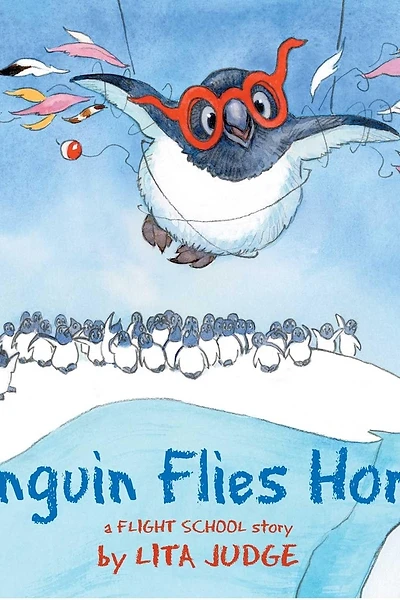
Penguin Flies Home
by Lita Judge
Pacing MaterialA penguin who has traveled far sets off for home, discovering that where you belong is where your heart returns.
Big Idea
Home is more than a place — it's where you are known and loved, and the journey back matters as much as the leaving.
Discussion Questions
- 1.Why does Penguin want to go home?
- 2.What does Penguin discover on the journey?
- 3.What does home mean to you?
- 4.Can home be a person, not just a place?
Classroom Activity
My Journey Home
Draw a map of your journey to a place that feels like home. Label three stops along the way.
Lesson Plan
Learning Goals
- Describe Penguin’s journey home using details from the story and illustrations.
- Explain how being known and loved can make a place feel like home.
- Create a map showing a journey to a place that feels like home, with three labeled stops.
- Retell the mapped journey in sequence and explain why the destination is meaningful.
Activity Steps
- 1.Read Penguin Flies Home aloud. Pause to examine the illustrations and ask: “How does Penguin feel about returning home? What details help you tell?”
- 2.Discuss the big idea: home can mean a place where we feel known and loved. Invite children to think of a real or imagined place that feels welcoming; sharing personal experiences is optional.
- 3.Model a simple journey map with a starting point, a welcoming destination, and three stops connected by a path or arrows. Explain that a map can show both where someone travels and what matters along the way.
- 4.Have students draw their own journey maps. Ask them to label three stops with words or dictated captions and add a picture or symbol showing why their destination feels like home.
- 5.In pairs, have students trace their routes and tell their journeys using “first,” “next,” and “finally.” Ask: “How is your journey like or different from Penguin’s?”
- 6.Close by inviting volunteers to share one map detail that shows belonging. Revisit how Penguin’s journey helps readers think about what home means.
Standards Connections
- ELA: RL.1.3 — Describe characters, settings, and major events in a story using key details.
- ELA: RL.1.7 — Use illustrations and story details to describe characters, settings, or events.
- ELA: SL.1.4 — Describe people, places, things, and events with relevant details and clear expression.
- Social Studies: Geography — Create and interpret a simple map using labels, symbols, and routes.
- SEL: Self-awareness and relationship skills — Identify feelings of belonging and recognize relationships that help people feel known and loved.
Pace-Write-Read Study with Pace-Write It!
Focus question: How does an author slow down and speed up a journey to help readers feel what home means? In Penguin Flies Home by Lita Judge, a traveling penguin makes a long trip back to where he belongs, and readers feel both the movement of the journey and the emotion of returning home. Judge uses pacing through page turns, quiet pauses, descriptive moments, and a heartfelt build toward home so young readers can notice how a story moves and rests.
| Element | How to notice or teach it in the novel |
|---|---|
| Pace | Read: Notice how Penguin’s trip feels fast in some parts and slow in others as he moves toward home, helping readers feel both distance and longing. Classroom Activity: Write 3 short sentences for a fast travel moment and 3 longer sentences for a slow, emotional homecoming moment. |
| Plot | Read: Follow the clear plot of Penguin traveling far and then setting off for home, with each step building the idea that belonging matters. Classroom Activity: Make a beginning-middle-end chart for Penguin’s journey, then write one sentence for each part. |
| Prosody | Read: Listen to how the story sounds when read aloud, especially in softer, calmer parts that match Penguin’s feelings about home. Classroom Activity: Choose one moment from Penguin’s journey and rewrite it so it sounds gentle and smooth when read aloud. |
| Word pause | Read: Notice where a reader naturally pauses on meaningful words like home, far, or belong, giving the ideas extra weight. Classroom Activity: Write 2 sentences about Penguin’s trip and underline the word where a reader should pause for meaning. |
| Concept | Read: Think about the big idea that home is not only a place but also a feeling of where your heart returns. Classroom Activity: Write a sentence stem response: 'Home is ___ because ___,' then connect it to Penguin’s journey. |
| Voice & World View | Read: Notice the warm, thoughtful voice that treats Penguin’s journey as important and full of feeling, helping readers see the world through the lens of belonging. Classroom Activity: Write 4 sentences in a caring, reflective voice about an animal searching for home. |
| Setting & Place | Read: Pay attention to the places Penguin travels through and how each setting makes home feel farther away until the ending feels earned. Classroom Activity: Draw and label 3 places Penguin might travel through, then write one sentence about how each place affects the journey. |
| Point of View | Read: Notice how the story lets readers stay close to Penguin’s experience so his wish to get home feels personal. Classroom Activity: Rewrite one part of Penguin’s trip using first person, starting with 'I am going home because...' |
| Original Characters | Read: Look at Penguin as a simple but memorable character whose strong wish to return home shapes the whole story. Classroom Activity: Invent a new animal traveler who is trying to get home and write 3 traits that make the character special. |
| Dialogue | Read: Notice whether the story uses little or no dialogue and how that choice keeps the focus on Penguin’s journey and feelings. Classroom Activity: Add 2 lines of dialogue between Penguin and a sea bird or another animal he meets on the way home. |
| Details | Read: Pay attention to small details that show distance, travel, and Penguin’s determination to return where he belongs. Classroom Activity: Write 3 detail sentences that show Penguin is far from home without saying 'He was far from home.' |
| Descriptions | Read: Notice how descriptions of Penguin and the journey help readers picture both movement and emotion. Classroom Activity: Write a descriptive sentence about Penguin moving toward home using color, weather, or motion words. |
| Strong First Lines | Read: Think about how the opening quickly introduces Penguin and his journey, inviting readers to wonder where he is going and why. Classroom Activity: Write a new first line for a story about an animal leaving or returning home. |
| Immediacy & Engagement | Read: Notice how the story keeps readers close to Penguin’s goal so we care right away about whether he will reach home. Classroom Activity: Write 2 opening sentences that make a reader care immediately about a character who misses home. |
| Story Scenes & Summaries & Unique Structures | Read: Notice how some parts of Penguin’s trip may feel like quick summary while other moments feel like full scenes, balancing a long journey with key emotional stops. Classroom Activity: Write one summary sentence about a long trip and one scene with 3 sentences about an important moment on that trip. |
| Flashback & Flash Forward & Cliffhangers | Read: Think about how readers may imagine where Penguin has been before the story or wonder what waits for him at home, even without a dramatic cliffhanger. Classroom Activity: Write a 2-sentence flashback about why Penguin left home or a 2-sentence flash forward about arriving there. |
| Tension & Suspense & Surprise | Read: Notice the gentle tension in wondering how Penguin will get home and when the moment of belonging will come. Classroom Activity: Write 3 sentences that build suspense as Penguin gets closer to home but has not reached it yet. |
| Page Turns and Chapter Breaks | Read: In this picture book, page turns help control pacing by making readers pause and then discover the next part of Penguin’s journey. Classroom Activity: Plan a 4-page mini picture book and mark what surprise, feeling, or new setting will come after each page turn. |
| Performance | Read: Notice how this story could be read with a calm voice during reflective parts and a brighter voice when Penguin nears home. Classroom Activity: Practice reading 4 lines aloud and mark where your voice should get softer, slower, or more excited. |
| Personality | Read: Pay attention to Penguin’s steady, loyal personality, which makes his journey home feel sincere and touching. Classroom Activity: Write 3 sentences that show Penguin’s personality through his actions instead of only naming traits. |
| Humor | Read: Notice whether any gentle humor comes from imagining a penguin traveling such a long way, balanced with the serious feeling of wanting to belong. Classroom Activity: Add one lighthearted sentence to a journey-home story without changing the warm theme. |
| Pause | Read: Notice the quiet moments where readers stop and think about what home means to Penguin. Classroom Activity: Write a short paragraph with one intentional pause shown by a line break or dash before the word home. |
| Poetry and Poetic Devices | Read: Listen for lyrical language, repeated sounds, or image-rich phrasing that gives Penguin’s trip an almost poetic feeling. Classroom Activity: Write 2 lines about home using alliteration, such as 'cold, curling currents' or 'soft, safe shore.' |
| Repetition | Read: Notice if words or ideas about home, returning, or belonging repeat to hold the story together. Classroom Activity: Write a 4-line piece that repeats the phrase 'going home' to create emphasis. |
| Rhythm | Read: Feel how sentence length and word choice can create a steady rhythm like traveling step by step or wave by wave. Classroom Activity: Write 3 rhythmic sentences about Penguin moving through water, wind, or snow. |
| Punctuation | Read: Notice how periods, commas, and perhaps exclamation points affect the speed and feeling of Penguin’s journey. Classroom Activity: Write the same sentence about Penguin in two ways—one calm with periods and one excited with an exclamation point. |
| Questions | Read: Think about the questions readers may ask, such as 'Will Penguin make it home?' and 'What makes a place feel like home?' Classroom Activity: Write 3 reader questions about Penguin’s journey, then answer one in a complete sentence. |
| Compare-Contrast | Read: Compare the places Penguin travels through with the place that feels like home, and contrast traveling alone with belonging somewhere. Classroom Activity: Make a T-chart labeled 'Away' and 'Home' and write 3 details in each column. |
| Objects | Read: Notice any important objects, natural features, or travel signs that help tell Penguin’s story and mark the path home. Classroom Activity: Choose one object Penguin might carry or notice on the way and write 2 sentences about why it matters. |
| Threes | Read: Look for patterns of three in events, places, or descriptive ideas that make the story easier to follow and remember. Classroom Activity: Write a sentence with three parts about Penguin’s trip, such as where he looked, what he felt, and where he went next. |
| Whitespace & Negative Space | Read: Notice how open space on picture-book pages can slow readers down and make Penguin feel small, far away, or quietly thoughtful. Classroom Activity: Plan one page of a picture book and decide where to leave extra blank space to show loneliness or calm. |
| Art & Graphics | Read: Pay attention to how the illustrations support the pacing by showing distance, movement, and the emotional pull of home in Penguin Flies Home. Classroom Activity: Sketch one illustration for a journey scene and write one sentence explaining how the picture slows down or speeds up the story. |
| Interactives & Gamification | Read: Think about how students can interact with Penguin’s path by tracking stops, feelings, and clues about home. Classroom Activity: Create a simple 'Penguin’s Path Home' board or map with 4 stops, and write one sentence for what happens at each stop. |
Pace-Write It!
20-Minute Classroom Flow\nRead (5 min): Read Penguin Flies Home by Lita Judge aloud. Pause briefly at page turns so students can feel how the journey unfolds and how the idea of home grows stronger.\nNotice (5 min): Ask: 'Where did the story move quickly? Where did it slow down?' Chart student ideas under two headings: Fast Journey Parts and Slow Feeling Parts. Notice how page turns, repeated ideas about home, and quiet illustration moments affect pacing.\nWrite (7 min): Students write a short journey-home piece inspired by Penguin. Writing frame: '___ was far from home. First, ___ . Next, ___ . Then, ___ . At last, ___ . Home felt ___ because ___ .' Encourage students to make one part fast with short sentences and one part slow with a feeling sentence.\nShare (3 min): Partners read their pieces aloud and point to one sentence that sounds fast and one sentence that sounds slow. Invite 1-2 students to share how they showed belonging.\nExit ticket: Write one sentence answering: 'How did Lita Judge help readers feel Penguin’s trip home?'
Pace-Write-Read Connection
Teach this book using the Pace-Write-Read method — Tool 8: Setting & Place.
Open the Mastery Manual