 2-5
2-5R KIRKFIELD
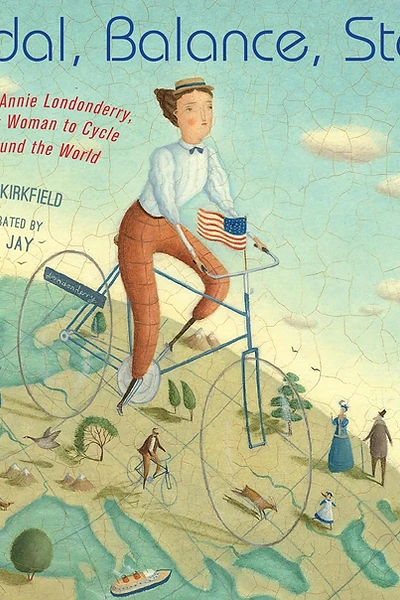
Pedal, Balance, Steer
by Vivian Kirkfield, Illustrated by Alison Jay
Pacing MaterialIn the 1890s, mother-of-three Annie Londonderry saw an ad promising $10,000 to a woman who could cycle around the world in a year—something no one thought possible. The only problem? She didn't know how to ride a bicycle. Annie waved goodbye to her family in Boston and set off for Chicago, facing robbers, sprained ankles, and disapproving stares along the way. She swapped her heavy women's bike and corset for a better bicycle and bloomers, and kept pedaling all over the world. Arriving in Chicago fourteen days before her deadline, Annie proved that women could do just about anything they set their minds to.
Big Idea
When you set your mind to a goal and keep pedaling—through setbacks, doubt, and disapproval—you can accomplish things no one thought possible.
Discussion Questions
- 1.Why do you think Annie decided to take on a challenge she wasn't prepared for? What does that tell you about her character?
- 2.Annie faced robbers, sprained ankles, and disapproving stares. Which obstacle do you think was the hardest, and why?
- 3.How did Annie change her approach after reaching Chicago the first time? What can we learn from her willingness to try a different route?
- 4.Why did people around the world—especially women—follow news of Annie's journey? What did her ride mean to them?
- 5.The phrase "Pedal. Balance. Steer." repeats throughout the book. What does each word represent in Annie's journey, both on and off the bicycle?
- 6.Annie's family was counting on the prize money. How did that responsibility affect her decisions when she wanted to quit?
Classroom Activity
Map Annie's World: A Journey of Perseverance
Students trace Annie Londonderry's journey on a world map, then create a "Pedal, Balance, Steer" perseverance journal connecting her challenges to a personal goal of their own.
Lesson Plan
Learning Goals
- Trace the route of Annie Londonderry's journey around the world using a map.
- Identify three obstacles Annie faced and describe how she overcame each one.
- Explain how the repeated phrase "Pedal. Balance. Steer." reflects both bicycle riding and life challenges.
- Connect Annie's perseverance to a personal goal and describe one step toward achieving it.
Activity Steps
- 1.Read the book aloud, pausing to note each location Annie visits. Record the places on a class chart as you go.
- 2.Distribute outline maps of the world. Have students mark Boston, Chicago, the route west, and the return to Chicago, drawing arrows to show Annie's path.
- 3.In small groups, students choose one obstacle Annie faced (robbers, sprained ankle, disapproving stares, wanting to quit) and discuss how she responded.
- 4.Each student creates a "Pedal, Balance, Steer" journal: one page for Pedal (a goal they want to achieve), one for Balance (a challenge they might face), and one for Steer (one step they can take to keep going).
- 5.Pairs share their journals and offer one encouraging word—just as people around the world cheered Annie on.
- 6.Close by reading Annie's final quote together and discussing: What does it mean to prove that women—or anyone—can do just about anything?
Standards Connections
- ELA: RI.2-5.1 — Ask and answer questions to demonstrate understanding of key details in a text.
- ELA: RI.2-5.3 — Describe the connection between a series of historical events in a text.
- ELA: RI.2-5.4 — Determine the meaning of words and phrases in context, including figurative language such as metaphors and similes.
- Social Studies: C3 Framework D2.His.2.3-5 — Compare life in the past to life today.
- Social Studies: C3 Framework D2.Geo.3.3-5 — Use maps to locate places and describe human/environment interactions.
- SEL: Self-management and responsible decision-making — identifying goals, persevering through challenges, and seeking support.
Pace-Write-Read Study with Pace-Write It!
Focus question: How do a repeated refrain, a deadline, and moving illustrations make a picture-book biography feel like a journey? This biography follows Annie Londonderry as she learns to ride, changes her route and equipment, and works toward a deadline. Jay's illustrations weave words, maps, and period details into the journey.
| Element | How to notice or teach it in the novel |
|---|---|
| Pace, plot & concept | Read: Map Annie's goal → departure → setback → changed plan → finish. How does the deadline keep the journey moving? Classroom Activity: Make a five-box story map. Label one box where the pace slows for a decision. |
| Prosody, word pause, performance, rhythm, repetition & punctuation | Read: Read the title refrain aloud wherever it returns. Notice how pauses between its three words can sound steady, urgent, or determined. Classroom Activity: Write an original three-word refrain for a journey. Perform it twice with different pauses. |
| Voice, worldview & point of view | Read: Distinguish the biographer's narration from Annie's quoted words. What do Annie's choices show about how she sees her goal? Classroom Activity: Write a short imagined journal entry based on one documented event. Label it creative writing rather than Annie's actual words. |
| Setting, place, details & descriptions | Read: Follow the locations on Jay's maps and in the text. Which period details quickly establish when and where Annie is? Classroom Activity: Write a caption for one stop on a researched journey, using two accurate setting details. |
| Original character, personality, dialogue & humor | Read: Annie is a real person. Find an action that reveals her resourcefulness or humor. Check for an actual quotation before calling any words dialogue. Classroom Activity: Show a determined character making a new plan through actions and one original line of speech. |
| Strong first lines, immediacy & engagement | Read: Examine the opening spread. What goal or question makes you want to follow Annie? Classroom Activity: Draft two openings for a biography: one starts with the person's goal, the other with an unexpected obstacle. |
| Story scenes, summaries & unique structures | Read: A journey covering many months must move quickly through some places and linger at turning points. Find an example of each. Use the timeline or back matter to add historical context. Classroom Activity: Summarize a week in one sentence; expand one important decision into a five-sentence scene. |
| Flashback, flash forward & cliffhangers | Read: Check whether the narration actually moves backward or forward in time. A map showing the route or a character imagining the destination is not automatically a flash forward. Classroom Activity: End a page just before a traveler announces a changed plan. Reveal the plan after the turn. |
| Tension, suspense, surprise, page turns & breaks | Read: Notice how the deadline and route changes raise the question of what Annie will do next. What does a page turn withhold or reveal? Classroom Activity: Create a two-page sequence: problem before the turn; resourceful response after it. |
| Pause, poetry & poetic devices | Read: Look for the refrain and language that suggests movement. Where does the narration pause long enough for readers to consider Annie's feelings or choices? Classroom Activity: Write four original lines about a journey, repeating one phrase but changing its emphasis. |
| Questions, compare–contrast & threes | Read: Compare Annie's plan at departure, a turning point, and the finish. What changes, and what stays important to her? Classroom Activity: Complete a three-part chart: plan / problem / revision. |
| Objects | Read: Track the bicycle, clothing, or a map as part of Annie's changing plan. What does each help readers understand about the journey? Classroom Activity: Choose one object from a historical photograph. Describe what it shows, then pose a question for research. |
| Whitespace, negative space, art & graphics | Read: Follow the refrain as it moves through Jay's art. Examine how maps, small vignettes, and open space guide your eye across a spread. Classroom Activity: Sketch a page layout with a route line, one short sentence, and open space around the turning point. |
| Interactives & gamification | Read: Use the book's geography to examine story structure. Classroom Activity: Give groups event cards from the biography. Have them place each on a story map and justify where readers would speed up, slow down, or pause. |
Pace-Write It!
20-minute workshop flow: 1. Read (5 min) — Read selected spreads aloud, letting students hear the returning refrain. 2. Notice (5 min) — Students mark one fast page, one pause, and one page turn that raises a question. 3. Write (7 min) — Students make a two-page account of a researched journey or an original everyday trip, including a three-word refrain and a changed plan. 4. Share (3 min) — Partners read aloud and explain how their refrain and page turn control the pace. Exit ticket: "The journey feels fastest when ______. Kirkfield slows me down at ______, and Jay's illustration makes me notice ______."