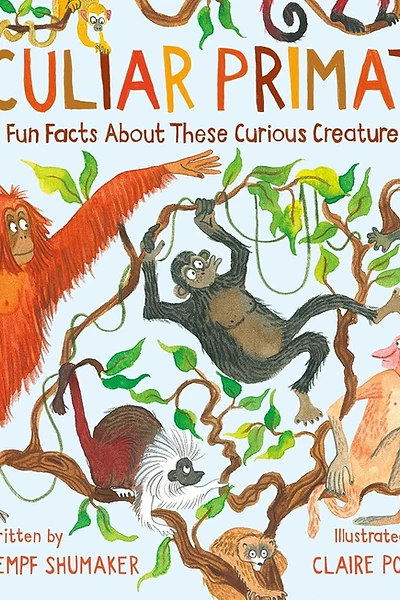
 K-3
K-3R P SHUMAKER
Peculiar Primates
by Debra Kempf Shumaker
Pacing MaterialExplore the wild world of primates in this engaging nonfiction guide that covers everything from tiny, nocturnal tarsiers to powerful gorillas. It highlights the fascinating behaviors and physical traits that make primates so unique.
Big Idea
Observing the variety in the primate family helps us appreciate the complexity and connection of life on Earth.
Discussion Questions
- 1.What are some similarities between humans and the primates in the book?
- 2.How do different primates move through their homes?
- 3.Which primate trait surprised you the most?
- 4.Why is it important to protect the habitats of these animals?
- 5.How do these primates use their bodies to communicate?
Classroom Activity
Primate Profile Cards
Students will research a specific primate from the book and create a 'Trading Card' showcasing its most distinct features.
Lesson Plan
Learning Goals
- Distinguish between different primate species
- Practice gathering information from non-fiction sources
- Summarize key facts clearly
Activity Steps
- 1.Select one primate featured in the book
- 2.Find three key facts about their size, diet, and habitat
- 3.Sketch the primate on the front of an index card
- 4.Write the facts on the back of the card
- 5.Trade cards with classmates to learn about different primates
Standards Connections
- NGSS.LS3.B
- CCSS.ELA-LITERACY.RI.3.1
- VA.3.CR3.1
Pace-Write-Read Study with Pace-Write It!
Focus question: How can a nonfiction picture book make readers move quickly through facts while still stopping to look closely? Peculiar Primates, illustrated by Claire Powell, introduces unusual primate traits through short rhyming text and expressive pictures. Its back matter gives readers more science to investigate. Shumaker has explained that she shaped the book from familiar traits toward more surprising ones, with a nighttime sequence near the end. That sequence gives the collection of facts a sense of movement.
| Element | How to notice or teach it in the novel |
|---|---|
| Pace, plot & concept | This is informational nonfiction, so its "plot" is the sequence of discoveries. Track how one primate or trait leads to the next. Classroom Activity: Arrange three verified animal facts from familiar to surprising. Explain your order. |
| Prosody, word pause, performance & rhythm | Read a spread aloud. Listen for the rhyme and steady beat; pause after a surprising fact so everyone can inspect the illustration. Classroom Activity: Write two original rhyming lines about a researched animal. Read them aloud and revise any line that trips the tongue. |
| Voice, worldview & point of view | Notice the book's lively, curious voice. Distinguish the author's presentation from the scientific facts in the back matter. Classroom Activity: Describe one verified fact first in a playful sentence, then in a straightforward science sentence. |
| Setting, place, details & descriptions | Look closely at each pictured habitat. Which visual details help you understand where a primate lives or how it behaves? Classroom Activity: Write one precise caption for an animal image. Include an observable detail and its source. |
| Original characters, personality & humor | The primates are real animals, not fictional characters. Discuss how Powell's expressions and Shumaker's word choices make each introduction memorable without treating an imagined personality as a scientific fact. Classroom Activity: Write a playful title for an animal fact card, followed by an accurate factual caption. |
| Strong first lines, immediacy & engagement | Examine the opening spread. How quickly does it establish the book's sound and its invitation to be curious? Classroom Activity: Draft two openings for a nonfiction read-aloud: one asks a question; one presents a surprising verified fact. |
| Dialogue | Check whether a selected spread contains actual speech before calling it dialogue. Consider how the text can sound conversational even without characters speaking. Classroom Activity: Turn one fact into a short reader-and-researcher question and answer. Keep the answer accurate. |
| Story scenes, summaries & unique structures | Compare the brief rhyming main text with the fuller explanations in the back matter. What can each part do at its own pace? Classroom Activity: Explain one fact in one lively line, then in three clear sentences. |
| Flashback, flash forward & cliffhangers | These narrative devices may not appear in a particular spread. Look instead for a page that invites a prediction about the next primate; a prediction is not a flash forward. Classroom Activity: End a page with a question about an animal adaptation. Answer it on the following page. |
| Tension, suspense, surprise & page turns | Before turning a page, predict which unexpected trait the next illustration might reveal. Notice how the actual reveal uses text and art together. Classroom Activity: Make a two-page fact reveal: question on page one; verified answer and image on page two. |
| Pause, poetry, poetic devices, repetition & punctuation | Find rhyme, repeated sentence patterns, and punctuation that guide a read-aloud. Where should the reader pause for laughter or wonder? Classroom Activity: Create a four-line factual verse with a repeated opening. Mark one purposeful pause. |
| Questions, compare–contrast & threes | Compare three primates by trait, possible use of the trait, and habitat. Confirm explanations in the back matter rather than guessing from the pictures. Classroom Activity: Make a three-column comparison chart and write one new research question. |
| Objects | Focus on a visible feature or item—such as a tail, hand, or food—and ask what readers can observe and what they still need to verify. Classroom Activity: Draw one feature, label what you can see, and add a sourced fact about its use. |
| Whitespace, negative space, art & graphics | Notice how the short text leaves room for Powell's illustrations. Where does your eye go first, and when do you return to the words? Classroom Activity: Lay out one fact on a mock picture-book spread. Leave enough open space for the animal to be the focus. |
| Interactives & gamification | Turn the book's surprising facts into an evidence game: students should be able to point to the page or back matter for every answer. Classroom Activity: Play Fact, Picture, or Question: sort cards into facts confirmed by the text, details visible in the art, and questions requiring further research. |
Pace-Write It!
Exit ticket: Choose one spread and complete: "The rhyme makes me read ______. I pause at ______ to examine ______. The back matter helps me understand ______." Shumaker also provides teacher resources for Peculiar Primates for extending the science discussion at https://debrashumaker.com/books/peculiar_primates/