 1-3
1-3GN NARWHAL
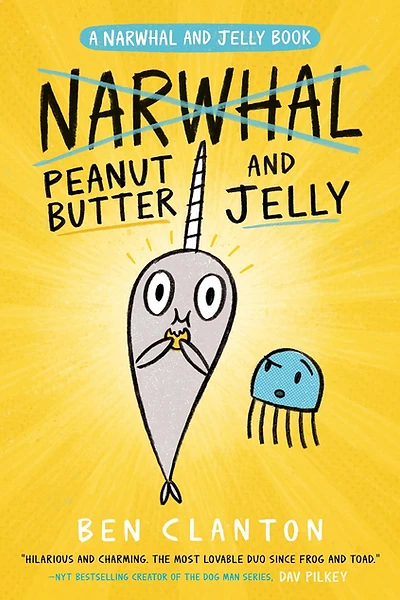
Peanut Butter and Jelly
by Ben Clanton
Pacing MaterialNarwhal is eager to share his excitement about trying peanut butter, an experience that leads to a funny exploration of taste and open-mindedness. This story celebrates the joy of trying new things and the importance of sharing discovery with your best friend.
Big Idea
Being open to trying new things and sharing experiences strengthens our friendships and helps us grow.
Discussion Questions
- 1.Have you ever tried a food you were scared to eat?
- 2.Why was Narwhal so excited to share the peanut butter with Jelly?
- 3.How do you feel when your friend encourages you to try something new?
- 4.What are some ways we can be brave when facing something unfamiliar?
- 5.Why is sharing experiences important to a friendship?
Classroom Activity
The New Taste Test Gallery
Students explore the concept of trying new things by mapping their preferences and creating a shared classroom chart of adventurous foods.
Lesson Plan
Learning Goals
- Develop a positive attitude toward trying new challenges
- Practice expressing personal opinions and preferences
- Engage in collaborative classroom data collection
Activity Steps
- 1.Read the story aloud and discuss the characters' reactions to peanut butter
- 2.Provide each student with a sheet to draw a new food they would like to try
- 3.Have students share their food choices in small groups
- 4.Create a collective class graph of 'Adventurous Foods We Want to Try'
- 5.Reflect on how trying new things together makes the experience less scary
Standards Connections
- CCSS.ELA-LITERACY.SL.1.1: Participate in collaborative conversations
- CASEL SEL Competency: Relationship Skills
- National Core Arts Standard: Responding
Pace-Write-Read Study with Pace-Write It!
Focus question: How does an author slow down and speed up a story to make trying something new feel funny, exciting, and important? In Peanut Butter and Jelly by Ben Clanton, Narwhal’s excitement about peanut butter and Jelly’s reactions create a playful graphic novel moment about friendship and being open to new experiences. Clanton uses comic panels, dialogue, page turns, and pauses between reactions to control pacing so readers can enjoy each joke, surprise, and discovery.
| Element | How to notice or teach it in the novel |
|---|---|
| Pace | Read: Notice how Ben Clanton moves quickly through funny back-and-forth moments between Narwhal and Jelly, then slows down when a character reacts to trying something new. The pacing helps the reader feel Narwhal’s excitement and Jelly’s caution. Classroom Activity: Write 4 short comic-panel sentences about a character trying a new food, making panel 1 fast, panel 2 slower, panel 3 the slowest reaction, and panel 4 a quick ending. |
| Plot | Read: Notice how the plot grows from a simple idea—Narwhal wants to share peanut butter—into a friendship moment about discovery and open-mindedness. The story stays easy to follow because each small event leads to the next. Classroom Activity: Write a beginning, middle, and end for a mini story where two friends try something new together. |
| Prosody | Read: Listen to how the dialogue sounds when read aloud; Narwhal’s energetic voice and Jelly’s quieter responses create a bouncy rhythm. The changing sound of the lines helps the funny timing land. Classroom Activity: Choose 3 lines you could imagine Narwhal saying and 3 lines Jelly might say, then read them aloud with different expression marks. |
| Word pause | Read: Notice where single words, short speech bubbles, or reaction words make you stop before moving on. These tiny pauses help the humor and surprise feel bigger in this graphic novel. Classroom Activity: Write a 5-line comic exchange using at least two one-word lines to create pauses before a big reaction. |
| Concept | Read: Notice that the big concept is trying new things with the help of a friend. Narwhal’s joy and Jelly’s careful thinking show that friendship can make new experiences feel safer and more fun. Classroom Activity: Write one sentence naming a new thing your character is nervous to try and one sentence showing how a friend helps. |
| Voice & World View | Read: Notice how the story’s voice feels cheerful, playful, and kind, making the world seem full of friendly surprises. Narwhal sees the world with wonder, while Jelly looks at it thoughtfully, and both viewpoints matter. Classroom Activity: Write two short paragraphs about the same snack—one in a super-excited voice like Narwhal and one in a careful voice like Jelly. |
| Setting & Place | Read: Notice how the ocean world stays simple, letting the friendship and peanut-butter idea stand out. The underwater setting adds silliness because peanut butter is such an unexpected object there. Classroom Activity: Write 3 sentences placing an unusual object in an underwater setting and explain how the place changes the mood. |
| Point of View | Read: Notice how readers mainly learn through Narwhal and Jelly’s shared experience, especially through what they say and how they react in panels. The point of view keeps us close to the friends’ feelings about trying something new. Classroom Activity: Rewrite one moment from the story idea from Jelly’s point of view, beginning with “I was not sure about…”. |
| Original Characters | Read: Notice how Narwhal and Jelly feel distinct and memorable—Narwhal is eager and enthusiastic, while Jelly is thoughtful and cautious. Their differences make the story funny and meaningful. Classroom Activity: Invent two sea-creature friends with opposite personalities and write 4 lines showing how they react differently to the same new experience. |
| Dialogue | Read: Notice how much of the story moves through dialogue instead of long explanation. Narwhal and Jelly’s conversation keeps the pace light, quick, and easy for young readers to follow. Classroom Activity: Write 6 lines of dialogue between two friends when one wants the other to try a surprising snack. |
| Details | Read: Notice the small details in the characters’ expressions and speech that show excitement, uncertainty, and curiosity. These details help readers understand the friendship without needing long narration. Classroom Activity: Make a list of 5 tiny details that could show a character is nervous but interested, then use 2 of them in a sentence. |
| Descriptions | Read: Notice that Ben Clanton keeps descriptions simple because the pictures do much of the work. When description does appear, it supports the playful tone and helps readers focus on taste, reaction, and feeling. Classroom Activity: Describe a new food in 3 kid-friendly words and then write one sentence about your character’s reaction to it. |
| Strong First Lines | Read: Notice how the opening quickly invites readers into Narwhal and Jelly’s playful world and gets to the main idea fast. A strong beginning helps the pacing start right away without too much setup. Classroom Activity: Write 3 possible first lines for a comic story about trying something new; choose the one that feels most exciting. |
| Immediacy & Engagement | Read: Notice how the book pulls readers in quickly with expressive characters, direct dialogue, and funny reactions. The graphic novel style makes readers feel like they are right there with Narwhal and Jelly in the moment. Classroom Activity: Write 4 short lines that begin in the middle of the action, such as when a character is already holding a strange snack. |
| Story Scenes & Summaries & Unique Structures | Read: Notice how the story mostly unfolds in scenes—moment by moment through panels and talk—rather than long summaries. This structure helps readers watch the friendship and the trying-new-things theme happen live. Classroom Activity: Write one scene in comic style with 4 panel captions instead of summarizing what happened over a whole day. |
| Flashback & Flash Forward & Cliffhangers | Read: Notice that this story stays in the present, but you can imagine how a cliffhanger page turn could make Jelly’s decision about trying peanut butter even funnier. Thinking about what the author does not use can help you understand the pacing choices. Classroom Activity: Write a 3-panel mini comic that ends panel 2 with a cliffhanger like “Should I taste it…?” before the final reveal. |
| Tension & Suspense & Surprise | Read: Notice the gentle tension in waiting to see how Jelly will respond to Narwhal’s enthusiasm. The suspense is not scary; it is playful and comes from wondering what will happen when someone tries something new. Classroom Activity: Write 5 sentences that build suspense before a character takes one bite of a surprising food. |
| Page Turns and Chapter Breaks | Read: Notice how page turns in a graphic novel can hold a joke, reaction, or reveal until just the right moment. Even without long chapters, turning the page helps pace Narwhal and Jelly’s discoveries. Classroom Activity: Plan a 2-page comic idea and write what happens before the page turn and what surprise comes after it. |
| Performance | Read: Notice how the story feels performable because the characters’ lines are expressive and full of personality. Narwhal’s excitement and Jelly’s careful replies invite readers to act out the scene. Classroom Activity: Write a short script for two readers, giving Narwhal-style stage directions like “bounce” or Jelly-style directions like “pause and think.” |
| Personality | Read: Notice how personality shapes pacing: Narwhal speeds things up with big enthusiasm, while Jelly slows things down by thinking carefully. Their friendship works because both personalities have space in the story. Classroom Activity: Write 4 sentences showing how a fast-moving character and a careful character handle the same problem differently. |
| Humor | Read: Notice that the humor comes from surprise, silly ideas, facial expressions, and the mismatch between Narwhal’s excitement and Jelly’s uncertainty. The jokes make the lesson about open-mindedness feel light instead of preachy. Classroom Activity: Write a funny dialogue exchange where one friend thinks a food looks strange and the other insists it is amazing. |
| Pause | Read: Notice the places where a reaction shot, a short line, or a silent panel would make readers pause and laugh. Those pauses help the story breathe and give meaning to each new response. Classroom Activity: Write a 4-panel scene and label one panel “silent reaction” to show a pause without words. |
| Poetry and Poetic Devices | Read: Notice that even in a graphic novel, sound patterns and playful word choices can make lines memorable. Narwhal’s joyful way of talking can feel almost chant-like or song-like. Classroom Activity: Write a 2-line chant about trying a new snack using alliteration, such as repeating the first sound in several words. |
| Repetition | Read: Notice how repeated reactions, repeated excitement, or repeated invitations can make the humor stronger. Repetition also helps young readers follow the pattern as Narwhal shares and Jelly considers. Classroom Activity: Write a short comic dialogue that repeats a key phrase like “Just one bite!” three times, changing the feeling each time. |
| Rhythm | Read: Notice the rhythm created by short speech bubbles, quick panel changes, and alternating voices. This rhythm helps Peanut Butter and Jelly feel lively and easy to read aloud. Classroom Activity: Write 6 very short lines that alternate between two friends so the conversation sounds bouncy. |
| Punctuation | Read: Notice how question marks, exclamation points, and ellipses can shape the feeling of a line in a graphic novel. Narwhal’s excitement and Jelly’s hesitation can be shown with punctuation as much as with words. Classroom Activity: Write the same sentence three ways—excited, worried, and unsure—by changing only the punctuation. |
| Questions | Read: Notice how questions can move the story forward by showing curiosity, confusion, or invitation. Questions fit this book especially well because trying new things often begins with asking about them. Classroom Activity: Write 5 questions Jelly might ask before trying peanut butter, then answer one as Narwhal. |
| Compare-Contrast | Read: Notice how the story invites readers to compare Narwhal and Jelly’s personalities and contrast their reactions to new experiences. Their differences are what make the friendship interesting and balanced. Classroom Activity: Make a T-chart comparing Narwhal and Jelly, then write 2 sentences explaining how their differences help the story. |
| Objects | Read: Notice how the object peanut butter becomes more than just food—it becomes the reason for conversation, surprise, and connection. A simple object can drive an entire scene in a graphic novel. Classroom Activity: Choose one object from your lunchbox and write 3 sentences showing how it could start a story between friends. |
| Threes | Read: Notice how sets of three can make jokes and pacing stronger: invite, hesitate, try; or excited line, careful line, reaction line. Patterns of three often sound satisfying to readers. Classroom Activity: Write a 3-step mini scene where a character sees, smells, and tastes a new food. |
| Whitespace & Negative Space | Read: Notice how open space around characters or speech bubbles can make readers focus on one reaction at a time. In a graphic novel like this, empty space helps slow the pace and highlight emotion. Classroom Activity: Sketch or describe a comic panel with lots of empty space around Jelly to show hesitation before trying something new. |
| Art & Graphics | Read: Notice how the art carries pacing through facial expressions, panel size, and visual jokes. Ben Clanton’s graphics help readers understand Narwhal and Jelly’s friendship even when the words are few. Classroom Activity: Draw or plan 3 comic panels showing excited face, unsure face, and happy-surprised face for a trying-something-new scene. |
| Interactives & Gamification | Read: Notice how the book’s playful tone invites readers to predict, react, and join the fun as if they are part of Narwhal and Jelly’s discovery. The graphic format makes it easy to turn reading into a participation game. Classroom Activity: Create a “Would you try it?” class chart with 3 silly foods and write one comic-style caption for each choice. |
Pace-Write It!
20-Minute Classroom Flow\nRead (5 min): Read a short section of Peanut Butter and Jelly by Ben Clanton aloud, showing the panels so students can hear Narwhal’s excited voice and notice Jelly’s reactions. Pause at a moment before the taste or reaction to let students predict what might happen next.\n\nNotice (5 min): Ask: “Where did the story go fast? Where did it slow down?” Guide students to notice short dialogue, reaction panels, punctuation, page turns, and how Narwhal and Jelly’s different personalities affect pacing. Chart two columns: Fast Parts and Slow Parts.\n\nWrite (7 min): Students write their own mini comic scene about two friends trying something new. Writing frame: “___ wanted ___ to try ___. ‘___!’ said ___. But ___ paused. ‘___?’ asked ___. At last, ___ tried it and said, ‘___!’” Encourage students to add one one-word pause, one question, and one excited line with an exclamation point.\n\nShare (3 min): Partners read their comic scenes aloud with expression—one partner reads the excited character and the other reads the careful character. Invite 1-2 pairs to share how they used a pause or page-turn-style surprise.\n\nExit ticket: Write one sentence answering: “How did Ben Clanton use pacing to make trying peanut butter funny and meaningful for Narwhal and Jelly?”