 K-3
K-3P MUSSER
Papilio
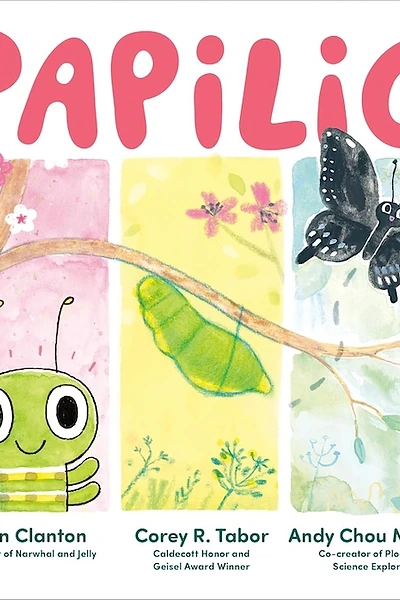
by Ben Clanton, Corey R. Tabor, and Andy Chou Musser
Pacing MaterialThree acclaimed author-illustrators team up to tell the story of Papilio, a caterpillar who discovers that becoming yourself is the greatest transformation of all.
Big Idea
Growth and change are part of every life, and becoming who you are is a journey worth taking.
Discussion Questions
- 1.How does Papilio change throughout the story?
- 2.What is hard about transformation?
- 3.How do the three illustrators' styles work together?
- 4.What is something you're growing into?
Classroom Activity
My Transformation
Draw yourself at three stages — now, a year ago, and a year from now. Show how you've grown.
Lesson Plan
Learning Goals
- Identify how Papilio changes as a caterpillar and explain how the story connects growth with becoming yourself.
- Sequence three stages of personal growth: a year ago, now, and a year from now.
- Use drawings and labels or sentences to describe changes in abilities, interests, or feelings.
- Recognize that people grow at different rates and can value both who they are now and who they hope to become.
Activity Steps
- 1.Read Papilio aloud, pausing to notice changes in Papilio’s body and sense of self. Ask: “What is changing for Papilio? What does becoming yourself mean?”
- 2.Discuss how children grow and change, too. Invite examples such as learning to read, making a friend, or trying something new. Explain that human growth is different from a caterpillar’s transformation.
- 3.Give each student paper divided into three panels labeled “A Year Ago,” “Now,” and “A Year From Now.” Model a simple example that shows a developing skill or interest.
- 4.Have students draw themselves in each panel, showing something they could do or enjoyed a year ago, something about themselves now, and something they hope to learn or try next year.
- 5.Ask students to add labels or sentences to explain their drawings. Offer the frames “I used to…,” “Now I…,” and “I hope to….” Younger students may dictate their ideas.
- 6.Invite students to share with a partner or the class. Connect their drawings to Papilio’s journey by asking: “How are you growing into yourself?” Close by naming one thing students appreciate about themselves today.
Standards Connections
- ELA: RL.K.3–RL.3.3 — Discuss characters and key events, with grade-appropriate attention to Papilio’s feelings, responses, and changes.
- ELA: W.K.3–W.3.3 — Use drawing, dictation, or writing to communicate personal experiences in a clear sequence.
- ELA: SL.K.1–SL.3.1 — Participate in collaborative conversations about the story and personal growth.
- SEL: Self-awareness — Identify personal strengths, interests, feelings, and hopes for future growth.
- Visual Arts: Creating — Use drawings and meaningful details to represent personal experiences and imagined future possibilities.
Pace-Write-Read Study with Pace-Write It!
Focus question: How do authors slow down and speed up a story to help readers feel a character changing on the inside and outside? In Papilio by Ben Clanton, Corey R. Tabor, and Andy Chou Musser, readers follow a caterpillar on a journey of transformation, discovery, and becoming himself. The book uses pacing through page turns, dialogue, visual humor, and moments of pause so readers can feel both the excitement and uncertainty of growth.
| Element | How to notice or teach it in the novel |
|---|---|
| Pace | Read: Notice how Papilio’s journey moves quickly during funny exchanges and slows down during moments when he wonders who he is becoming. Classroom Activity: Write 3 short sentences that speed up a character’s action, then 1 longer sentence that slows down the moment to show a feeling about change. |
| Plot | Read: Notice how the plot follows Papilio from being a caterpillar to facing transformation and discovering that becoming himself matters most. Classroom Activity: Make a 4-box plot map labeled beginning, middle, change, and end, then write one sentence for each box about Papilio’s growth. |
| Prosody | Read: Listen to how the words in Papilio can be read aloud with lively expression during humorous parts and softer expression during thoughtful parts. Classroom Activity: Choose one moment from Papilio and rewrite it for a read-aloud, adding slash marks where a reader should pause and underline words that should be read with strong feeling. |
| Word pause | Read: Notice where a single word or short phrase can make readers stop and think about Papilio’s transformation. Classroom Activity: Write a tiny scene about a character noticing a change, and include one one-word line such as 'Wait.' or 'Oh.' to create a pause. |
| Concept | Read: Notice that the big concept in Papilio is transformation, but also identity—changing does not mean becoming someone else; it means becoming yourself. Classroom Activity: Finish this sentence in your notebook: 'A transformation can look like ___, but it can really mean ___.’ Then turn it into a 2-sentence book idea. |
| Voice & World View | Read: Notice how the storytelling voice feels playful, warm, and curious while honoring Papilio’s feelings about growth. Classroom Activity: Write 4 sentences about a small creature changing, using a voice that is both funny and kind, like the style of Papilio. |
| Setting & Place | Read: Notice how the natural world around Papilio helps shape the story, making his transformation feel connected to the outdoor setting. Classroom Activity: Write a setting description for where a caterpillar might pause, hide, or grow, using 3 sensory details from nature. |
| Point of View | Read: Notice how readers stay close to Papilio’s experience, so his confusion, hope, and discovery shape the pacing of the story. Classroom Activity: Rewrite one moment from the point of view of another creature who watches Papilio change and react to him. |
| Original Characters | Read: Notice how Papilio stands out as a memorable character because he is not just changing physically—he is figuring out who he is. Classroom Activity: Invent an original tiny animal character who is changing in some way, and write 3 details that make the character feel unique. |
| Dialogue | Read: Notice how dialogue helps build humor and keeps the story moving as Papilio interacts with others during his journey. Classroom Activity: Write a 4-line dialogue between Papilio and another creature in which one character misunderstands the transformation at first. |
| Details | Read: Notice the small details that help readers understand Papilio’s body, feelings, and the world around him. Classroom Activity: Make a list of 5 specific details a reader might notice before, during, and after a character’s transformation, then use 3 in a sentence. |
| Descriptions | Read: Notice how description in Papilio supports both the physical process of change and the emotional experience of becoming yourself. Classroom Activity: Write 2 descriptive sentences—one showing what a character looks like on the outside and one showing what they feel like on the inside. |
| Strong First Lines | Read: Notice how the opening of a picture book like Papilio must quickly pull readers into the character’s problem or situation. Classroom Activity: Write 3 possible first lines for a story about a creature on the edge of change, and star the one that creates the most curiosity. |
| Immediacy & Engagement | Read: Notice how Papilio feels immediate because readers are right beside him as events happen and questions about change appear. Classroom Activity: Write 3 sentences in the present tense about a creature changing right now, so the reader feels close to the action. |
| Story Scenes & Summaries & Unique Structures | Read: Notice how some parts of Papilio feel like full scenes with action and talk, while other parts move more quickly to carry readers through the transformation. Classroom Activity: Write one scene of Papilio talking to another creature, then write one summary sentence that jumps time forward. |
| Flashback & Flash Forward & Cliffhangers | Read: Notice how a book about transformation can create anticipation by hinting at what is coming next, even without long flashbacks. Classroom Activity: Write a cliffhanger page ending for Papilio using this frame: 'Papilio looked around. Something was changing... but what would happen next?' Then add one more original sentence. |
| Tension & Suspense & Surprise | Read: Notice how the suspense in Papilio comes from not fully knowing how the transformation will feel or what it will mean for him. Classroom Activity: Write 3 sentences that build tension before a change, ending with a surprising final line. |
| Page Turns and Chapter Breaks | Read: Notice how picture books like Papilio use page turns to hold a surprise, reveal a feeling, or show a big visual change. Classroom Activity: Plan a 2-page mini-book scene and write what happens before the page turn and what surprise or reveal happens after it. |
| Performance | Read: Notice how Papilio invites expressive reading with changes in feeling, humor, and dramatic pauses. Classroom Activity: Mark up one short passage with directions like 'whisper,' 'pause,' or 'say loudly,' then practice performing it with a partner. |
| Personality | Read: Notice how Papilio’s personality helps readers care about him; his reactions to change make the pacing feel personal. Classroom Activity: Write a character card for Papilio or a new creature, including 'likes,' 'worries,' and 'how this character reacts to change.' |
| Humor | Read: Notice how humor in Papilio keeps a story about change feeling welcoming and lively, even during uncertain moments. Classroom Activity: Write a funny moment in which a creature misunderstands what transformation means, then revise it to make the punch line land on the last line. |
| Pause | Read: Notice how the story makes room for quiet moments when Papilio stops, notices, or reflects. Classroom Activity: Write a 3-line pause moment in which nothing big happens on the outside, but a character realizes something important on the inside. |
| Poetry and Poetic Devices | Read: Notice how the language in Papilio can feel lyrical at moments, especially when describing change, beauty, and becoming. Classroom Activity: Write a short poem of 4 lines about a caterpillar changing, using at least one simile such as 'like' or 'as.' |
| Repetition | Read: Notice if words, ideas, or patterns repeat in Papilio to remind readers of the theme of transformation and identity. Classroom Activity: Write a repeated line for a story, such as 'I am changing, but I am still me,' and use it 3 times in different parts of a mini-story. |
| Rhythm | Read: Notice how sentence length and word choice create a rhythm that can feel bouncy in humorous parts and slower in reflective parts. Classroom Activity: Write one bouncy sentence with many small beats and one calm sentence with a slower rhythm about the same character. |
| Punctuation | Read: Notice how punctuation in Papilio can shape pacing by making readers stop, rush, wonder, or exclaim. Classroom Activity: Write the same line 3 ways using a period, question mark, and exclamation point to show different feelings about transformation. |
| Questions | Read: Notice how questions in Papilio can help show uncertainty, curiosity, and discovery as Papilio changes. Classroom Activity: Write 3 questions Papilio might ask during his transformation, then answer one of them in a complete sentence. |
| Compare-Contrast | Read: Notice how readers naturally compare Papilio before and after his change, on the outside and on the inside. Classroom Activity: Make a T-chart labeled 'Before' and 'After' for Papilio, then write a compare-contrast sentence using both sides. |
| Objects | Read: Notice how important objects in a transformation story can symbolize growth, waiting, or becoming. Classroom Activity: Choose one object from a nature setting—leaf, branch, shell, or cocoon-like shelter—and write 2 sentences explaining how it helps a character change. |
| Threes | Read: Notice how groups of three can make writing feel satisfying and easy to follow, especially in picture books with humor and strong rhythm like Papilio. Classroom Activity: Write a sentence with 3 actions Papilio does while facing change, or 3 feelings he has in order. |
| Whitespace & Negative Space | Read: Notice how open space on a page can slow readers down and draw attention to Papilio’s small body, big feelings, or a moment of change. Classroom Activity: Plan a picture-book page in your notebook and decide which single sentence deserves lots of blank space around it for emphasis. |
| Art & Graphics | Read: Notice how the illustrations in Papilio help pace the story by showing expression, motion, and transformation in ways words alone cannot. Classroom Activity: Sketch 3 quick panels showing a character before, during, and after a change, and write one caption under each panel. |
| Interactives & Gamification | Read: Notice how Papilio invites readers to predict, notice clues, and respond to the character’s transformation journey. Classroom Activity: Create a 'predict the change' card for a partner with 3 clues about a transforming creature, then have your partner guess and write the final reveal sentence. |
Pace-Write It!
20-Minute Classroom Flow\nRead (5 min): Read aloud a key section of Papilio by Ben Clanton, Corey R. Tabor, and Andy Chou Musser that shows Papilio in the middle of change. Pause at a page turn or a moment of uncertainty so students can feel how the pacing builds curiosity.\nNotice (5 min): Ask: 'Where did the story speed up? Where did it slow down?' Chart student noticings about dialogue, page turns, humor, quiet thinking moments, and illustration space. Point out how the authors help us feel Papilio’s transformation both physically and emotionally.\nWrite (7 min): Students write a short transformation scene about a tiny creature becoming something new while also learning something true about itself. Writing frame: 'At first, I was ____. Then something began to change. I felt ____, ____, and ____. When I looked again, I was ____. But the biggest change was ____.' Encourage students to add one short dialogue line and one one-word pause line.\nShare (3 min): Partners read their transformation scenes aloud with expression, pausing at the one-word line and emphasizing the final realization. Invite 1-2 students to share how they used pacing to slow down an important moment.\nExit ticket: Write one sentence answering: 'How did the authors of Papilio use pacing to help readers understand transformation?'
Pace-Write-Read Connection
Teach this book using the Pace-Write-Read method — Tool 30: Contrast.
Open the Mastery Manual