 K-5
K-5C OWL DIARIES
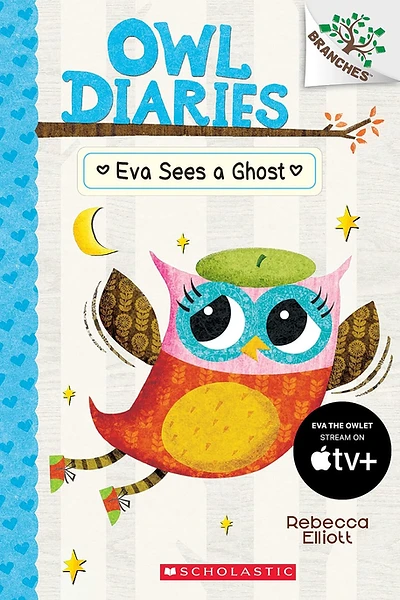
Owl Diaries Eva Sees A Ghost
by Rebecca Elliott
Pacing MaterialWhen Eva Wingdale sees something large and white flying above her she is convinced that it is a ghost, although most of the other owls just laugh at her--until something large and heavy and white lands on the school roof. "¡Eva ve un fantasma! O al menos, eso piensa& Así que con su mejor amiga, sale en busca del fantasma. Perfecto para niñas a las que les encantan las historias de animales y de amistad. "
Big Idea
Eva Sees a Ghost teaches that our fears are often based on misunderstandings and that checking the facts with friends can turn a scary mystery into a fun discovery.
Discussion Questions
- 1.Why did Eva think the white shape in the sky was a ghost at first?
- 2.How did Eva's feelings change from the beginning of the book to the end?
- 3.Why is it helpful to have a best friend like Lucy when you are scared?
- 4.If you saw something strange in the sky, what steps would you take to find out what it really is?
- 5.How does writing in a diary help Eva express her feelings about her day?
Classroom Activity
The Mystery Investigation Journal
Students will create their own 'investigation' diary entries to practice observation skills and logical thinking, mirroring Eva's process of solving the ghost mystery.
Lesson Plan
Learning Goals
- Identify the difference between a fear-based assumption and a fact-based conclusion.
- Practice narrative writing by documenting a 'mystery' from their own lives.
- Analyze how characters use dialogue and observation to solve problems.
- Understand the diary format as a tool for personal reflection.
Activity Steps
- 1.Discuss a time you were scared of something that turned out to be harmless.
- 2.Provide students with a 'Diary Entry' template that includes space for a drawing.
- 3.Ask students to write about a 'mystery' they encountered, using the prompt: 'I saw something strange, and I thought it was...', followed by 'But then I discovered it was actually...'
- 4.Encourage students to include speech bubbles in their drawings to show what they said to their friends during the investigation.
- 5.Have students share their entries in small groups to compare how they solved their mysteries.
Standards Connections
- ELA: RL.K.3 (Describe characters, settings, and major events)
- ELA: W.K.3 (Use a combination of drawing and writing to narrate a single event)
- SEL: Self-awareness (Identifying and managing emotions)
- Art: Visual literacy (Using illustrations to convey narrative meaning)
Pace-Write-Read Study with Pace-Write It!
Eva Sees a Ghost is a masterclass in pacing for early readers, utilizing the diary format to create a sense of immediate, personal connection. By breaking the narrative into daily entries, Rebecca Elliott controls the flow of information, allowing the reader to experience the mystery alongside Eva in real-time. This structure teaches students that writing is a process of documenting thoughts as they evolve, rather than just recording finished facts. The book demonstrates how to balance text and visual storytelling to maintain momentum. The use of speech bubbles and colorful illustrations acts as a 'pacing break,' giving the reader's eyes a rest while simultaneously advancing the plot. This study will help students understand how to use white space, dialogue, and visual cues to keep a reader engaged and eager to turn the page.
| Element | How to notice or teach it in the novel |
|---|---|
| Pace | The diary format naturally segments the story into bite-sized daily chunks, keeping the reading speed brisk. |
| Plot | The plot follows a classic mystery arc: observation, fear, investigation, and resolution. |
| Prosody | Encourage students to read Eva's excited diary entries with an enthusiastic, fast-paced tone. |
| Word Pause | Use the diary dates and headings as natural pauses to transition between different days in the story. |
| Concept | The core concept is the 'fear of the unknown' and how curiosity overcomes it. |
| Voice & World View | Eva's voice is optimistic and dramatic, reflecting the world view of a young, imaginative owl. |
| Setting & Place | Treetopolis is established as a cozy, community-focused setting that makes the 'ghost' mystery feel safe. |
| Point of View | The first-person diary perspective makes the reader feel like Eva's confidant. |
| Original Characters | Eva is defined by her curiosity, while Lucy serves as the grounded, supportive foil. |
| Dialogue | Dialogue is often placed in speech bubbles, which speeds up the reading and adds character personality. |
| Details | Focus on the specific descriptions of the 'ghost'—large, white, and heavy—to show how details build suspense. |
| Descriptions | The illustrations provide the primary descriptions, allowing the text to focus on Eva's internal reactions. |
| Strong First Lines | Eva's entries often start with a hook, like 'Today I saw a ghost!', immediately grabbing attention. |
| Immediacy & Engagement | The diary format makes the reader feel like they are reading a secret, increasing engagement. |
| Story Scenes & Summaries & Unique Structures | The book uses a hybrid of prose and comic-style panels to structure the narrative. |
| Flashback & Flash Forward & Cliffhangers | Each diary entry ends with a sense of anticipation for what will happen tomorrow. |
| Tension & Suspense & Surprise | The tension builds as Eva tries to convince others of the ghost, culminating in the surprise reveal. |
| Page Turns and Chapter Breaks | Page turns are used to reveal the 'ghost' or the reaction of other characters, creating mini-cliffhangers. |
| Performance | The book is perfect for reading aloud with different voices for Eva and her friends. |
| Personality | Eva's personality is vibrant and expressive, shown through her exclamation points and drawings. |
| Humor | The humor comes from the irony of Eva being scared of something that turns out to be mundane. |
| Pause | Use the illustrations to pause and ask students to predict what the 'ghost' might be. |
| Poetry and Poetic Devices | The text uses alliteration and onomatopoeia to make the reading experience playful. |
| Repetition | Eva's repeated attempts to tell others about the ghost build the story's rhythm. |
| Rhythm | The short, punchy sentences create a fast, energetic rhythm suitable for early readers. |
| Punctuation | Exclamation points are used frequently to emphasize Eva's high-energy emotions. |
| Questions | Eva asks many questions in her diary, which invites the reader to think along with her. |
| Compare-Contrast | Compare Eva's initial fear of the ghost with her final understanding of what it actually was. |
| Objects | The 'ghost' (a white object) is the central object that drives the entire plot. |
| Threes | Eva often lists three things she did or three reasons why she is scared. |
| Whitespace & Negative Space | The layout uses plenty of white space to keep the pages from feeling cluttered for new readers. |
| Art & Graphics | The art is essential; it provides the visual evidence that contradicts Eva's fears. |
| Interactives & Gamification | The book includes comprehension questions at the end, turning the reading into a game of recall. |
Pace-Write It!
In 20 minutes, have students write a 'Diary Entry' about a mystery they solved today (e.g., 'Where did my pencil go?'). They must include one speech bubble and one drawing that shows the 'clue' they found.