 K-5
K-5C OWL DIARIES
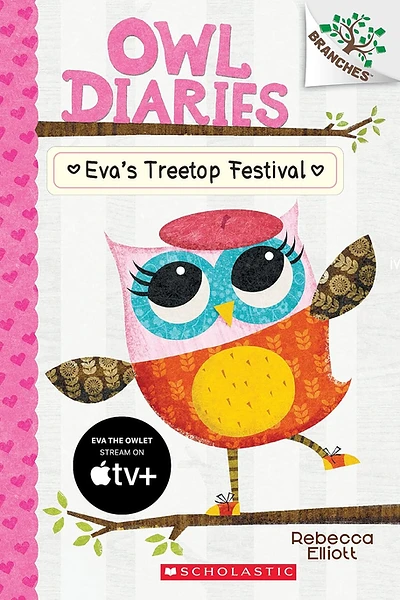
Owl Diaries Eva's Treetop Festival
by Rebecca Elliott
Pacing MaterialHaving a Bloomtastic Festival at school to celebrate spring is a great idea--but Eva Wingdale, a young owl, discovers that it is also a lot of work, and there is nothing wrong with asking her friends for help.
Big Idea
Eva Wingdale learns that while big ideas are exciting, they require teamwork and humility to succeed. Asking for help is a sign of strength, not weakness, when tackling a large project.
Discussion Questions
- 1.Why did Eva think she could organize the entire Bloomtastic Festival by herself?
- 2.How did Eva feel when she realized she had bitten off more than she could chew?
- 3.What are the benefits of working with friends compared to working alone?
- 4.How does Eva's diary format help us understand her feelings better than a regular storybook might?
- 5.What does it mean to be a good friend, and how did Eva show this by the end of the festival?
Classroom Activity
The Bloomtastic Planning Committee
Students will work in small groups to plan their own 'mini-festival' for the classroom, practicing delegation and collaborative brainstorming just like Eva and her friends.
Lesson Plan
Learning Goals
- Identify the importance of collaboration in completing complex tasks.
- Analyze how characters change their perspective through experience.
- Practice organizing information using lists and schedules.
- Demonstrate effective communication skills within a small group setting.
Activity Steps
- 1.Divide students into small groups and assign each group a 'festival theme' (e.g., Reading Festival, Art Festival).
- 2.Have students create a 'To-Do' list for their festival, similar to Eva's diary lists.
- 3.Require each group to assign specific roles to each member to ensure no one person is doing all the work.
- 4.Students draw a 'festival map' or poster illustrating their event.
- 5.Groups present their plan to the class, explaining why they chose to divide the tasks the way they did.
Standards Connections
- ELA: RL.K.3 (Describe characters and events)
- SEL: Relationship Skills (Collaborative teamwork)
- ELA: W.K.5 (Participate in shared writing projects)
- Speaking & Listening: SL.K.1 (Participate in collaborative conversations)
Pace-Write-Read Study with Pace-Write It!
Eva's Treetop Festival is a masterclass in the 'diary' narrative structure, which teaches students how to blend personal voice with chronological storytelling. By using a diary format, Rebecca Elliott creates an immediate, intimate connection between the reader and Eva, showing how writing can be used to process daily challenges and organize complex thoughts. This book demonstrates how to pace a story through the use of mixed media—lists, calendars, and speech bubbles—which break up long blocks of text and keep the reader engaged. It teaches students that writing doesn't always have to be long paragraphs; it can be a collection of thoughts, plans, and reflections that move a plot forward quickly and effectively.
| Element | How to notice or teach it in the novel |
|---|---|
| Pace | The story moves quickly through short, dated entries that mirror a busy school schedule. |
| Plot | The plot follows a clear arc: the 'big idea,' the struggle of doing it alone, and the resolution through teamwork. |
| Prosody | The text uses expressive, conversational language that encourages readers to read with excitement and urgency. |
| Word Pause | The diary format naturally creates pauses between entries, allowing the reader to reflect on the passage of time. |
| Concept | The central concept is the 'Bloomtastic Festival,' which serves as the anchor for all character actions. |
| Voice & World View | Eva’s voice is optimistic, energetic, and relatable, reflecting the worldview of a young student. |
| Setting & Place | The setting of Treetopolis is established through whimsical illustrations that ground the reader in an owl-centric world. |
| Point of View | The first-person diary perspective allows readers to see Eva's internal struggle with pride and stress. |
| Original Characters | Characters like Lucy and Sue provide distinct personality foils to Eva’s high-energy approach. |
| Dialogue | Dialogue is often contained in speech bubbles, making it easy to distinguish between internal thoughts and spoken words. |
| Details | Specific details about 'slug sandwiches' and school supplies add humor and realism to the fantasy setting. |
| Descriptions | Descriptions are visual and sensory, focusing on the colors and decorations of the festival. |
| Strong First Lines | The book opens with a hook about Eva's love for writing, immediately establishing her character. |
| Immediacy & Engagement | The use of 'Dear Diary' creates an immediate sense of being a confidant to the protagonist. |
| Story Scenes & Summaries & Unique Structures | The book uses a hybrid structure of prose, lists, and graphic elements to summarize events efficiently. |
| Flashback & Flash Forward & Cliffhangers | The diary format uses chronological entries that act as mini-cliffhangers, pushing the reader to the next day. |
| Tension & Suspense & Surprise | Tension builds as the festival date approaches and Eva realizes she is overwhelmed. |
| Page Turns and Chapter Breaks | Page turns are used to reveal new illustrations or list items that advance the plot. |
| Performance | The text is written to be read aloud with high energy, mimicking a child’s enthusiastic storytelling. |
| Personality | Eva’s personality is defined by her 'can-do' attitude, which is both her strength and her flaw. |
| Humor | Humor is derived from the contrast between Eva's grand plans and the messy reality of her life. |
| Pause | The visual breaks in the text provide natural pauses for the reader to examine the illustrations. |
| Poetry and Poetic Devices | The book uses alliteration in titles like 'Bloomtastic Festival' to make the event sound exciting. |
| Repetition | The recurring theme of 'asking for help' reinforces the moral of the story. |
| Rhythm | The rhythm is fast and upbeat, matching the frantic pace of a student planning an event. |
| Punctuation | Exclamation points are used frequently to convey Eva’s high level of excitement. |
| Questions | Eva often asks herself rhetorical questions in her diary, showing her internal processing. |
| Compare-Contrast | The book contrasts Eva’s initial 'I can do it' mindset with her final 'we can do it' realization. |
| Objects | Objects like the diary itself and the festival decorations are central to the plot. |
| Threes | The story follows a classic three-act structure: planning, struggling, and succeeding together. |
| Whitespace & Negative Space | The layout uses whitespace effectively to keep the pages from feeling cluttered despite the many illustrations. |
| Art & Graphics | The illustrations are integral to the story, providing context and emotional cues for the reader. |
| Interactives & Gamification | The book includes lists and checklists that invite the reader to 'check off' items along with Eva. |
Pace-Write It!
Students will spend 20 minutes writing a 'Diary Entry' about a time they had to ask for help. They must include one list of three things they needed to do and one speech bubble showing what they said to a friend.