 K-3
K-3P UNDERWOOD
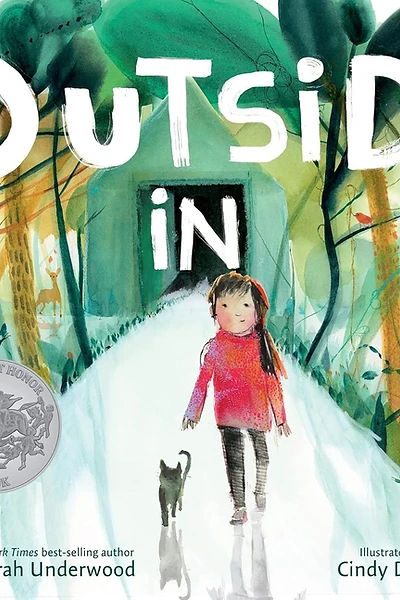
Outside In
by Deborah Underwood, Illustrated by Cindy Derby
Pacing MaterialBig Idea
Nature is not a separate place we visit, but a persistent, living force that constantly reaches into our indoor lives to connect with us. The book invites readers to recognize the 'slow magic' of the natural world in their everyday surroundings.
Discussion Questions
- 1.The author says that once, there was nothing between us and Outside. What do you think she means by that?
- 2.How does the author describe the ways nature tries to get our attention while we are inside?
- 3.Look at the illustrations: how does the artist use color and light to show the difference between being inside and outside?
- 4.Have you ever noticed a piece of nature, like a bug or a shadow, 'sneaking' into your house or classroom? How did it make you feel?
- 5.Why do you think the author chose to write this story as a poem rather than a regular story with a beginning, middle, and end?
Classroom Activity
Nature Detective: The 'Outside In' Scavenger Hunt
Students will act as nature detectives to find evidence of the 'Outside' world infiltrating their indoor classroom environment, documenting their findings through sketches and descriptive writing.
Lesson Plan
Learning Goals
- Identify sensory details that connect indoor spaces to the natural world.
- Analyze how authors and illustrators use personification to give nature a 'voice'.
- Practice observational skills by documenting small, overlooked details in the environment.
- Express personal connections to nature through creative writing and art.
Activity Steps
- 1.Read 'Outside In' aloud, focusing on the sensory language used to describe nature's 'tricks'.
- 2.Take a 'silent walk' around the classroom or school hallway to look for nature's influence (e.g., shadows, dust motes, a spiderweb, a plant, or light through a window).
- 3.Provide students with 'Detective Journals' to sketch one item they found and write one sentence about how it 'sneaked' inside.
- 4.Have students share their findings in small groups, discussing why they think nature 'wants' to be noticed.
- 5.Create a class mural titled 'Outside In' where students add their sketches to a shared visual representation of the classroom.
Standards Connections
- CCSS.ELA-LITERACY.RL.K.7: With prompting and support, describe the relationship between illustrations and the story.
- CCSS.ELA-LITERACY.W.1.3: Write narratives in which they recount two or more appropriately sequenced events.
- NGSS K-ESS3-1: Use a model to represent the relationship between the needs of different plants or animals and the places they live.
- National Core Arts Standard VA:Cr1.1.K: Engage in exploration and imaginative play with materials.
Pace-Write-Read Study with Pace-Write It!
The pacing of 'Outside In' is a masterclass in lyrical, meditative rhythm. Unlike traditional plot-driven narratives, this book relies on a 'pulse'—a steady, breathing cadence that mimics the ebb and flow of nature itself. By slowing down the reading experience, the author allows the reader to transition from the frantic pace of modern life to the 'slow magic' of the natural world. In this study, we examine how the book uses white space, line breaks, and visual texture to control the reader's speed. The pacing is not about moving the story forward, but about moving the reader inward, encouraging a state of mindfulness that mirrors the book's central theme of connection.
| Element | How to notice or teach it in the novel |
|---|---|
| Pace | The pace is slow and deliberate, using line breaks to force the reader to pause and breathe. |
| Plot | There is no traditional plot; instead, the 'plot' is the relationship between the reader and the natural world. |
| Prosody | Read with a soft, hushed tone to emphasize the reverence for nature. |
| Word Pause | The sparse text on each page creates natural pauses that allow the illustrations to speak. |
| Concept | The core concept is the permeability of the boundary between inside and outside. |
| Voice & World View | The voice is gentle and observant, viewing nature as a persistent, friendly entity. |
| Setting & Place | The setting shifts between the sterile indoors and the vibrant, encroaching outdoors. |
| Point of View | The story uses a collective 'we,' inviting the reader to see themselves as part of the narrative. |
| Original Characters | The 'character' is nature itself, personified as a playful, patient friend. |
| Dialogue | There is no spoken dialogue, which emphasizes the quiet, internal nature of the experience. |
| Details | Focus on small details like a snail on kale or a shadow on the floor. |
| Descriptions | Descriptions are sensory-heavy, focusing on smells, sounds, and light. |
| Strong First Lines | The opening line establishes the historical connection between humans and nature. |
| Immediacy & Engagement | The book engages the reader by pointing out things they might see in their own homes. |
| Story Scenes & Summaries & Unique Structures | The structure is a series of vignettes rather than a linear story. |
| Flashback & Flash Forward & Cliffhangers | The book uses a 'flashback' to a time before we were separated from nature. |
| Tension & Suspense & Surprise | Tension is created by the contrast between our busy lives and nature's quiet persistence. |
| Page Turns and Chapter Breaks | Page turns are used to reveal the 'magic' of nature in new, unexpected places. |
| Performance | Perform the reading by varying volume to match the 'whispers' of nature. |
| Personality | The book has a calm, patient, and inviting personality. |
| Humor | Subtle humor is found in the idea of nature 'sneaking' into our lives. |
| Pause | Use the white space on the pages as a visual cue to pause. |
| Poetry and Poetic Devices | The text is free verse, using rhythm to mimic the movement of wind or water. |
| Repetition | Repetition of the word 'Outside' reinforces the theme throughout the book. |
| Rhythm | The rhythm is steady and heartbeat-like, encouraging a calm reading state. |
| Punctuation | Ellipses and line breaks are used to extend the feeling of waiting. |
| Questions | The text asks the reader to consider their own relationship with the outdoors. |
| Compare-Contrast | The entire book is a compare-contrast exercise between inside and outside. |
| Objects | Objects like windows and doors act as the 'membrane' between the two worlds. |
| Threes | The book often lists three sensory experiences to ground the reader in a moment. |
| Whitespace & Negative Space | Whitespace is used to represent the 'empty' space of the indoors. |
| Art & Graphics | The art uses ink and graphite to create a textured, organic feel. |
| Interactives & Gamification | The book acts as a game of 'I Spy' for the reader to play in their own home. |
Pace-Write It!
Spend 20 minutes in a 'Silent Observation' session. Students sit in different parts of the room and write down three things they see, hear, or smell that come from 'Outside' (e.g., a breeze, a bird, a shadow). They then write one line of poetry about their observation, mimicking the book's style.