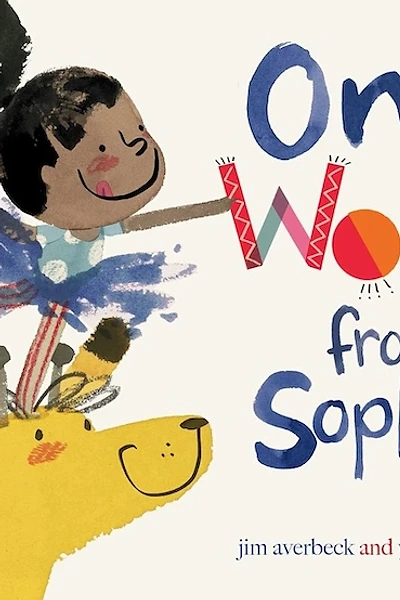
 K-3
K-3P AVERBECK
One Word from Sophia
by Jim Averbeck
Pacing MaterialSophia wants a giraffe for her birthday and tries one elaborate word after another to persuade each family member — but the perfect word is the simplest one.
Big Idea
The right word, chosen with care and heart, can be more persuasive than a hundred big ones.
Discussion Questions
- 1.Why does Sophia try such big words?
- 2.Which family member is hardest to persuade, and why?
- 3.What does Sophia learn about communication?
- 4.What word would you use to ask for something you really want?
Classroom Activity
My Perfect Word
Choose something you really want and write one persuasive sentence using the perfect word. Illustrate your request.
Lesson Plan
Learning Goals
- Identify how word choice affects persuasion
- Write a clear, persuasive sentence using one well-chosen word
- Explain why the simplest word can be the strongest
Activity Steps
- 1.Read the story, listing each word Sophia tries on the board.
- 2.Discuss: 'Why didn't the big words work? What finally did?'
- 3.Model writing one persuasive sentence with a single powerful word.
- 4.Students write their own persuasive sentence and illustrate it.
- 5.Share sentences and vote on the most persuasive.
Standards Connections
- ELA: RL.K.1 — Ask and answer questions about key details
- ELA: RL.K.2 — Retell stories, including key details
- ELA: RL.K.3 — Describe characters, setting, and events
- ELA: RL.3.6 — Acknowledge differences in characters' points of view
- ELA: SL.K.1 — Participate in collaborative conversations about the text
- ELA: W.K.3 — Write narratives recounting events with descriptive details
- SEL: Social Awareness
- SEL: Relationship Skills
- Art: VA:Re7 — Perceive and analyze artistic work
Pace-Write-Read Study with Pace-Write It!
Focus question: How does an author slow down and speed up a story to make persuasion more powerful? In One Word from Sophia by Jim Averbeck, Sophia tries to convince each member of her family to help her get a giraffe for her birthday by using long, impressive words and carefully planned speeches. The pacing stretches out as she builds each argument, then shifts quickly at the end when the simplest word creates the biggest change.
| Element | How to notice or teach it in the novel |
|---|---|
| Pace | Read: Notice how the story moves step by step through Sophia’s conversations with her mother, father, uncle, and grandmother, slowing down for each persuasive attempt and then speeding up when Sophia finally speaks to her family all together. Classroom Activity: Write 4 short scenes in which a character asks different family members for the same thing, making the last scene the shortest and strongest. |
| Plot | Read: Track the plot as Sophia wants a giraffe, plans her arguments, speaks to one family member at a time, and learns that the best persuasive word is not the fanciest one. Classroom Activity: Make a beginning-middle-end persuasion plot map for a character who wants an unusual birthday gift. |
| Prosody | Read: Listen to the rhythm of the long persuasive words Sophia uses, such as when she tries to sound smart and convincing, and how those words sound different from the simple ending. Classroom Activity: Say 3 big persuasive words aloud, then write a short speech that ends with one simple, powerful word or phrase. |
| Word pause | Read: Notice where readers naturally pause around Sophia’s elaborate vocabulary and before the important final moment, which helps build anticipation. Classroom Activity: Write 3 persuasive sentences and mark with slashes where a reader should pause for effect. |
| Concept | Read: Think about the big idea that persuasion is not just about using impressive language; it is also about understanding people and speaking from the heart, as Sophia does with her family. Classroom Activity: Write one sentence explaining the lesson Sophia learns, then create your own story idea that teaches a similar lesson. |
| Voice & World View | Read: Notice how the book’s voice admires Sophia’s determination and intelligence while also gently showing that her world view changes when she realizes love and politeness matter. Classroom Activity: Write in the voice of a confident child who thinks a clever plan will work, then add a final line showing what the child learns. |
| Setting & Place | Read: Notice that the home setting keeps the focus on Sophia’s family conversations, making each room or family interaction feel like a stage for persuasion. Classroom Activity: Choose a place in a home and write a persuasion scene there between a child and one adult. |
| Point of View | Read: Notice that readers mostly follow Sophia’s goal and plans, so the story stays close to her efforts to get the giraffe. Classroom Activity: Rewrite one of Sophia’s persuasion moments from the point of view of her father, mother, uncle, or grandmother. |
| Original Characters | Read: Notice how Sophia stands out as determined, organized, and dramatic, while each family member reacts differently to her wish for a giraffe. Classroom Activity: Invent an original child character who wants something surprising and list 3 traits that shape how the character persuades others. |
| Dialogue | Read: Pay attention to how Sophia’s speeches to each family member reveal her strategy and how the family responses help pace the story. Classroom Activity: Write a dialogue between a child and a family member about an unusual pet, giving each speaker 3 lines. |
| Details | Read: Notice the specific details about Sophia’s preparation, her words, and the giraffe idea that make her persuasion attempts feel believable and funny. Classroom Activity: Write 5 details that would help make a persuasion scene about a birthday request more convincing. |
| Descriptions | Read: Notice how descriptions of Sophia’s manner and the family’s reactions help readers picture each attempt and feel the rising effort. Classroom Activity: Describe a character’s face, hands, and voice during a moment of trying to convince someone. |
| Strong First Lines | Read: Notice how the beginning quickly introduces Sophia’s strong desire and gives readers an immediate reason to care about what she wants. Classroom Activity: Write 3 possible first lines for a story about a child who wants something extraordinary for a birthday. |
| Immediacy & Engagement | Read: Notice how the book keeps readers engaged by giving Sophia an urgent goal and letting us wonder whether any of her carefully chosen words will work. Classroom Activity: Write an opening paragraph that shows a character wanting something right away and trying to get it today. |
| Story Scenes & Summaries & Unique Structures | Read: Notice the repeated scene structure as Sophia approaches each family member one by one, which creates a clear pattern and helps readers compare her methods. Classroom Activity: Use a repeated structure to write 3 mini-scenes in which a character makes the same request to different people. |
| Flashback & Flash Forward & Cliffhangers | Read: Notice that this story stays mainly in the present instead of using flashbacks or flash forwards, and the suspense comes from ending each attempt without success. Classroom Activity: Write a scene that ends with a tiny cliffhanger, such as a family member saying, “I have one more thing to tell you…” |
| Tension & Suspense & Surprise | Read: Notice the tension as Sophia keeps trying bigger and fancier persuasive words, and the surprise comes when the simplest word matters most. Classroom Activity: Write a short persuasion story in which the ending surprises readers because the solution is simpler than expected. |
| Page Turns and Chapter Breaks | Read: Notice how page turns help hold suspense between Sophia’s speeches and the family’s reactions, making readers want to see what happens next. Classroom Activity: Plan a 6-page picture book dummy and decide what important question or reaction should happen right before each page turn. |
| Performance | Read: Notice how Sophia’s persuasive speeches feel almost like a performance, with planning, dramatic delivery, and careful word choice. Classroom Activity: Write and perform a 4-line speech in which a child tries to convince someone to say yes to an unusual idea. |
| Personality | Read: Notice how Sophia’s personality shines through as persistent, intelligent, and a little theatrical, which affects the pacing because she keeps trying new approaches. Classroom Activity: Write a character sketch of a child whose strong personality drives a whole story problem. |
| Humor | Read: Notice the humor in the very serious way Sophia argues for such a surprising birthday gift and in the mismatch between the grand words and the simple ending. Classroom Activity: Write 3 funny reasons a character gives for wanting an absurd present. |
| Pause | Read: Notice how the story creates pauses before key reactions and before the final important word, giving that moment extra weight. Classroom Activity: Write a short scene and add an ellipsis or line break to create a dramatic pause before the most important line. |
| Poetry and Poetic Devices | Read: Notice the pleasing sound of Sophia’s language and how the repeated persuasive pattern makes parts of the story feel poetic. Classroom Activity: Create a 4-line persuasive poem using alliteration for a wanted gift or pet. |
| Repetition | Read: Notice the repeated pattern of Sophia speaking to each family member, which builds rhythm, humor, and expectation. Classroom Activity: Write a repeated sentence starter such as “First I asked…” or “Then I told…” and use it in 4 lines of a story. |
| Rhythm | Read: Notice the rhythm created by the sequence of Sophia’s attempts and by the contrast between long formal words and short direct language. Classroom Activity: Write 2 long persuasive sentences and 2 very short sentences, then arrange them to create a strong rhythm. |
| Punctuation | Read: Notice how punctuation helps control pacing in Sophia’s speeches and in the family’s reactions, especially when emphasis and pauses matter. Classroom Activity: Rewrite a persuasive sentence 3 ways using a period, question mark, and exclamation point to change its effect. |
| Questions | Read: Notice the questions readers may ask while listening: Will Sophia’s plan work? Which family member might say yes? Why doesn’t the fancy language succeed? Classroom Activity: Write 3 questions a reader might have during a persuasion story, then answer them at the end of your draft. |
| Compare-Contrast | Read: Compare Sophia’s long, impressive words with the simple word that finally works, and contrast each family member’s response. Classroom Activity: Make a T-chart comparing fancy persuasive language and simple persuasive language, then write one example of each. |
| Objects | Read: Notice how the giraffe is the central object that drives the whole story and turns an ordinary birthday wish into something memorable. Classroom Activity: Pick one unusual object or animal a character wants and write 5 reasons it matters in the story. |
| Threes | Read: Notice how patterns in stories often feel satisfying in groups, and think about how Sophia’s repeated efforts prepare readers for a final important attempt. Classroom Activity: Write a persuasion piece with 3 reasons, 3 attempts, or 3 people the character asks before the ending. |
| Whitespace & Negative Space | Read: Notice how space on the page can slow readers down and spotlight Sophia’s important words or reactions, especially in a picture book. Classroom Activity: On a page, place one key line by itself to show it is the most important part of your scene. |
| Art & Graphics | Read: Notice how the illustrations help show Sophia’s confidence, planning, and family reactions, adding humor and pacing beyond the words alone. Classroom Activity: Sketch one scene from your persuasion writing and add labels to show what the pictures reveal that the words do not. |
| Interactives & Gamification | Read: Notice how readers can almost predict and join the pattern by guessing which word Sophia will try next and whether it will work. Classroom Activity: Create a class persuasion game where students draw a family member card, a surprising gift card, and a word-choice card, then improvise a short persuasive pitch. |
Pace-Write It!
20-Minute Classroom Flow\nRead (5 min): Read aloud key sections of One Word from Sophia by Jim Averbeck, stopping after Sophia speaks to each family member. Ask students to listen for how the story slows down during each persuasive attempt and speeds up at the end.\nNotice (5 min): Chart what Sophia does each time: who she asks, what kind of words she uses, and how the family member responds. Discuss: Which parts feel slow and careful? Which part feels fast and powerful? Why does the simple ending work best?\nWrite (7 min): Students write their own short persuasion piece about wanting an unusual gift, pet, or privilege. Use this writing frame: “I wanted _____. First I asked _____. I said, ‘_____.’ But _____. Next I asked _____. I used the word _____ because _____. But _____. Finally I said, ‘_____.’ Then _____.” Encourage students to use one long fancy word somewhere and one short powerful line at the end.\nShare (3 min): Partners read their pieces aloud and snap or clap when they hear the strongest final word or line. Invite 1-2 students to share how they changed pacing by making the ending shorter.\nExit ticket: Write one sentence answering: What kind of words worked better in your story—fancy words or simple words—and why?
Pace-Write-Read Connection
Teach this book using the Pace-Write-Read method — Tool 4: Word.
Open the Mastery Manual