 K-4
K-4P VIDELO
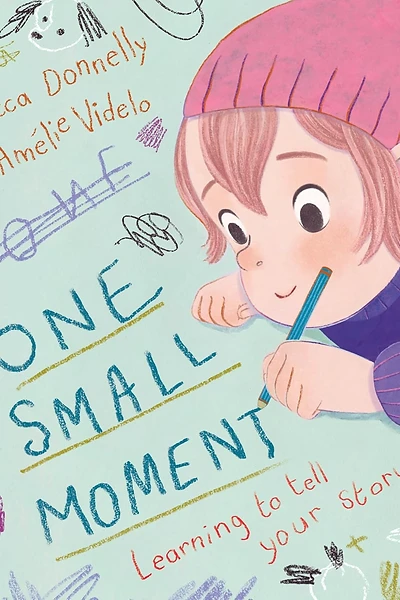
One Small Moment: Learning to Tell Your Story
by Rebecca Donnelly and Amélie Videlo
Pacing MaterialA child discovers that the best stories don't have to be big — sometimes one small moment is all you need to tell a story that matters.
Big Idea
Every story starts with a single moment — and your moments matter, no matter how small they seem.
Discussion Questions
- 1.What is a 'small moment' the child notices?
- 2.How does the child turn a moment into a story?
- 3.What's a small moment from your day that you could write about?
- 4.Why do small moments make great stories?
Classroom Activity
My Small Moment
Think of one small moment from today. Draw it and write one or two sentences telling the story of that moment.
Lesson Plan
Learning Goals
- Explain how the book’s big idea shows that a small everyday moment can become a meaningful story.
- Choose one moment from today and distinguish it from a summary of the whole day.
- Draw details that show who was there, what happened, and where the moment took place.
- Write, dictate, or label one or two sentences that tell what happened and express why the moment mattered.
- Share a personal story and listen respectfully to classmates’ experiences.
Activity Steps
- 1.Read One Small Moment: Learning to Tell Your Story aloud. Ask: “What does this book help us understand about the moments worth telling?” Discuss how a story can focus on something small rather than a big adventure.
- 2.Model choosing a moment from today, such as a friend saving you a seat. Contrast “My whole morning” with “The moment my friend waved me over.” Sketch the moment and model two sentences: “My friend saved me a seat. I felt welcome.”
- 3.Invite students to recall one small moment from today: hearing a funny sound, helping someone, noticing something outside, or greeting a friend. Have partners briefly tell who was there, where they were, and what happened.
- 4.Have students draw their chosen moment, including two or three details that help a reader understand it. Remind them to show just that moment, not every event of the day.
- 5.Ask students to add one or two sentences telling the story. Offer dictation, labels, or the frame “Today, I ____. I felt ____.” for younger writers; encourage older writers to include a precise action or sensory detail.
- 6.Invite students to share with a partner or the class. Partners name one detail they noticed. Close by asking: “How did your small moment become a story that matters?” Collect work to check for a focused moment and matching picture and words.
Standards Connections
- ELA: RL.K.1–RL.4.1 — Ask and answer questions about the story, using text and illustrations to support understanding at the appropriate grade level.
- ELA: W.K.3–W.4.3 — Develop a personal narrative focused on an event, using drawing, dictation, or writing and increasingly descriptive details.
- ELA: SL.K.1–SL.4.1 — Participate in collaborative conversations, listen to others, and build on shared ideas.
- SEL: Self-awareness — Recognize personal experiences and feelings as meaningful sources for storytelling.
- SEL: Relationship skills — Share experiences and respond respectfully to classmates’ stories.
Pace-Write-Read Study with Pace-Write It!
Focus question: How can slowing down to notice one small moment help us tell a stronger story? In One Small Moment: Learning to Tell Your Story by Rebecca Donnelly and Amélie Videlo, a child learns that meaningful stories do not need huge adventures; they can grow from one brief, important experience. The book uses pacing by stretching a single moment with careful observation, feelings, and details so young writers can see how small events become powerful narratives.
| Element | How to notice or teach it in the novel |
|---|---|
| Pace | Read: Notice how One Small Moment: Learning to Tell Your Story slows the action so the child storyteller can focus on one memory instead of rushing through many events. The pacing helps readers stay inside the moment and see why a small experience matters. Classroom Activity: Write 3-4 sentences about one tiny moment from your day, making it slow by telling what happened first, next, and right then. |
| Plot | Read: Notice that the plot in this book is not built around a giant adventure; instead, the child moves from wondering what story to tell to discovering that one small moment can be enough. This simple arc matches the theme of self-expression. Classroom Activity: Plan a beginning, middle, and end for a story about one small moment, such as dropping an ice cream cone, hearing thunder, or hugging someone goodbye. |
| Prosody | Read: Listen to how the language in One Small Moment: Learning to Tell Your Story sounds gentle, thoughtful, and inviting when read aloud. The flow of the sentences supports the reflective mood as the child storyteller learns to notice and share a personal memory. Classroom Activity: Read your own small-moment sentences aloud and revise one line so it sounds smooth and expressive. |
| Word pause | Read: Notice places where the wording encourages a reader to pause and think, giving the child’s ideas time to settle. These small pauses help the book feel calm and reflective instead of hurried. Classroom Activity: Write a sentence about a small moment and add a pause with a dash, comma, or line break where you want your reader to slow down. |
| Concept | Read: The central concept of One Small Moment: Learning to Tell Your Story is that stories can come from everyday life, not just big events. The child learns that paying attention to one meaningful instant is enough to begin writing. Classroom Activity: Make a list of 5 ordinary moments from your life that could become stories, then circle one to develop. |
| Voice & World View | Read: Notice how the book values a child’s inner life and shows that a young person’s feelings, memories, and observations are worth telling. The voice supports the worldview that every child has a story that matters. Classroom Activity: Write two sentences in your own voice beginning with “I noticed…” and “It mattered to me because…”. |
| Setting & Place | Read: Pay attention to how place helps shape the child’s small moment, even when the story stays focused on feeling and memory. The setting gives the moment context without taking over the story. Classroom Activity: Choose one place for your small-moment story and add 3 setting details about what could be seen, heard, or felt there. |
| Point of View | Read: Notice that the story stays close to the child’s perspective, helping readers experience the moment through that child’s thoughts and feelings. This close point of view makes the story personal and immediate. Classroom Activity: Write your small-moment story using “I” so the reader can feel the moment through your eyes. |
| Original Characters | Read: The child at the center of One Small Moment: Learning to Tell Your Story feels original because the book honors the child’s curiosity, uncertainty, and growing confidence as a storyteller. Even without a huge cast, the main character feels real and relatable. Classroom Activity: Create a child character based on yourself or an imagined student and write 3 details about what that character notices in one important moment. |
| Dialogue | Read: Notice whether spoken words are used sparingly, with the focus staying mostly on the child’s thinking and noticing. When dialogue appears or is imagined, it can spotlight what made the small moment memorable. Classroom Activity: Add one line of dialogue to your small-moment story, such as something you said, heard, or wished someone had said. |
| Details | Read: This book shows that the power of a story often comes from precise details rather than from a big plot. The child’s story grows stronger by noticing little things in the moment. Classroom Activity: Write 4 small details about one moment using your senses—for example, a sound, a color, a texture, and a feeling. |
| Descriptions | Read: Notice how descriptions help stretch one brief moment so it feels full and alive. In One Small Moment: Learning to Tell Your Story, description turns a simple experience into something worth sharing. Classroom Activity: Take a plain sentence like “I was outside” and expand it into 2-3 descriptive sentences about that moment. |
| Strong First Lines | Read: Think about how the opening invites readers into the child’s search for a story and signals that something small can still be important. A strong first line helps set the reflective tone right away. Classroom Activity: Write three possible first lines for your own small-moment story and choose the one that makes a reader want to know more. |
| Immediacy & Engagement | Read: Notice how the book makes readers feel close to the child’s discovery process, as if we are noticing the moment alongside the narrator. This closeness keeps the story engaging even though the action is quiet. Classroom Activity: Revise one sentence in your draft so it sounds like the moment is happening right now, using vivid action or feeling words. |
| Story Scenes & Summaries & Unique Structures | Read: Notice how the book emphasizes a scene—a zoomed-in moment—rather than summarizing a whole day or week. Its structure teaches young writers that a story can be built from one scene with emotional importance. Classroom Activity: Write one scene from your life in 5 sentences without summarizing everything that happened before or after. |
| Flashback & Flash Forward & Cliffhangers | Read: Consider how this book mostly stays grounded in the present idea of remembering and shaping one moment, rather than jumping all over time. That choice keeps the pacing clear for young writers learning to focus. Classroom Activity: Write one sentence that briefly names what happened before your moment, then return right away to the main scene. |
| Tension & Suspense & Surprise | Read: Notice that the tension in One Small Moment: Learning to Tell Your Story is emotional rather than action-packed: the child wonders what story is worth telling and then discovers the answer. The surprise is that something small can hold big meaning. Classroom Activity: Add one sentence to your story that shows a feeling of wondering, worry, or surprise in your small moment. |
| Page Turns and Chapter Breaks | Read: In this picture book, page turns help hold attention and give each part of the child’s discovery room to breathe. The turn can make readers pause before the next idea or image appears. Classroom Activity: Fold a paper into 4 parts and plan what part of your small-moment story would go on each page to create a good page turn. |
| Performance | Read: Notice how this book invites expressive read-aloud performance through changes in tone—quiet wondering, noticing, and realization. The child’s growing understanding can be shown in the way a reader uses voice. Classroom Activity: Practice reading your favorite sentence from the book or your own draft with expression, emphasizing the most important word. |
| Personality | Read: The child storyteller’s personality shines through the act of noticing, wondering, and choosing a meaningful memory. The book suggests that personality in writing comes from what we care about and how we tell it. Classroom Activity: Write 3 sentences that show your personality in a small-moment story by including something you really think, love, or remember. |
| Humor | Read: Even though the book’s main tone is thoughtful, students can notice that small moments can also be funny, awkward, or playful. A child’s storytelling voice can include light humor without losing meaning. Classroom Activity: Write about a tiny funny moment from your life and include one detail that would make a classmate smile. |
| Pause | Read: Notice how pauses in the text and illustrations give space for reflection, helping readers sit with the child’s memory. These pauses are part of the book’s calm pacing and support the theme of paying attention. Classroom Activity: Reread your story and mark one place where the reader should pause, then add punctuation or a line break there. |
| Poetry and Poetic Devices | Read: The language in One Small Moment: Learning to Tell Your Story can be appreciated for its lyrical, image-rich quality, which fits the inward, reflective theme. Poetic touches help a simple memory feel memorable. Classroom Activity: Add one simile, repetition, or image to your small-moment draft, such as “The rain sounded like fingers tapping.” |
| Repetition | Read: Notice whether ideas, words, or sentence patterns repeat to reinforce the message that one small moment is enough. Repetition can make the child’s realization feel stronger and easier for young readers to hold onto. Classroom Activity: Write a 3-line piece that repeats the same beginning, such as “I remember…” or “In one small moment…”. |
| Rhythm | Read: Listen for the steady rhythm of the text as the child moves from searching to noticing to understanding. The rhythm supports the gentle pacing and helps readers feel the shape of the story. Classroom Activity: Clap the beats of one sentence you wrote and revise it so it sounds balanced and easy to read aloud. |
| Punctuation | Read: Notice how punctuation in a reflective picture book can control pace by making readers stop, continue, or emphasize emotion. In a story about one small moment, punctuation helps stretch the feeling of the scene. Classroom Activity: Take one sentence from your draft and rewrite it two ways using different punctuation, such as commas, ellipses, or an exclamation point, then discuss how the pace changes. |
| Questions | Read: The child’s journey in One Small Moment: Learning to Tell Your Story is shaped by wondering—what story should be told, and what makes a moment matter? Questions help pull readers into the process of finding a story. Classroom Activity: Begin your draft with a question your narrator is wondering, then answer it by the end of the piece. |
| Compare-Contrast | Read: Notice the contrast between ‘big stories’ and ‘small moments’ in the book’s message. This comparison helps readers understand that quiet, personal experiences can be just as powerful as dramatic events. Classroom Activity: Make a T-chart comparing a big event and a small moment, then write why the small moment might make a stronger story. |
| Objects | Read: Pay attention to any everyday objects in the illustrations or text that help anchor the child’s memory. In a small-moment story, one object can hold a lot of feeling and help readers picture the scene. Classroom Activity: Choose one object from a real memory—a shoe, leaf, cup, or toy—and write 3 sentences showing why it matters in your story. |
| Threes | Read: Notice how listing details in groups of three can make ideas feel complete and memorable, especially in a picture book about noticing. Three images or feelings can deepen a small moment without making it too long. Classroom Activity: Write one sentence that includes three details from your moment, such as “I heard the bell, felt the wind, and squeezed my backpack strap.” |
| Whitespace & Negative Space | Read: The book’s picture-book design likely uses open space to slow readers down and let the child’s thoughts and the illustrations breathe. This visual pacing matches the theme of paying close attention to one moment. Classroom Activity: On a page, write only 2-4 important lines from your story and leave space around them to show where the moment feels quiet or important. |
| Art & Graphics | Read: Amélie Videlo’s illustrations help show the child’s inner world and support the idea that small moments can be rich with feeling and meaning. The art works with the text to slow pacing and focus attention on one experience. Classroom Activity: Draw your small moment first, then label 3 visual details from the picture that you will include in your writing. |
| Interactives & Gamification | Read: This book naturally invites students to hunt for story-worthy moments in their own lives, almost like collecting treasures from ordinary days. Its theme turns noticing into an active storytelling game. Classroom Activity: Play “Small Moment Search”: students list 5 tiny moments from recess, lunch, or the walk to school, then choose one to turn into a 4-sentence story. |
Pace-Write It!
20-Minute Classroom Flow Read (5 min): Read One Small Moment: Learning to Tell Your Story aloud, pausing to notice where Rebecca Donnelly slows the story down and where Amélie Videlo’s illustrations help us stay inside one important moment. Notice (5 min): Ask: What makes this a story about one small moment instead of a whole day? Chart student ideas such as feelings, tiny actions, sensory details, pauses, and close-up illustrations. Highlight how the child storyteller discovers that small experiences can carry big meaning. Write (7 min): Students write their own small-moment piece using this frame: “One small moment I remember is ____. First, I noticed ____. Then, I felt ____. The moment mattered because ____.” Encourage students to add one sound, one object, and one feeling. Share (3 min): Partners read their writing aloud. Listeners name one detail that helped the story feel slow, clear, and important. Exit ticket: Write one sentence answering: “Why can one small moment make a strong story?”
Pace-Write-Read Connection
Teach this book using the Pace-Write-Read method — Tool 29: Questions.
Open the Mastery Manual