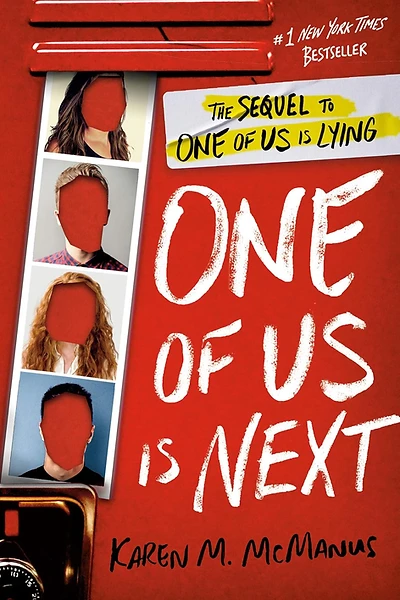
 9-12
9-12YA ONE US
One of Us Is Next
by Karen M. McManus
Pacing MaterialAfter a mysterious game of truth or dare terrorizes Bayview High, a new group of students is forced to navigate life-threatening challenges. The sequel explores how digital anonymity fuels social cruelty and the high cost of seeking justice in a digital age.
Big Idea
Digital platforms can amplify social toxicity, requiring individuals to be intentional about their role in online discourse.
Discussion Questions
- 1.How does the 'Phantom' app differ in its psychological impact from the original 'About That' app?
- 2.What is the moral responsibility of a bystander when they see bullying happen online?
- 3.Does the pursuit of justice justify the use of risky or unethical methods?
- 4.How does the trauma from the first book influence the survivors' reactions to the new game?
- 5.How can schools foster a culture that discourages participation in anonymous gossip platforms?
Classroom Activity
The Digital Ethics Simulation
Students simulate an anonymous messaging thread to examine the ethics of information sharing and the ripple effects of online rumors.
Lesson Plan
Learning Goals
- Understand the consequences of digital vigilantism.
- Assess the ethical implications of anonymous communication.
- Discuss the role of empathy in digital interaction.
Activity Steps
- 1.Form small groups to represent different stakeholders in a school scandal.
- 2.Provide a scenario involving a hypothetical anonymous social media post.
- 3.Require each group to draft a response strategy based on school and personal ethics.
- 4.Discuss as a class how information evolves or changes as it is shared.
- 5.Reflect on how personal values should guide behavior in digital spaces.
Standards Connections
- CCSS.ELA-LITERACY.SL.9-10.1 (Engage effectively in collaborative discussions)
- CASEL Relationship Skills (Resolving conflict constructively)
- Media Literacy Education (Critical analysis of digital media content)
Pace-Write-Read Study with Pace-Write It!
Focus question: How does an unexpected message change the pace of a mystery? In this sequel, a new anonymous Truth or Dare game reaches students at Bayview High. Phoebe, Maeve, and Knox become central to the story. McManus shifts among their perspectives, letting readers learn something in one chapter while waiting to see how another character will respond. This study uses chapters students have already read and avoids revealing the solution.
| Element | How to notice or teach it in the novel |
|---|---|
| Pace, plot & concept | Track the pattern of a message arriving, a character responding, and a new question emerging. Notice where that pattern changes. Classroom Activity: Draw a three-stage pacing map: message → response → consequence. Label each stage fast or slow. |
| Voice, worldview, point of view & original characters | Compare what Phoebe, Maeve, and Knox notice first. Which concerns make their accounts sound distinct? Classroom Activity: Describe a misplaced school banner from three viewpoints. Give each narrator a different reason to care. |
| Setting, place, details & descriptions | Notice how school and other familiar places feel different when characters expect another message. Identify details that affect the scene's mood. Classroom Activity: Describe a familiar hallway before and after a surprising but harmless announcement. Change only three details. |
| Strong first lines, immediacy & engagement | Look at a narrator's first chapter. What does its opening make you want to know? Classroom Activity: Draft two openings: one begins with a message; one begins just before it arrives. Compare their pace. |
| Dialogue, personality & humor | Compare what a character says to friends with what they think privately. Notice whether a lighter exchange gives readers a pause. Classroom Activity: Write a brief conversation in which two students interpret the same ordinary message differently. |
| Story scenes, summaries & unique structures | Find a closely narrated conversation and a passage that covers a longer period quickly. Why does McManus spend more words on one? Classroom Activity: Expand a two-sentence summary into a short scene, stopping at the moment a character must decide what to say. |
| Flashback, flash forward & cliffhangers | Note when earlier events at Bayview shape a character's present reaction. A reference to the past is different from a full flashback; a prediction is different from a flash forward. Classroom Activity: Add a two-sentence memory to an original scene. End the scene with an unanswered question. |
| Tension, suspense, surprise, page turns & chapter breaks | Mark where a chapter ends before a response or explanation. What does the next viewpoint add—and what does it still withhold? Classroom Activity: Try two endings for the same harmless mystery scene. Ask a partner which creates a stronger page turn. |
| Prosody, word pause, performance, rhythm & punctuation | Read a short exchange aloud. Compare the pace of message text, dialogue, and a narrator's thoughts. Notice where punctuation asks you to pause. Classroom Activity: Write an original 60-word exchange. Revise its sentence lengths and punctuation to make it sound more urgent, then read both versions aloud. |
| Poetry, poetic devices & repetition | This is a prose mystery. Look for repeated phrases, images, or questions that gain meaning as the story develops. Classroom Activity: Repeat one ordinary phrase in three short scenes, changing its meaning each time. |
| Questions, compare–contrast & threes | After three viewpoint chapters, list one question each narrator answers and one each leaves open. Compare their accounts with confirmed facts. Classroom Activity: Write a three-step reveal: first impression → second viewpoint → overlooked fact. |
| Objects | Follow a phone, message, or other object through a scene. Separate what the object actually shows from what characters assume it means. Classroom Activity: Introduce an ordinary object as a possible clue; later give it a simple, surprising explanation. |
| Whitespace, negative space, art & graphics | Inspect the edition in hand for message formatting, paragraph breaks, and chapter headings. Explain how the visible layout affects your reading speed. Classroom Activity: Set the same original information as a paragraph and as a short message exchange. Compare what readers notice first. |
| Interactives & gamification | The book's game structure is a subject for analysis. For class, use an evidence-sorting activity rather than having students direct personal questions or dares at one another. Classroom Activity: Sort cards into confirmed fact, character claim, and reader inference. Move a card only when a later chapter supplies evidence. |
Pace-Write It!
Exit ticket: Choose a chapter in which new information arrives. Complete: "I read faster/slower after ______ because McManus used ______. The next viewpoint changed my understanding by ______."