 9-12
9-12YA ONE US
One of Us Is Lying
by Karen M. McManus
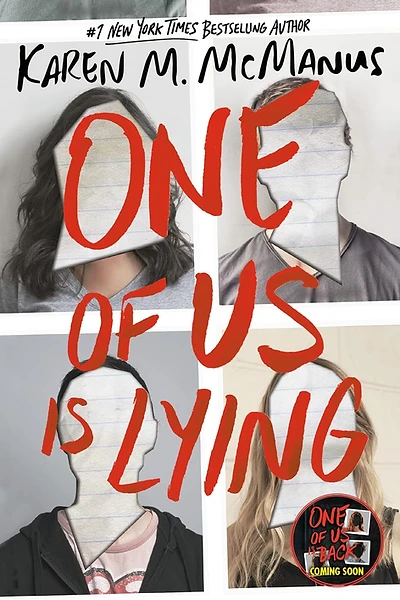
Pacing MaterialWhen five students enter detention, only four leave alive after the school's social outcast dies from a fatal allergic reaction. As investigators scrutinize the survivors, their carefully curated high school personas begin to crack under the weight of dark secrets.
Big Idea
Labels and reputations are often destructive oversimplifications of complex human identities.
Discussion Questions
- 1.How do the initial labels assigned to the characters shape our perception of their potential guilt?
- 2.To what extent is Simon's creation of the 'About That' app a reflection of modern social media culture?
- 3.How does the pressure to maintain a 'perfect' reputation drive the characters' decision-making?
- 4.In what ways does the mystery genre highlight the unreliability of first impressions?
- 5.Is it ever possible to fully outgrow or escape the stereotypes placed upon us by our peers?
Classroom Activity
The Stereotype Deconstruction Project
Students analyze the intersection between outward appearances and hidden truths by creating dual-sided identity profiles for each character.
Lesson Plan
Learning Goals
- Identify the impact of stereotyping on individual identity.
- Analyze character development through narrative point of view.
- Evaluate how external pressures influence internal moral conflicts.
Activity Steps
- 1.Create a profile template with an 'Outer Image' side and 'Inner Truth' side.
- 2.Assign one of the five characters to each student group.
- 3.Identify specific moments in the text that reveal a secret contradicting a character's stereotype.
- 4.Fill in both sides of the profile using direct text evidence.
- 5.Present how the character's 'Inner Truth' affects their behavior during the investigation.
Standards Connections
- CCSS.ELA-LITERACY.RL.9-10.3 (Analyze complex character development)
- CASEL Self-Awareness (Identifying personal and social biases)
- ISTE Digital Citizen (Understanding how digital footprint shapes reputation)
Pace-Write-Read Study with Pace-Write It!
Focus question: How does changing narrators change what readers believe? The novel begins with five students in detention at Bayview High. After one student dies, the other four—Bronwyn, Addy, Cooper, and Nate—become the focus of a mystery. They take turns narrating, so readers must keep revising what they think they know. This study stays spoiler-light and works with chapters students have already read.
| Element | How to notice or teach it in the novel |
|---|---|
| Pace, plot & concept | Track how a new clue changes the central question. Separate what happened from what characters think happened. Classroom Activity: Make a "known / suspected / unanswered" chart after a chapter. |
| Voice, worldview, point of view & original characters | Compare what Bronwyn, Addy, Cooper, and Nate notice, worry about, and choose to share. How does each voice affect your trust? Classroom Activity: Describe a missing class trophy from two students' viewpoints. Give each a different concern and vocabulary. |
| Setting, place, details & descriptions | Notice how detention, school spaces, and public attention affect what characters can say or do. Which details feel like possible clues? Classroom Activity: Describe a familiar room with three details. Make only one detail significant later. |
| Strong first lines, immediacy & engagement | Examine the first chapter's opening. What attitude and unanswered question draw you in? Classroom Activity: Write two openings for the trophy mystery: one with a surprising observation, one with a character already in motion. |
| Dialogue, personality & humor | Notice how characters present themselves in conversation compared with what they privately think. Look for moments of humor that briefly ease the tension. Classroom Activity: Write eight lines of dialogue. Let one speaker misunderstand an ordinary detail without explaining the misunderstanding to the reader. |
| Story scenes, summaries & unique structures | Find a scene told closely, then a passage that moves through time more quickly. Consider why McManus gives one event more space. Classroom Activity: Turn a three-sentence summary of a school day into a one-minute scene. Keep only details that affect the mystery. |
| Flashback, flash forward & cliffhangers | Identify when a narrator reveals something from before detention. Distinguish a memory from a true flash forward. What question remains at a chapter ending? Classroom Activity: End a scene just after a harmless discovery. Start the next scene in another narrator's viewpoint. |
| Tension, suspense, surprise, page turns & chapter breaks | Keep track of information a narrator knows, a different narrator knows, and the reader knows. Notice how a switch delays an answer. Classroom Activity: Move a scene break to three different places. Ask a partner which placement most encourages a page turn and why. |
| Prosody, word pause, performance, pause & rhythm | Read a short exchange aloud. Notice where brief sentences, paragraph breaks, and unanswered questions make you speed up or stop. Classroom Activity: Revise an original paragraph twice: once for urgency, once for hesitation. Read both aloud. |
| Poetry, poetic devices, repetition & punctuation | The book is prose. Look for repeated words, images, or patterns of phrasing and ask how punctuation sharpens a moment; do not assume it uses verse techniques throughout. Classroom Activity: Repeat one ordinary phrase in three scenes, changing what it means each time. |
| Questions, compare–contrast & threes | Write down three questions a chapter raises. Compare two narrators' interpretations of one event, then add a third piece of evidence. Classroom Activity: Build a three-step reveal: first impression → conflicting account → new clue. |
| Objects | Track an object or message mentioned in a chapter. Is its importance confirmed, or are characters and readers guessing? Classroom Activity: Place one ordinary object in an opening scene. Give it a new meaning later without changing the object itself. |
| Whitespace, negative space, art & graphics | Inspect the edition being read. Notice paragraph and chapter breaks, plus any text or message formatting that appears. Use the actual page as evidence for claims about its design. Classroom Activity: Format the same original exchange as a dense paragraph and as separated messages. Compare the pace. |
| Interactives & gamification | Use a clue tracker to test interpretations while reading. Classroom Activity: In groups, sort evidence cards into fact, character claim, and inference. Allow students to move a card when a later chapter changes their reasoning. |
Pace-Write It!
Exit ticket: Choose a change of narrator. Write: "Before the switch, I thought ____. After hearing ____, I now think ____ because ____." Then identify one sentence, detail, or chapter break that caused the shift. Teaching note: The novel includes a student death and serious themes. A pacing lesson can use early, selected passages and the fictional trophy mystery for writing practice without asking students to reenact the book's events.