 9-12
9-12YA ONE US
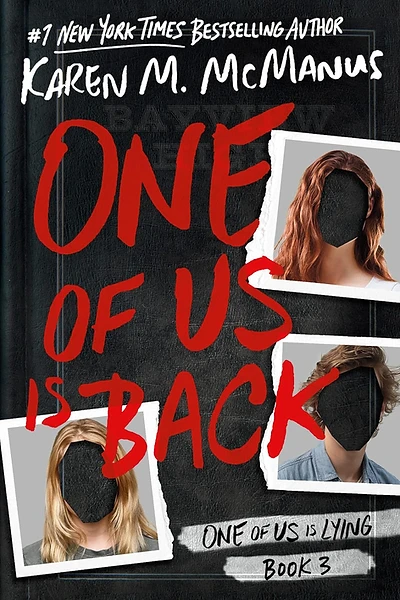
One of Us Is Back
by Karen M. McManus
Pacing MaterialAs the Bayview saga reaches its conclusion, the lingering trauma of past events resurfaces when a new mystery entangles the protagonists. The narrative focuses on the difficulty of healing while secrets from the past continue to influence the present.
Big Idea
True resolution requires the courage to acknowledge past trauma and prioritize honesty over preservation of secrets.
Discussion Questions
- 1.How does the passage of time affect the way the characters view the initial events at Bayview?
- 2.Why is it difficult for characters to move on from traumatic experiences while living in the same environment?
- 3.How does the concept of 'loyalty' manifest in both healthy and toxic ways throughout the book?
- 4.What role does 'speaking truth to power' play in ending the cycle of mystery and violence?
- 5.How does the author use the setting of Bayview High as a character in itself?
Classroom Activity
The Trauma and Recovery Timeline
Students map the emotional trajectory of the characters across the trilogy, focusing on moments of closure versus moments of regression.
Lesson Plan
Learning Goals
- Map narrative arcs against character emotional growth.
- Examine how trauma serves as a catalyst for behavioral changes.
- Reflect on themes of resilience and long-term recovery.
Activity Steps
- 1.Draw a timeline representing the events spanning the three books.
- 2.Mark major events that caused character trauma.
- 3.Label each event with the characters' reactions and subsequent coping mechanisms.
- 4.Use color coding to distinguish between 'helpful' and 'harmful' recovery strategies.
- 5.Discuss how the characters finally achieve closure or personal growth by the end of the book.
Standards Connections
- CCSS.ELA-LITERACY.RL.9-10.2 (Determine a theme and analyze its development)
- CASEL Responsible Decision-Making (Evaluating consequences of long-term choices)
- Psychology/Health Standard (Understanding the impact of trauma on development)
Pace-Write-Read Study with Pace-Write It!
Focus question: How does a mystery move forward when clues from the present point back to the past? The Bayview group returns in the trilogy's final book. A mysterious billboard signals another mystery, while the story moves among present-day narrators Addy, Nate, and Phoebe and selected chapters set earlier. That structure lets McManus raise a question in one time period and change its meaning in another. This study stays spoiler-light.
| Element | How to notice or teach it in the novel |
|---|---|
| Pace, plot & concept | Chart when a present-day clue raises a question about the past. Notice whether the next chapter answers it or adds another question. Classroom Activity: Make a two-column timeline labeled Then and Now. Draw arrows where information connects the timelines. |
| Voice, worldview, point of view & original characters | Compare how Addy, Nate, and Phoebe respond to the same development. What does each notice first, and what prior experience shapes that response? Classroom Activity: Tell the story of a misplaced class photograph from three viewpoints. Give each narrator a different reason to value it. |
| Setting, place, details & descriptions | Notice how returning to Bayview changes the meaning of familiar places. Which small details suggest that a character remembers something others do not? Classroom Activity: Describe a familiar room twice: once during an ordinary visit and once after learning a surprising fact about it. |
| Strong first lines, immediacy & engagement | Examine the opening of a present-day chapter and an earlier-set chapter. What question does each create in its first paragraph? Classroom Activity: Write two openings for the same harmless mystery: one begins now; the other begins years earlier. |
| Dialogue, personality & humor | Compare a character's spoken response with their private thoughts. Look for brief, lighter exchanges that let readers pause. Classroom Activity: Write six lines of dialogue in which friends remember the same event differently. |
| Story scenes, summaries & unique structures | Mark a scene shown moment by moment and a passage that quickly bridges time. Ask why the earlier-set chapters appear where they do. Classroom Activity: Summarize a discovery in two sentences, then expand its most important moment into a short scene. |
| Flashback, flash forward & cliffhangers | The chapters set in the past provide a strong example of shifting timelines. Track what they reveal when the reader receives them. Check the text for an actual jump ahead before labeling anything a flash forward. Classroom Activity: End a present-day scene with a question. Follow it with a past scene that gives a partial answer. |
| Tension, suspense, surprise, page turns & chapter breaks | Note where McManus switches narrator or time period before resolving a question. Does the switch delay an answer or make you reconsider a clue? Classroom Activity: Place a chapter break at two points in an original scene. Ask a partner which creates the stronger reason to keep reading. |
| Prosody, word pause, performance, rhythm & punctuation | Read a short passage aloud. Listen for changes in sentence length and places where punctuation or a paragraph break makes you stop. Classroom Activity: Revise an original paragraph into a fast version and a reflective version. Read both aloud. |
| Poetry, poetic devices & repetition | This is prose fiction. Look for recurring words, images, or ideas whose meanings shift between then and now. Classroom Activity: Repeat one image in a past scene and a present scene, changing what it suggests. |
| Questions, compare–contrast & threes | Across three consecutive chapters, record one fact learned, one assumption challenged, and one question remaining. Classroom Activity: Build a three-step reveal: old memory → present clue → revised understanding. |
| Objects | Follow a physical object or message mentioned in a selected chapter. Distinguish what it proves from what a character assumes. Classroom Activity: Give a harmless object two possible explanations. Reveal evidence for one explanation later. |
| Whitespace, negative space, art & graphics | Inspect the edition in hand for timeline labels, chapter headings, paragraph breaks, and any message formatting. Describe only design features you can see. Classroom Activity: Format the same original clue as a paragraph and as a brief message. Compare what catches the reader's eye first. |
| Interactives & gamification | Use the novel's mystery structure for evidence analysis. Classroom Activity: Sort teacher-prepared clue cards into past, present, confirmed, and inferred. Explain each choice using a chapter already read. |
Pace-Write It!
Exit ticket: Choose one move between then and now. Explain: What question did you have before the switch? What information did the new chapter supply? How did the switch change your reading pace?