 2-5
2-5R KIRKFIELD
One Girl's Voice
by Vivian Kirkfield, Illustrated by Rebecca Gibbon
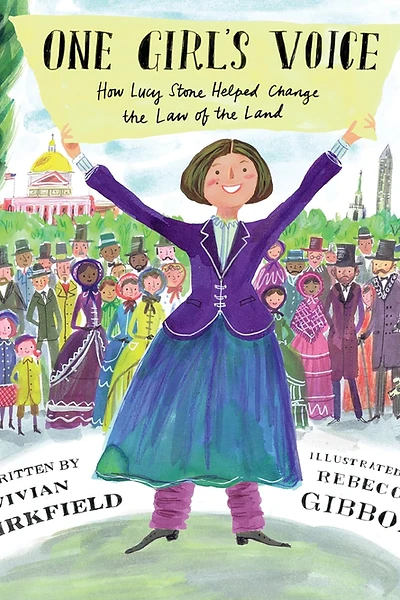
Pacing MaterialOne Girl's Voice follows Lucy Stone from a childhood in which girls were discouraged from speaking publicly to her work for women's rights and the abolition of slavery. Kirkfield selects turning points from Lucy's life; Gibbon's illustrations help readers picture the people and places around her.
Big Idea
One person's voice, raised with determination, can break through barriers of silence and change the world.
Discussion Questions
- 1.Lucy Stone grew up in a time when girls were discouraged from speaking publicly. What details in the opening pages help you understand the limits she faced?
- 2.Kirkfield selects specific turning points from Lucy's long life. Which turning point receives the most space, and why do you think the author chose to linger there?
- 3.How can you tell the difference between the biographer's narration and Lucy's own words? Why does that distinction matter in a biography?
- 4.Lucy worked for both women's rights and the abolition of slavery. How did those two causes connect in her life?
- 5.Gibbon's illustrations show both quiet moments with one figure and crowded public scenes. How does the shift between these two types of images affect the way you read the story?
- 6.The title is "One Girl's Voice." At what point in the story does Lucy's voice become powerful enough to change minds? What had to happen first?
Classroom Activity
Turning Points: Mapping Lucy Stone's Voice
Students create a visual biography map tracing Lucy Stone's journey from a child who was told to be quiet to a public advocate, identifying the barriers she faced, the actions she took, and the effects of her choices at each turning point.
Lesson Plan
Learning Goals
- Identify five key turning points in Lucy Stone's life and place them in chronological order.
- Distinguish between the biographer's narration and words attributed to Lucy herself.
- Explain how Lucy's actions at each turning point reveal her beliefs about women's rights and abolition.
- Connect the visual choices in Gibbon's illustrations (crowds vs. single figures) to the story's emotional pacing.
Activity Steps
- 1.Read the book aloud, pausing at each turning point. Record each turning point on the board: restriction, determination, learning, speaking, change.
- 2.Distribute the five-box biography map template. Students label each box with one turning point and note what barrier Lucy faced and what action she took.
- 3.In pairs, students examine one illustration that shows a single figure and one that shows a crowd. They discuss how the visual choice affects attention and pace.
- 4.Each student completes a three-part chart for one turning point: barrier / action / effect, using the book or its timeline to verify facts.
- 5.Students draft an imagined journal entry from Lucy's perspective at one documented turning point, labeling it as creative writing rather than Lucy's actual words.
- 6.Partners share their biography maps and discuss which turning point they think was the most important and why.
- 7.Close by reading the exit ticket prompt together and discussing what it means for one voice to grow in power.
Standards Connections
- ELA: RI.2-5.1 — Ask and answer questions to demonstrate understanding of key details in a text.
- ELA: RI.2-5.3 — Describe the relationship between a series of historical events in a text.
- ELA: RI.2-5.6 — Distinguish their own point of view from that of the author of a text.
- Social Studies: C3 Framework D2.His.2.3-5 — Compare life in the past to life today.
- Social Studies: C3 Framework D2.Civ.10.3-5 — Identify the origins of core democratic values in United States history.
- SEL: Self-awareness and social awareness — recognizing the power of one voice to create change.
Pace-Write-Read Study with Pace-Write It!
Focus question: How does a picture-book biography make readers feel the growing power of one person's voice? One Girl's Voice follows Lucy Stone from a childhood in which girls were discouraged from speaking publicly to her work for women's rights and the abolition of slavery. Kirkfield selects turning points from Lucy's life; Gibbon's illustrations help readers picture the people and places around her.
| Element | How to notice or teach it in the novel |
|---|---|
| Pace, plot & concept | Read: Track restriction → determination → learning → speaking → change. Which turning point receives the most space? Classroom Activity: Make a five-box biography map. Label where the pace speeds up or slows down. |
| Prosody, word pause & performance | Read: Read a selected page aloud. Pause where Lucy must make a choice, then consider whether the pause helps listeners understand its weight. Classroom Activity: Write three original sentences about someone preparing to speak. Mark pauses for a read-aloud. |
| Voice, worldview & point of view | Read: Distinguish Kirkfield's narration from any historical words attributed to Lucy. What do Lucy's documented actions tell us about her beliefs? Classroom Activity: Write a third-person account of a researched person's decision. Keep facts separate from imagined thoughts. |
| Setting, place, details & descriptions | Read: Find clues in the words and illustrations that place Lucy in the nineteenth century. Which details help explain the limits she faced? Classroom Activity: Describe one historical setting using two details checked against a source. |
| Original characters, personality & dialogue | Read: Lucy is a real person. Identify an action that reveals her persistence. Treat words presented as her own differently from invented dialogue. Classroom Activity: Show a fictional character's determination through an action and a brief exchange. |
| Strong first lines, immediacy & engagement | Read: Examine the opening spread. How quickly does it establish the problem of whose voices were heard? Classroom Activity: Draft two openings for a biography: one starts with a question; one with a meaningful action. |
| Story scenes, summaries & unique structures | Read: The book covers many years in few pages. Find a closely shown event and a passage that moves quickly across time. Consult the timeline for dates the main story passes over. Classroom Activity: Summarize five years in one sentence, then expand one documented turning point into a short scene without inventing speech. |
| Flashback, flash forward & cliffhangers | Read: Check whether the main story changes time periods or proceeds chronologically. A timeline in the back matter is a reference tool, not necessarily a flash forward in the narrative. Classroom Activity: End an original page just before a decision; let the next page reveal the choice. |
| Tension, suspense, surprise & page turns | Read: Even though readers may know Lucy became an advocate, they can still wonder how she will respond to each obstacle. Classroom Activity: Write a two-page sequence: challenge before the turn; response after it. |
| Pause, poetry, poetic devices, repetition, rhythm & punctuation | Read: Listen for repeated ideas about speaking and being heard. Notice whether short sentences or punctuation give a statement extra weight. Classroom Activity: Write four original lines about finding a voice. Repeat one key word and vary the line lengths. |
| Questions, compare–contrast & threes | Read: Compare Lucy at three stages: child, student, public advocate. What changes in what she can do? Classroom Activity: Complete a three-part chart: barrier / action / effect. |
| Objects | Read: Choose an item visible in an illustration—such as a book, paper, or sign. What does it help communicate? Verify its historical role before claiming it was Lucy's own. Classroom Activity: Sketch an object for a biography page and write a factual caption. |
| Whitespace, negative space, art & graphics | Read: Look at where Gibbon gives a figure room on the page and where a crowd fills the scene. How does that affect attention and pace? Examine any reproduced words or documents in your copy. Classroom Activity: Make two layouts for one original sentence: a quiet page focused on one person and a busy public scene. |
| Humor & emotional contrast | Read: If a spread includes a lighter detail, ask how it affects the mood. Use the page as evidence rather than assuming every biography needs humor. Classroom Activity: Add a moment of warmth to an original story about practicing a presentation. |
| Interactives & gamification | Read: Turn close reading into a search for supported evidence. Classroom Activity: Sort event cards into what happened, what Lucy did, and what changed. Use the book or its timeline to check the order. |
Pace-Write It!
20-minute workshop: 1. Read (5 min) — Read selected spreads aloud. Students listen for changes in speed and moments that call for a pause. 2. Notice (5 min) — Partners identify one page turn, one strong visual choice, and one turning point in Lucy's life. 3. Write (7 min) — Students create two pages about a documented person or an original fictional character finding a way to make an idea heard. 4. Share (3 min) — Partners read aloud and explain where they want listeners to pause. Exit ticket: "Kirkfield slows the story when ______. Gibbon's illustration draws my attention to ______. Together, these choices show ______."