 4-7
4-7GN WILLIAMS-GARCIA
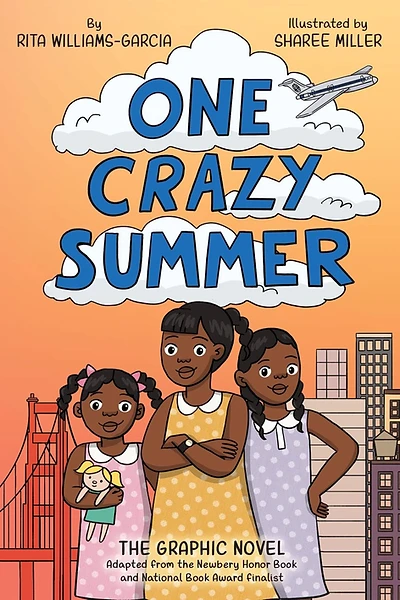
One Crazy Summer: The Graphic Novel
by Rita Williams-Garcia
Pacing MaterialIn 1968, three sisters travel from Brooklyn to Oakland to spend the summer with the mother who abandoned them, discovering the Black Panther movement and their own family history along the way.
Big Idea
Understanding where we come from helps us understand who we are — even when the truth is complicated.
Discussion Questions
- 1.How do the sisters' expectations of their mother differ from reality?
- 2.What do the girls learn about the Black Panther Party during their summer?
- 3.How does the setting of 1968 Oakland shape the story?
- 4.What does it mean to be a family?
Classroom Activity
1968 History Research Project
Students research a key event or movement from 1968 and create a presentation connecting it to the story.
Lesson Plan
Learning Goals
- Understand the historical context of the Civil Rights Movement and Black Panther Party
- Analyze how setting and time period shape a story
- Examine the theme of family identity and belonging
- Develop research and presentation skills
Activity Steps
- 1.Discuss the historical setting of 1968 Oakland, California
- 2.Introduce key topics: Civil Rights, Black Panther Party, Vietnam War
- 3.Have students research one topic and create a presentation
- 4.Students present and connect their research to events in the book
- 5.Reflect on how understanding history helps us understand the characters
Standards Connections
- ELA: RL.4.1 — Ask and answer questions about key details
- ELA: RL.4.2 — Retell stories, including key details
- ELA: RL.4.3 — Describe characters, setting, and events
- ELA: RL.7.6 — Acknowledge differences in characters' points of view
- ELA: SL.4.1 — Participate in collaborative conversations about the text
- ELA: W.4.3 — Write narratives recounting events with descriptive details
- SEL: Relationship Skills
- SEL: Social Awareness
- Art: VA:Re7 — Perceive and analyze artistic work
Pace-Write-Read Study with Pace-Write It!
Focus question: How does pacing help readers feel the sisters’ changing emotions as they move through a summer of surprise, conflict, and belonging? In One Crazy Summer: The Graphic Novel by Rita Williams-Garcia, three sisters—Delphine, Vonetta, and Fern—travel to Oakland in 1968 and slowly uncover truths about their mother, their family, and themselves. The graphic novel uses quick dialogue, expressive illustrations, scene changes, and carefully timed pauses to speed up tense moments and slow down emotional discoveries.
| Element | How to notice or teach it in the novel |
|---|---|
| Pace | Read: Notice how the story moves quickly during the sisters’ arrival in Oakland and their first confusing encounters with Cecile, then slows during reflective moments when Delphine thinks about family and belonging. Classroom Activity: Write two short paragraphs about arriving in an unfamiliar place—one fast-paced with short sentences and one slower-paced with reflection. |
| Plot | Read: Track how the plot builds from the girls’ trip from Brooklyn to Oakland, to their disappointment with Cecile, to their growing understanding of the Black Panther community and their family history. Classroom Activity: Create a 5-step plot ladder and then write a new mini-scene that could fit between two major plot events. |
| Prosody | Read: Listen to how dialogue sounds different for Delphine, Vonetta, Fern, and Cecile, and how the rhythm of their speech helps set the mood of each scene. Classroom Activity: Write a short exchange between siblings in which each speaker has a distinct speaking rhythm. |
| Word pause | Read: Notice moments when a single word, reaction, or brief line lands with extra force, especially when the sisters are stunned by Cecile’s coldness or by what they learn in Oakland. Classroom Activity: Write a 6-8 line scene and use one single-word line to create an emotional pause. |
| Concept | Read: Think about the big idea that family belonging is not simple; the book explores identity, abandonment, community, and pride through the sisters’ summer experiences. Classroom Activity: Write a paragraph explaining how a summer experience can change the way a character understands home. |
| Voice & World View | Read: Notice how Delphine’s voice shows responsibility, caution, and protectiveness, shaping how readers understand Cecile, Vonetta, Fern, and the Black Panther movement. Classroom Activity: Rewrite one family scene from Fern’s point of view to show a different worldview. |
| Setting & Place | Read: Study how Oakland in 1968 feels different from Brooklyn, with community centers, rallies, neighborhood streets, and Cecile’s kitchen all shaping the story’s mood. Classroom Activity: Write a setting paragraph about a neighborhood that feels unfamiliar at first but becomes meaningful over time. |
| Point of View | Read: Notice how the story stays close to Delphine, so readers experience confusion, frustration, and new understanding as she does. Classroom Activity: Write a scene in first person from the perspective of a child trying to make sense of an adult’s choices. |
| Original Characters | Read: Look at how Delphine, Vonetta, Fern, and Cecile each feel original because of their specific habits, reactions, and relationships, rather than fitting simple roles. Classroom Activity: Invent a family character with one contradiction, such as seeming tough but acting secretly caring, and write a short character sketch. |
| Dialogue | Read: Notice how dialogue reveals tension between the sisters and Cecile, and how sibling talk adds humor, conflict, and affection. Classroom Activity: Write a dialogue-only scene between siblings who disagree about whether to trust an adult. |
| Details | Read: Pay attention to meaningful details—food, clothing, household spaces, Panther breakfasts, and neighborhood sights—that root the story in 1968 and make emotions feel real. Classroom Activity: Write a scene using five concrete details to show a time period without directly naming the year. |
| Descriptions | Read: Notice how descriptions in words and pictures help readers feel the heat, discomfort, confusion, and energy of the sisters’ Oakland summer. Classroom Activity: Describe a room where a character feels unwelcome, using sensory details and emotional hints. |
| Strong First Lines | Read: Study how opening moments quickly establish curiosity and emotional stakes by placing the sisters in a situation full of expectation and uncertainty. Classroom Activity: Write three possible opening lines for a story about meeting a family member who feels like a stranger. |
| Immediacy & Engagement | Read: Notice how the graphic novel format pulls readers into each moment through facial expressions, panel sequence, and crisp dialogue, making Delphine’s reactions feel immediate. Classroom Activity: Write a scene that begins in the middle of action, with no explanation in the first three lines. |
| Story Scenes & Summaries & Unique Structures | Read: Observe how some parts unfold as full scenes, like tense family interactions, while other parts move more quickly through summary to carry readers across the summer. Classroom Activity: Write one detailed scene and then a three-sentence summary of the next few days. |
| Flashback & Flash Forward & Cliffhangers | Read: Notice how memories and withheld family information shape the sisters’ understanding of Cecile, and how chapter endings can leave readers wanting answers. Classroom Activity: End a short scene with a cliffhanger after a character learns one surprising fact about a parent. |
| Tension & Suspense & Surprise | Read: Track the tension created by Cecile’s distance, the unfamiliar city, and the girls’ uncertainty about what adults are hiding, along with surprises about family and community. Classroom Activity: Write a scene in which a child expects rejection but receives an unexpected response. |
| Page Turns and Chapter Breaks | Read: Notice where page turns and chapter breaks come after sharp dialogue, emotional reactions, or new discoveries, increasing suspense and momentum. Classroom Activity: Draft a one-page scene and mark the best place for a page turn that would make readers keep going. |
| Performance | Read: Think about how characters perform versions of themselves—Delphine as the responsible sister, Cecile as guarded and distant, and the sisters as brave even when uncertain. Classroom Activity: Write a monologue for a character who acts strong in public but reveals worry in private. |
| Personality | Read: Notice how Vonetta’s boldness, Fern’s sensitivity, Delphine’s maturity, and Cecile’s guarded nature affect the speed and emotional tone of scenes. Classroom Activity: Write four one-sentence reactions to the same event, each from a different personality type. |
| Humor | Read: Look for moments when sibling banter, misunderstandings, or sharp observations lighten the story even during painful situations. Classroom Activity: Write a serious family scene that includes one moment of believable humor to reveal character. |
| Pause | Read: Notice when the story pauses after a hard comment, a new realization, or a meaningful look, allowing readers to sit with Delphine’s feelings. Classroom Activity: Revise a short scene by adding one pause after an important line and explain its effect. |
| Poetry and Poetic Devices | Read: Pay attention to how Cecile’s identity as a poet connects language, image, and emotion, and how poetic moments deepen themes of expression and selfhood. Classroom Activity: Write a free-verse poem from Delphine to Cecile using at least one image from summer in Oakland. |
| Repetition | Read: Notice repeated ideas about mothers, belonging, rules, and responsibility, and how repetition strengthens the emotional core of the story. Classroom Activity: Write a paragraph that repeats a key phrase three times, each time with a slightly different meaning. |
| Rhythm | Read: Feel how the rhythm shifts between busy sibling scenes, tense silences with Cecile, and reflective moments about identity and family. Classroom Activity: Write a scene that begins with quick, choppy sentences and ends with longer, calmer ones. |
| Punctuation | Read: Notice how dashes, ellipses, question marks, and exclamation points shape tone in dialogue, especially in scenes of confusion, irritation, or surprise. Classroom Activity: Write the same two-line exchange twice, changing only punctuation to create two different moods. |
| Questions | Read: Track the many questions Delphine carries about Cecile, why she left, and what the sisters mean to her, and how those questions drive the pacing. Classroom Activity: Write a list of five questions a character has about a family member, then build a short scene around one of them. |
| Compare-Contrast | Read: Compare Brooklyn and Oakland, Big Ma and Cecile, and what the girls expect from their mother versus what they actually find. Classroom Activity: Write a compare-contrast paragraph about two adults in a child’s life who show care in very different ways. |
| Objects | Read: Notice how everyday objects—kitchen items, clothing, printed materials, and community supplies—help reveal character, setting, and historical moment. Classroom Activity: Choose one object a child carries into a new place and write how it shows both fear and hope. |
| Threes | Read: Think about how the three sisters create a natural pattern in scenes, with their different responses building rhythm, humor, and layered understanding. Classroom Activity: Write a scene with three characters reacting one after another to the same surprising news. |
| Whitespace & Negative Space | Read: In the graphic novel format, notice how silent panels, spacing, and visual gaps can emphasize loneliness, hesitation, or emotional distance, especially in scenes with Cecile. Classroom Activity: Plan a comic-style page with one silent panel that shows a character’s feelings without words. |
| Art & Graphics | Read: Study how illustrations show facial expressions, body language, clothing, and setting details that deepen the sisters’ emotions and the historical world of Oakland in 1968. Classroom Activity: Sketch or describe a 4-panel sequence showing a character’s feelings changing from hope to disappointment to understanding. |
| Interactives & Gamification | Read: Notice how readers can almost ‘play detective’ by using both words and images to infer hidden feelings, family tension, and the meaning of community events. Classroom Activity: Create a clue hunt chart with three visual clues and three dialogue clues that reveal how a character truly feels about home. |
Pace-Write It!
20-Minute Classroom Flow\nRead (5 min): Read a short excerpt showing the sisters arriving in Oakland or interacting tensely with Cecile. Ask students to notice where the story speeds up with dialogue and where it slows down with reactions, silence, or images.\nNotice (5 min): Students underline one fast-paced moment and circle one slow, meaningful pause. Discuss: How do Delphine’s thoughts, the sisters’ dialogue, and the graphic panels help us feel confusion, disappointment, or belonging?\nWrite (7 min): Students write their own short scene about arriving somewhere unfamiliar and meeting someone important. Writing frame: “When I arrived at _____, I expected _____. But when I saw/heard _____, everything changed. At first, I _____. Then I noticed _____. I wanted to ask _____, but instead I _____. In that moment, I began to understand _____.” Challenge students to include one quick dialogue line, one descriptive pause, and one final sentence that hints at a bigger family or identity question.\nShare (3 min): Partners read their scenes aloud and identify one place where the pacing moved quickly and one place where the pause made the emotion stronger.\nExit ticket: In one or two sentences, explain how slowing down a moment can help readers understand a character’s feelings.