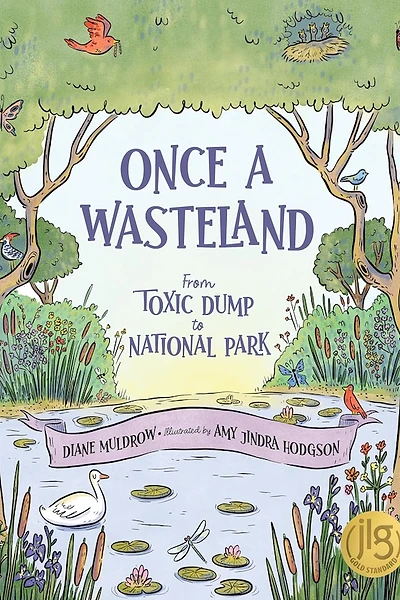
 2-5
2-5R MULDROW
Once a Wasteland: From Toxic Dump to National Park
by Diane Muldrow
Pacing MaterialThe true story of how a toxic wasteland was cleaned up and transformed into a thriving national park, proving that people can heal the land.
Big Idea
Even the most damaged places can be restored, and people have the power to heal the earth.
Discussion Questions
- 1.How did the land become a wasteland?
- 2.What did people do to restore it?
- 3.Why is cleanup hard?
- 4.How long can restoration take?
- 5.What place near you could be restored?
Classroom Activity
Restoration Plan
Choose a damaged place and write a three-step plan to restore it. Illustrate the before and after.
Lesson Plan
Learning Goals
- Identify how the damaged land changed from a toxic dump into a thriving national park in Once a Wasteland.
- Use details from the book to explain how people's actions helped restore the land.
- Write a three-step restoration plan for a damaged place, putting actions in a logical order.
- Create labeled before-and-after illustrations showing how restoration can help plants, animals, and people.
Activity Steps
- 1.Read Once a Wasteland aloud. Pause to discuss: What damaged this place? What did people do to help? What evidence shows that the land recovered? Record students' answers using details from the book.
- 2.Create a class chart with three headings: Damage, Actions Taken, and Signs of Recovery. Add examples from the story and discuss why restoring land takes planning, teamwork, and time.
- 3.Invite each student to choose a real or imagined damaged place, such as a littered playground, polluted stream, or empty lot with little plant life. Have students draw and label its current condition.
- 4.Model a three-step restoration plan using First, Next, and Finally. Students write their own plans, identifying who could help and how each action would improve the place. Explain that toxic waste and unknown substances must be handled by trained professionals, not children.
- 5.Have students draw and label an after illustration showing the expected results of their plans. Encourage them to include healthier soil or water, suitable plants, wildlife habitat, and safe spaces for people where appropriate.
- 6.Ask partners to share their plans and check whether the steps address the damage shown. Students revise one detail, then finish the sentence: 'Like the people in Once a Wasteland, we can help heal the earth by…'
Standards Connections
- ELA: CCSS RI.2.3 / RI.3.3 — Describe relationships among events, ideas, and steps in the book's account of land restoration.
- ELA: CCSS W.2.2 / W.3.2 / W.4.2 / W.5.2 — Write informative texts explaining a damaged place and a logically organized restoration plan.
- ELA: CCSS SL.2.1 / SL.3.1 / SL.4.1 / SL.5.1 — Participate in collaborative discussions, building on others' ideas about environmental restoration.
- Science: NGSS 5-ESS3-1 — Obtain and combine information about how communities use science ideas to protect Earth's resources and environment.
Pace-Write-Read Study with Pace-Write It!
Focus question: How does an author control the speed of a true story so readers can feel both the damage to the land and the hope of restoration? In Once a Wasteland: From Toxic Dump to National Park by Diane Muldrow, the pacing moves between the slow, serious problem of pollution and the steady progress of cleanup and renewal. Muldrow uses clear nonfiction storytelling, strong scene details, and carefully chosen moments of change to help readers feel how long healing the land can take—and why the final transformation matters.
| Element | How to notice or teach it in the novel |
|---|---|
| Pace | Read: Notice how Diane Muldrow slows down when showing the toxic damage and then moves forward through the long cleanup toward the creation of a national park. The pacing helps readers feel that environmental restoration takes patience, effort, and hope. Classroom Activity: Write 4 sentences about a place changing over time, making the first 2 sentences slow and descriptive and the last 2 move more quickly toward improvement. |
| Plot | Read: Track the true-story sequence in Once a Wasteland: first the land is harmed, then people recognize the problem, then cleanup begins, and finally the area becomes a thriving national park. The plot follows a problem-to-solution structure that supports the theme that people can heal the land. Classroom Activity: Make a 4-box plot map labeled damage, discovery, cleanup, and renewal, then write one sentence for each box. |
| Prosody | Read: Listen to the way the sentences sound when read aloud, especially in parts describing pollution compared with parts describing recovery. The language shifts from heavy and serious to more hopeful and flowing as the land changes. Classroom Activity: Read one page aloud with a partner and mark where your voice becomes slower, stronger, or brighter; then write 2 sentences you would read in a serious tone and 2 in a hopeful tone. |
| Word pause | Read: Notice where meaning-rich words such as toxic, dump, cleaned, restored, and park make you pause to think. These important words slow readers down and emphasize the seriousness of the land’s condition and the importance of change. Classroom Activity: Choose 5 key words from the book’s topic and write a sentence for each, leaving a slash mark where a reader should pause for emphasis. |
| Concept | Read: The big concept is environmental restoration—the idea that damaged land can be repaired through human effort and care. In Once a Wasteland, Muldrow makes this concept clear by showing a real place transformed from pollution to protection. Classroom Activity: Write a short explanation beginning, “Environmental restoration means…” and add one example from the book and one example you imagine from your own community. |
| Voice & World View | Read: Diane Muldrow’s voice is informative, respectful, and hopeful, showing a worldview that people are responsible for the earth and can work together to improve it. The book treats the land’s recovery as both a scientific and human story. Classroom Activity: Write 3 sentences in a hopeful nonfiction voice about helping the environment, using facts and encouraging language. |
| Setting & Place | Read: Pay attention to how the place changes from a toxic dump into a national park. The setting is not just a backdrop; it is the center of the story because the land itself is what changes most. Classroom Activity: Draw a before-and-after T-chart of the setting and write 3 sensory details for the wasteland side and 3 for the restored park side. |
| Point of View | Read: The book is told in a nonfiction third-person point of view, allowing Diane Muldrow to explain the history of the land and the actions people took to restore it. This point of view helps readers understand the whole process, not just one person’s experience. Classroom Activity: Rewrite one moment from the story from the point of view of the land itself, beginning, “I used to…”. |
| Original Characters | Read: In this real story, the ‘characters’ include the people who chose to clean up the land and, in a broader sense, the land and wildlife that return. Even without fictional heroes, Muldrow makes the people involved seem important because their actions create change. Classroom Activity: Invent a realistic helper character—a scientist, park worker, neighbor, or child volunteer—and write 5 sentences about how that person helps restore the land. |
| Dialogue | Read: Notice whether the book relies more on explanation than conversation, which is common in nonfiction. Because Once a Wasteland centers on a real environmental transformation, readers can imagine what people might have said during the cleanup and celebration. Classroom Activity: Write a 4-line dialogue between two people seeing the place before and after restoration. |
| Details | Read: Look for specific details that help you understand the land’s toxic condition and the work needed to clean it. Muldrow’s details turn a big environmental idea into a story readers can picture. Classroom Activity: Write 3 precise details for a polluted place and 3 precise details for the same place after it has been restored. |
| Descriptions | Read: Notice how description shapes mood—words about waste and toxicity create concern, while descriptions of a thriving park create relief and wonder. These descriptions guide the emotional pace of the book. Classroom Activity: Describe one setting twice, once as damaged and once as healed, using at least 2 adjectives each time. |
| Strong First Lines | Read: Study how the opening quickly introduces a place with a serious problem so readers immediately want to know what happened and how it changed. A strong beginning helps launch the story’s pacing. Classroom Activity: Write an opening line for a nonfiction story about a ruined place that makes readers want to keep reading. |
| Immediacy & Engagement | Read: Even though the story covers real events over time, Muldrow keeps readers engaged by making the problem feel urgent and the transformation meaningful. Readers want to know whether the damaged land can really become a national park. Classroom Activity: Write 3 sentences that make a community problem feel important right now, using vivid verbs. |
| Story Scenes & Summaries & Unique Structures | Read: Notice how the book likely blends scene-like moments of change with summary sections that explain longer periods of cleanup. This structure helps a long real process feel understandable for young readers. Classroom Activity: Write one short scene showing a person noticing pollution, then write one summary sentence telling that cleanup took many years. |
| Flashback & Flash Forward & Cliffhangers | Read: The book’s before-and-after structure can feel like a kind of flashback because readers learn what the land used to be before seeing what it became. The transformation itself creates anticipation as readers wonder how a wasteland could turn into a national park. Classroom Activity: Write 2 sentences beginning with “Years ago…” and 2 beginning with “One day…” to show past damage and future hope. |
| Tension & Suspense & Surprise | Read: The tension comes from the serious question at the heart of the book: can a toxic dump really be healed? The surprise is that a place once badly damaged can become a protected, thriving park. Classroom Activity: Write a short paragraph that builds tension with the question “Could this place ever recover?” and ends with a surprising hopeful fact. |
| Page Turns and Chapter Breaks | Read: Think about how each page turn may reveal a new stage in the land’s story—from harm to cleanup to renewal. In a picture book or short nonfiction text, page turns help control suspense and discovery. Classroom Activity: Plan a 4-page mini-book and write what readers discover at each page turn. |
| Performance | Read: When performing the book aloud, readers can change pace and expression to match the land’s journey from danger to hope. The serious parts may be slower and heavier, while the ending can sound brighter and proud. Classroom Activity: Practice reading 3 selected sentences aloud and add performance notes such as slow, pause, stronger, or joyful. |
| Personality | Read: Although this is nonfiction, the book gives personality to the place through the way it is described before and after restoration. The land can seem neglected at first and full of life later, which shapes how readers connect to it. Classroom Activity: Personify the land in 4 sentences, showing its ‘personality’ before cleanup and after restoration. |
| Humor | Read: Notice that Once a Wasteland is mostly serious because it deals with pollution and recovery. If there is any lightness, it likely comes from relief, wonder, or the joy of nature returning rather than jokes. Classroom Activity: Write one gentle, hopeful line that adds warmth to an environmental story without making fun of the problem. |
| Pause | Read: Notice where readers may naturally pause to think—especially after learning how damaged the land was or after discovering what it became. These pauses help the message sink in. Classroom Activity: Copy 3 sentences you write about environmental change and underline where a reader should stop and reflect. |
| Poetry and Poetic Devices | Read: Even in nonfiction, Diane Muldrow may use vivid imagery or strong word choices that feel poetic when describing the wasteland and the thriving park. These choices make the real story memorable. Classroom Activity: Write 3 lines of free verse about a damaged place becoming healthy again, using imagery from nature. |
| Repetition | Read: Notice repeated ideas such as waste, cleanup, change, land, and park. Repetition helps reinforce the main idea that healing the environment takes ongoing effort. Classroom Activity: Write a 5-sentence paragraph that repeats one important word or phrase, such as “Little by little” or “The land changed,” for effect. |
| Rhythm | Read: Listen to how sentence length affects rhythm: shorter sentences can stress danger or discovery, while longer ones can explain the cleanup process. This rhythm supports the pacing of the real story. Classroom Activity: Write 2 short sentences and 1 longer sentence about a place being restored, then read them aloud to hear the rhythm change. |
| Punctuation | Read: Look at how punctuation helps control reading speed and feeling—periods can make facts sound firm, commas can slow readers to take in details, and question marks can highlight uncertainty. In this book, punctuation supports a serious, informative tone. Classroom Activity: Write one sentence with commas listing signs of pollution and one question sentence about whether the land can recover. |
| Questions | Read: The story raises big questions for readers: How did the land become toxic? Who decided to help? What does restoration require? Why does protecting nature matter? Classroom Activity: Write 4 questions you would ask Diane Muldrow or a park worker after reading the book, then answer one of them in a complete sentence. |
| Compare-Contrast | Read: The strongest structure in Once a Wasteland is compare-contrast: toxic dump versus national park, damage versus healing, neglect versus care. This contrast creates powerful pacing because readers feel the size of the change. Classroom Activity: Write a compare-contrast paragraph using the frame “At first…, but later….” about the land in the book. |
| Objects | Read: Pay attention to meaningful objects connected to the story of pollution and restoration, such as trash, contaminated ground, tools, plants, signs, or park spaces. Objects help make a large environmental issue concrete for children. Classroom Activity: Choose one object from the damaged land and one from the restored park and write 2 sentences explaining what each object symbolizes. |
| Threes | Read: Notice if the author groups ideas in threes, such as three details of damage or three signs of renewal. Groups of three can make information easier to remember and give writing a satisfying pace. Classroom Activity: Write 3 details that show the land was once harmed and 3 details that show it is healthy now. |
| Whitespace & Negative Space | Read: In a nonfiction picture book, open space on the page can slow readers down and give them time to think about the transformation from wasteland to park. Whitespace can make an important image or sentence feel more powerful. Classroom Activity: Create a page layout for one sentence about restoration, leaving extra space around the most important words. |
| Art & Graphics | Read: Notice how illustrations, photos, maps, labels, or other visuals may help show the real place, the damage, and the cleanup process. In a book about environmental restoration, art and graphics can carry part of the pacing by revealing change step by step. Classroom Activity: Make a before-and-after sketch or labeled diagram of the place and add captions that match the book’s serious-then-hopeful tone. |
| Interactives & Gamification | Read: Think about how the book invites active thinking by asking readers to notice change, sequence events, and imagine restoration. The true story can easily inspire classroom games about sorting actions that harm land versus actions that heal it. Classroom Activity: Create 6 action cards—3 that damage the environment and 3 that restore it—and use them to sequence a mini restoration story based on the book’s theme. |
Pace-Write It!
20-Minute Classroom Flow\nRead (5 min): Read a short section from Once a Wasteland: From Toxic Dump to National Park by Diane Muldrow that shows the land before cleanup and another short section that shows the restored park. Ask students to listen for places where the story feels slow, serious, fast, or hopeful.\nNotice (5 min): On chart paper, make two columns: “Wasteland” and “National Park.” Invite students to name words, details, and pacing choices that fit each side. Discuss: How does Diane Muldrow slow us down to understand the damage? How does she move us forward to show hope and change?\nWrite (7 min): Students write a short before-and-after paragraph about a place being restored. Writing frame: “At first, the place was ____. It looked/smelled/felt ____. People noticed ____. Little by little, they ____. In the end, the place became ____, and now ____.” Encourage students to use at least one strong contrast and one pacing move, such as a pause word, repetition, or a short final sentence.\nShare (3 min): Students read their paragraph to a partner, using a slower voice for the damaged setting and a brighter voice for the restored setting. Ask partners to say one place where the pacing helped them picture the change.\nExit ticket: Write one sentence answering this question: How did Diane Muldrow’s pacing help you understand that healing the land takes time?
Pace-Write-Read Connection
Teach this book using the Pace-Write-Read method — Tool 15: Story Scenes, Summaries & Structures.
Open the Mastery Manual