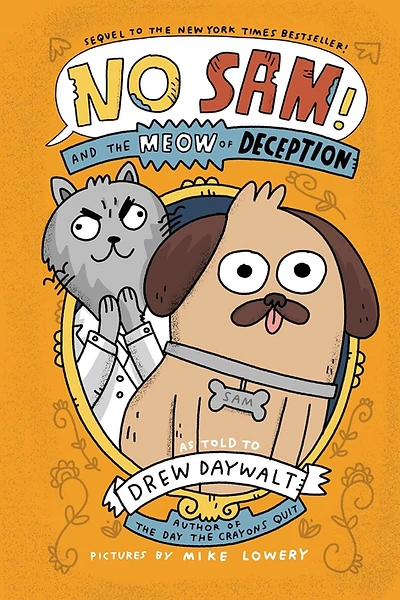
 1-4
1-4C NO SAM
No Sam! and the Meow of Deception
by Drew Daywalt, pictures by Mike Lowery
Pacing MaterialSam the pug is back, and trouble is close behind. In this funny illustrated chapter book, Sam faces mystery, mischief, and a suspicious cat connected to deception. The story uses humor, bold illustrations, and Sam's dramatic point of view to pull readers into a fast-paced adventure about trust, clues, and figuring out what is really going on.
Big Idea
Sometimes the truth is hidden behind appearances, so careful readers and careful thinkers look for clues before making judgments.
Discussion Questions
- 1.Who is Sam, and how would you describe his personality?
- 2.What does the title suggest about the story before you begin reading?
- 3.Why do you think the author uses the phrase "Meow of Deception"?
- 4.What clues help readers understand that something suspicious is happening?
- 5.How does humor affect the way you read the story?
- 6.Is Sam a reliable narrator? Why or why not?
- 7.How do the illustrations add extra information or jokes?
- 8.What role does the cat play in the mystery?
- 9.How does Sam respond when he faces a problem?
- 10.What lesson can readers learn about jumping to conclusions?
- 11.Which scene was funniest? What made it funny?
- 12.How does this book mix chapter-book storytelling with comic-style illustrations?
Classroom Activity
Mystery Clue Tracker
Students create a chart with three columns: Clue, What I Think It Means, What It Really Means. As they read, they track how their thinking changes.
Lesson Plan
Learning Goals
- Students will explain how point of view shapes a story.
- Students will evaluate whether a narrator gives readers the full truth.
- Students will support their thinking with evidence from words and illustrations.
Activity Steps
- 1.Introduce Point of View: Explain that stories can change depending on who tells them. Ask: "Would a pug and a cat tell the same event the same way?"
- 2.Read a Short Section: Choose a scene where Sam reacts strongly or misunderstands something.
- 3.Model Thinking: Say: "Sam tells us what he thinks is happening, but readers need to look at the words and pictures to decide if he is correct."
- 4.Evidence Hunt: Students mark places where Sam's words, actions, or the illustrations give clues about what is really happening.
- 5.Partner Talk: Students discuss: "What does Sam believe? What might actually be true?"
- 6.Independent Response: Students write: "Sam is / is not a reliable narrator because…"
- 7.Share and Reflect: Discuss how humorous stories often let readers know more than the main character.
Standards Connections
- ELA: RL.1.6 — Identify who is telling the story at various points in a text
- ELA: RL.2.6 — Acknowledge differences in the points of view of characters
- ELA: RL.3.3 — Describe characters in a story and explain how their actions contribute to the sequence of events
- ELA: RL.4.1 — Refer to details and examples in a text when explaining what the text says explicitly and when drawing inferences from the text
- SEL: Social Awareness — Identify verbal, physical, and situational cues that indicate how others may feel
- SEL: Relationship Skills — Demonstrate the ability to prevent and resolve interpersonal conflicts in constructive ways
Pace-Write-Read Study with Pace-Write It!
How does Drew Daywalt utilize rhythmic pacing, a distinct animal point of view, and sharp humor to construct a compelling mystery in 'No Sam! and the Meow of Deception'? The author masterfully balances the frenetic energy of Sam the pug with the deliberate introduction of clues, creating a narrative flow that keeps early readers engaged. By grounding the mystery in the domestic sphere, Daywalt allows the tension to escalate through comedic misunderstanding rather than traditional stakes, turning every squeaky toy and mysterious meow into a potential pivot point for the investigation. The interplay between Mike Lowery’s bold illustrations and Sam’s dramatic internal monologue provides a secondary layer of pacing, where visual jokes often interrupt or accentuate the text, forcing readers to oscillate between reading words and decoding images. This rhythmic variation—frequent pauses for visual gags versus rapid-fire action sequences—transforms the reading experience into a dynamic game of cat and mouse. By analyzing how these elements converge, students can better understand the mechanics behind building suspense in a way that is both intellectually satisfying and genuinely funny, ultimately mastering the art of the literary reveal.
| Element | How to notice or teach it in the novel |
|---|---|
| Pace | Read: Observe how the story speeds up during action sequences and slows down when Sam investigates a clue. Classroom Activity: Draw a line graph showing the intensity levels across a single chapter. |
| Plot | Read: Identify the inciting incident where the 'meow of deception' first interrupts Sam's routine. Classroom Activity: Write a one-sentence summary of the main problem Sam is trying to solve. |
| Prosody | Read: Notice the author’s use of punctuation like exclamation points and ellipses to guide how you should read aloud. Classroom Activity: Practice reading a dialogue-heavy page with a partner using varied expressions. |
| Unreliable Narrator | Read: Consider if Sam’s perspective on the cat is based on fact or his own pug-sized prejudice. Classroom Activity: Write a diary entry from the cat's perspective about the same event. |
| Suspense | Read: Look for moments where a character hides or sneaks around to keep the mystery alive. Classroom Activity: Predict what is behind the closed door or under the rug. |
| Clue Dropping | Read: Pay attention to tiny details in the text or art that suggest the cat is acting suspiciously. Classroom Activity: Create a 'Detective Log' listing three clues found in the first five chapters. |
| Comic Timing | Read: Notice the space between a joke being set up and the punchline being delivered. Classroom Activity: Rewrite a scene to make the joke happen faster or slower to see how it changes the humor. |
| Voice | Read: Identify the specific words or phrases that make Sam sound like a grumpy but brave pug. Classroom Activity: Write a short paragraph about a snack using Sam's dramatic dog voice. |
| Humor | Read: Analyze why a situation might be funny to the reader but serious to Sam. Classroom Activity: Identify your favorite funny moment and explain why it made you laugh. |
| Character Perspective | Read: Observe how Sam sees the world differently than the humans in the story. Classroom Activity: Sketch what Sam sees compared to what the human sees in the same room. |
| Visual Cues | Read: Look at how the illustrations provide information that the text might be hiding. Classroom Activity: Describe one illustration that tells a different story than Sam’s narration. |
| Red Herrings | Read: Find a moment where Sam thinks he has solved the mystery but is completely wrong. Classroom Activity: Create a list of 'False Suspects' that Sam encounters. |
| Dialogue | Read: Notice how characters speak to one another to move the investigation forward. Classroom Activity: Write a short conversation between Sam and the cat. |
| Sensory Details | Read: Track the smells and sounds that distract or guide Sam during his mystery. Classroom Activity: List three smells that Sam mentions and explain what they represent to him. |
| Sentence Length | Read: Notice how short sentences create quick movement and long sentences build anticipation. Classroom Activity: Try writing a paragraph using only short, punchy sentences. |
| Mystery Genre | Read: Identify the common tropes of mystery books used in this story. Classroom Activity: Match the events of the book to standard mystery steps like 'Discovery,' 'Investigation,' and 'Climax'. |
| Internal Monologue | Read: Pay attention to Sam's private thoughts that are not spoken to other characters. Classroom Activity: Write a 'thought bubble' for Sam during a moment of high tension. |
| Motivation | Read: Consider why Sam is so determined to catch the suspicious cat. Classroom Activity: Write a sentence explaining Sam's main goal for the chapter. |
| Scene Setting | Read: Analyze how the location, such as the living room or backyard, changes the mood. Classroom Activity: Draw a map of the house and mark where the mystery unfolds. |
| Action Verbs | Read: Find strong verbs that help the reader visualize Sam moving or reacting. Classroom Activity: Rewrite a sentence to make the verb more exciting or descriptive. |
| Emotional Arc | Read: Track how Sam’s feelings change from confidence to worry and back again. Classroom Activity: Draw three faces representing Sam's moods at the beginning, middle, and end. |
| Conflict | Read: Identify the external force standing in Sam's way during his mission. Classroom Activity: State the conflict clearly in a 'Problem vs. Solution' chart. |
| Foreshadowing | Read: Look for early hints about the ending that the reader might miss on the first pass. Classroom Activity: Find one hint about the cat's true motive. |
| Repetition | Read: Notice phrases or actions that repeat to create a sense of rhythm. Classroom Activity: Create a recurring catchphrase that Sam might say. |
| Intertextuality | Read: Consider how the book borrows from classic detective stories. Classroom Activity: Compare Sam to a famous human detective. |
| Tone Shifts | Read: Feel when the tone goes from silly to serious during a mysterious encounter. Classroom Activity: Identify a word that signals a change in the story's mood. |
| Cause Effect | Read: Examine how Sam’s actions lead to specific reactions from the cat. Classroom Activity: Make a flowchart of a 'Sam action' leading to a 'cat reaction'. |
| Descriptive Imagery | Read: Look for adjectives that make the mystery feel spookier or more urgent. Classroom Activity: Write a description of the cat using three spooky adjectives. |
| Character Foil | Read: See how the cat acts as the opposite of Sam to highlight his personality. Classroom Activity: Create a Venn diagram comparing Sam and the cat. |
| Resolution | Read: Decide if the ending feels earned based on the clues provided earlier. Classroom Activity: Write a different ending where the mystery remains unsolved. |
| Symbolism | Read: Think about if any object, like a ball or blanket, symbolizes Sam's safety. Classroom Activity: Explain what an object in the book might symbolize. |
| Genre Blending | Read: Note how the book mixes mystery elements with silly animal humor. Classroom Activity: Brainstorm another genre that would fit this story well. |
| Theme Reflection | Read: Summarize the lesson Sam learns about honesty and friendship. Classroom Activity: Write a short paragraph explaining the book's main message. |
Pace-Write It!
Writing Prompt: Sam thinks he has uncovered a major mystery. Write a new scene where Sam investigates a suspicious sound, object, or animal. Include at least three clues, one funny misunderstanding, and a surprising truth at the end.