 4-7
4-7M GLASER
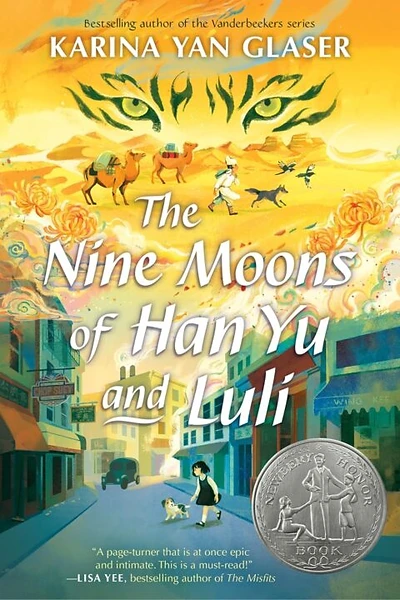
The Nine Moons of Han Yu and Luli
by Karina Yan Glaser
Pacing MaterialTwo young people's lives intertwine across nine moons and a vast landscape, weaving an epic yet intimate tale of friendship, resilience, and the stories that bind us.
Big Idea
Every great journey is measured not in miles but in the people we meet and the stories we carry.
Discussion Questions
- 1.What do the nine moons represent in the story?
- 2.How do Han Yu and Luli's journeys connect?
- 3.What role does the landscape play in the narrative?
- 4.How does the author blend epic and intimate storytelling?
Classroom Activity
Moon Journey Timeline
Research a historical journey and create an illustrated timeline of the key events.
Lesson Plan
Learning Goals
- Analyze narrative structure across dual storylines
- Explore themes of journey and connection
- Examine the use of symbolism in storytelling
Standards Connections
- ELA: RL.4.1 — Ask and answer questions about key details
- ELA: RL.4.2 — Retell stories, including key details
- ELA: RL.4.3 — Describe characters, setting, and events
- ELA: RL.7.6 — Acknowledge differences in characters' points of view
- ELA: SL.4.1 — Participate in collaborative conversations about the text
- ELA: W.4.3 — Write narratives recounting events with descriptive details
- SEL: Relationship Skills
- SEL: Social Awareness
Pace-Write-Read Study with Pace-Write It!
Focus question: How does an author slow down and speed up a story to make a friendship journey feel both epic and intimate? In The Nine Moons of Han Yu and Luli by Karina Yan Glaser, the story stretches across time, distance, and changing circumstances while staying closely connected to two young people whose lives gradually intertwine. Glaser uses pacing through scene shifts, emotional beats, descriptive pauses, and the structure of nine moons to help readers feel both the sweep of the journey and the tenderness of friendship.
| Element | How to notice or teach it in the novel |
|---|---|
| Pace | Read: Notice how The Nine Moons of Han Yu and Luli moves between swift moments of travel and slower, reflective moments between Han Yu and Luli, so the friendship feels earned over time. Classroom Activity: Write a short scene in which two characters cross a difficult landscape; include one fast paragraph and one slow paragraph to control pacing. |
| Plot | Read: Notice how Karina Yan Glaser builds the plot across nine moons, letting each section add a new layer to Han Yu and Luli’s journey, resilience, and growing bond. Classroom Activity: Create a 9-box plot map for an original friendship story, giving each box one moon or stage of the journey. |
| Prosody | Read: Listen to the flow of sentences in scenes that feel hushed, urgent, hopeful, or uncertain, and notice how the sound of the language supports the emotional pace of Han Yu and Luli’s story. Classroom Activity: Rewrite 4-5 sentences from your own draft so the sentence lengths match a mood such as fear, longing, or relief. |
| Word pause | Read: Notice where single powerful words or short phrases create a pause in the reading, especially at emotional turns in Han Yu and Luli’s unfolding connection. Classroom Activity: Write a paragraph about a reunion or parting and add three intentional word pauses using dashes, line breaks, or sentence fragments. |
| Concept | Read: Think about the big idea that stories can carry people across distance, hardship, and time, and how the nine-moon structure deepens the themes of journey and friendship. Classroom Activity: Write a theme statement beginning with “Friendship survives when…” and support it with two imagined moments inspired by Han Yu and Luli’s story world. |
| Voice & World View | Read: Notice how the narration reflects a thoughtful, emotionally observant view of the world, treating travel, survival, and human connection with seriousness and wonder. Classroom Activity: Write 6-8 sentences in a reflective voice about a difficult journey, showing what your narrator believes about loyalty and hope. |
| Setting & Place | Read: Pay attention to how the vast landscape shapes the pace of the story, making each stop, path, and changing environment matter to Han Yu and Luli’s experience. Classroom Activity: Describe one setting from a journey—a mountain pass, market road, village, or riverbank—and explain how it helps or hinders two friends. |
| Point of View | Read: Notice how point of view helps readers stay emotionally close to Han Yu and Luli even as the story spans large distances and many changes. Classroom Activity: Write the same brief travel moment twice—once from one character’s point of view and once from the other’s—to show how pacing changes with perspective. |
| Original Characters | Read: Notice how Han Yu and Luli are developed as distinct individuals whose choices, fears, and strengths make their friendship feel specific rather than generic. Classroom Activity: Invent two original characters on a shared journey and give each one a different goal, worry, and strength. |
| Dialogue | Read: Watch how dialogue can be brief and meaningful, revealing trust, tension, and growing understanding between Han Yu and Luli without slowing the story too much. Classroom Activity: Write 10 lines of dialogue between two travelers who disagree at first but begin to respect each other by the end. |
| Details | Read: Notice which small details Karina Yan Glaser selects to make the world feel lived-in and to reveal the emotional state of Han Yu and Luli. Classroom Activity: Write a scene with 5 precise details from a journey, including one sound, one texture, one object, one weather detail, and one facial expression. |
| Descriptions | Read: Notice how description slows the pace at key moments so readers can absorb the beauty, danger, or loneliness of the landscape around Han Yu and Luli. Classroom Activity: Describe a place in 5-7 sentences, then underline the one sentence that most changes the mood. |
| Strong First Lines | Read: Study how an opening in a journey-centered story can create immediate curiosity about where Han Yu and Luli are, what they want, and what stands in their way. Classroom Activity: Draft three different first lines for a middle grade journey story—one mysterious, one emotional, and one action-filled. |
| Immediacy & Engagement | Read: Notice how the story keeps readers emotionally engaged by placing us close to moments of choice, danger, memory, and connection in Han Yu and Luli’s lives. Classroom Activity: Write a scene that begins with a character making a difficult decision in the present moment, using sensory details to make it immediate. |
| Story Scenes & Summaries & Unique Structures | Read: Notice when Glaser zooms into full scenes and when she summarizes time passing across the nine moons, balancing intimacy with sweep. Classroom Activity: Write one full scene from a journey day and one 3-sentence summary of the next two weeks of travel. |
| Flashback & Flash Forward & Cliffhangers | Read: Pay attention to any moments when the story reaches back to earlier experiences or ends a section with uncertainty, deepening Han Yu and Luli’s emotional stakes. Classroom Activity: End a paragraph with a cliffhanger, then write a short flashback that explains why the moment matters. |
| Tension & Suspense & Surprise | Read: Notice how tension grows not only from external obstacles in the landscape but also from whether Han Yu and Luli will find, trust, or understand each other. Classroom Activity: Write a suspenseful scene in which two friends hear something unexpected during a night journey. |
| Page Turns and Chapter Breaks | Read: Notice how chapter endings can leave readers with a question, image, or emotional shift that encourages the next page turn in Han Yu and Luli’s story. Classroom Activity: Write a chapter ending of 2-4 sentences that makes readers need to know what happens next. |
| Performance | Read: Read a short passage aloud and notice where your voice speeds up, softens, or pauses to match the emotional journey of Han Yu and Luli. Classroom Activity: Mark up a paragraph from your own writing with slashes for pauses and arrows for places to speed up or slow down when reading aloud. |
| Personality | Read: Notice how the personalities of Han Yu and Luli shape the rhythm of scenes—one character’s caution, courage, tenderness, or determination can affect pacing. Classroom Activity: Write a paragraph showing a character’s personality through actions during a hard walk, without directly naming the trait. |
| Humor | Read: Notice whether brief light moments or gentle humor offer relief inside a story filled with distance, uncertainty, and resilience, helping pace the emotional journey. Classroom Activity: Add one small moment of humor to a serious travel scene to give readers a breath. |
| Pause | Read: Notice how pauses for reflection let readers sit with what Han Yu and Luli have lost, learned, or begun to mean to each other. Classroom Activity: Write a pause moment in which a character stops beside the road and realizes something new about a friend. |
| Poetry and Poetic Devices | Read: Notice any lyrical language, imagery, symbolism, or repeated sounds that make the world of Han Yu and Luli feel mythic as well as intimate. Classroom Activity: Write 4 lines of prose using imagery and personification to describe the moon watching over travelers. |
| Repetition | Read: Notice how repeated images, ideas, or references to moons, stories, distance, or promise can unify Han Yu and Luli’s journey. Classroom Activity: Write a paragraph that repeats one meaningful word or phrase three times for emphasis. |
| Rhythm | Read: Pay attention to how sentence patterns create a steady travel rhythm in some places and a broken, anxious rhythm in others. Classroom Activity: Write three long flowing sentences for a peaceful travel moment and three short choppy sentences for a dangerous one. |
| Punctuation | Read: Notice how commas, dashes, ellipses, and end punctuation help shape tension, hesitation, and emotional pace in scenes involving Han Yu and Luli. Classroom Activity: Take a plain 4-sentence paragraph and revise it twice using punctuation to create calm in one version and suspense in another. |
| Questions | Read: Notice the questions the book raises for readers—about survival, trust, belonging, and where Han Yu and Luli’s paths may lead. Classroom Activity: Write five story questions that could guide a journey narrative, including at least one emotional question and one plot question. |
| Compare-Contrast | Read: Compare the inner journeys of Han Yu and Luli as well as the different settings, moods, or choices across the nine moons. Classroom Activity: Make a T-chart comparing two characters on a journey, then write a paragraph explaining how their differences create tension and growth. |
| Objects | Read: Notice whether certain objects carry memory, comfort, identity, or story value for Han Yu and Luli, helping link scenes across time and distance. Classroom Activity: Choose one object a traveler would carry and write how it changes meaning in three different moments. |
| Threes | Read: Notice how groups of three details, actions, or images can make scenes about Han Yu and Luli more memorable and rhythmic. Classroom Activity: Write a description of a campsite using three sounds, three sights, and three emotions. |
| Whitespace & Negative Space | Read: Notice how breaks between sections or shorter paragraphs can give emotional breathing room after intense moments in Han Yu and Luli’s journey. Classroom Activity: Revise a scene by breaking one long paragraph into smaller parts to emphasize pauses and emotional shifts. |
| Art & Graphics | Read: Imagine how a map, moon chart, or symbolic illustration could support readers in following Han Yu and Luli across a wide landscape and nine-part structure. Classroom Activity: Design a simple visual companion for a story—a map, timeline, or moon tracker—and label key journey moments. |
| Interactives & Gamification | Read: Think about how the nine-moon structure invites readers to track progress, milestones, and changes in Han Yu and Luli’s friendship like a story path. Classroom Activity: Create a ‘journey tracker’ with nine checkpoints; at each checkpoint, add one obstacle, one feeling, and one friendship change. |
Pace-Write It!
20-Minute Classroom Flow\nRead (5 min): Read aloud a short excerpt from The Nine Moons of Han Yu and Luli that shows movement across landscape and a quieter emotional moment between the two characters. Ask students to listen for where the story speeds up and where it slows down.\nNotice (5 min): Students turn and talk: What made the scene feel fast? What made it feel slow? Chart student observations under these headings: action, description, dialogue, reflection, sentence length, and section/chapter break.\nWrite (7 min): Students write a short journey scene inspired by the book’s themes of friendship and resilience. Writing frame: “By the ___ moon, ___ and ___ had traveled across ___. At first, ___. Then, when ___, everything seemed to slow. ‘___,’ said ___. In that moment, ___ realized ___. But just as they began to ___, ___.” Encourage students to include one fast part, one slow reflective part, and an ending that creates a page-turn question.\nShare (3 min): Invite 2-3 students to read one sentence that speeds up the scene and one sentence that slows it down. Classmates name the craft move they hear.\nExit ticket: Write one sentence answering: How did you control pacing in your scene, and which part was meant to make readers pause?