
 3-7
3-7GN CRAFT
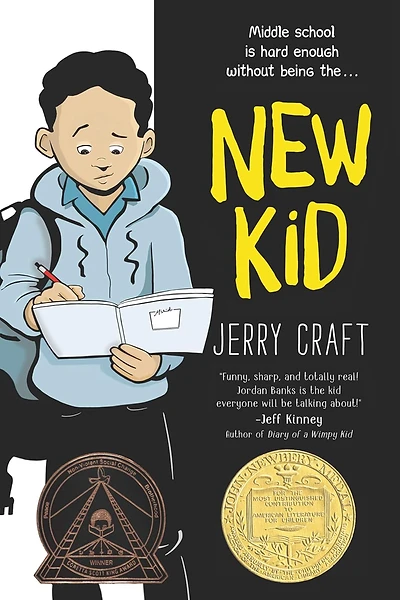
New Kid
by Jerry Craft
Pacing MaterialSeventh-grader Jordan Banks navigates a prestigious new school where he's one of the few kids of color, drawing his experiences along the way.
Big Idea
Staying true to who you are while finding your place in a new world is hard — and art can help you make sense of it.
Discussion Questions
- 1.How does Jordan use drawing to process his feelings?
- 2.What microaggressions does Jordan notice at his new school?
- 3.How do the two worlds Jordan moves between differ?
- 4.Which character did you most relate to, and why?
- 5.How does the graphic format help tell this story?
Classroom Activity
Slice-of-Life Comic
Draw a one-page comic about a moment from your own school day. Use panels, speech bubbles, and a caption to show how you felt.
Lesson Plan
Learning Goals
- Identify how Jordan uses drawing to process his feelings
- Create a one-page slice-of-life comic about a school day
Activity Steps
- 1.Read a selected chapter, noting Jordan's drawings.
- 2.Discuss: 'How does Jordan's art help him?'
- 3.Model a 4-panel comic about a school moment.
- 4.Students create their own one-page comic.
- 5.Share comics in a 'class anthology'.
Standards Connections
- ELA: RL.3.1 — Ask and answer questions about key details
- ELA: RL.3.2 — Retell stories, including key details
- ELA: RL.3.3 — Describe characters, setting, and events
- ELA: RL.7.6 — Acknowledge differences in characters' points of view
- ELA: SL.3.1 — Participate in collaborative conversations about the text
- ELA: W.3.3 — Write narratives recounting events with descriptive details
- SEL: Self-Awareness
- SEL: Social Awareness
- Art: VA:Re7 — Perceive and analyze artistic work
Pace-Write-Read Study with Pace-Write It!
Focus question: How does Jerry Craft control the speed of Jordan’s story so readers can feel both the funny moments and the hard moments at school? In New Kid, Jerry Craft tells the story of Jordan Banks, a seventh-grader who starts at a prestigious private school and often feels caught between different worlds. As a graphic novel, the book uses panels, page turns, dialogue, silence, and Jordan’s drawings to speed up exciting scenes, slow down uncomfortable moments, and help readers notice identity, belonging, and storytelling.
| Element | How to notice or teach it in the novel |
|---|---|
| Pace | Read: Notice how Jerry Craft speeds up busy school scenes with many small panels and slows down emotional moments when Jordan is thinking about fitting in at Riverdale Academy Day School. Watch how the pace changes between funny friend moments and awkward or painful experiences with Andy, Liam, and teachers. Classroom Activity: Write a short comic scene about a student entering a new place for the first time, using at least one fast section and one slow section. |
| Plot | Read: Track how Jordan’s year unfolds from the opening school decision to friendships, misunderstandings, microaggressions, and growing confidence. Notice how each event builds the larger story of identity and belonging in New Kid. Classroom Activity: Create a 5-part plot ladder for Jordan’s story, then write your own 5-part plot ladder about a character balancing two different worlds. |
| Prosody | Read: Listen to how the dialogue in New Kid would sound if read aloud, especially Jordan’s calm observations, Drew’s energy, and Andy’s bragging tone. Notice how sentence length and word choice affect the mood and pace of each conversation. Classroom Activity: Choose one conversation style from the book and write 6 lines of dialogue for a new scene, making the voice easy to hear aloud. |
| Word pause | Read: Notice where a single word, a short reply, or a small reaction makes you stop, especially in scenes where Jordan is processing what someone has said about race, class, or belonging. In a graphic novel, even one word in a panel can create a pause. Classroom Activity: Write a 6-sentence scene and include three one-word or two-word pauses to show a character reacting internally. |
| Concept | Read: Think about the big idea in New Kid: what it feels like to be a new student, a kid of color in a mostly white school, and someone who uses art to make sense of life. Notice how the concept of living between worlds shapes the pacing of the story. Classroom Activity: Write a paragraph beginning, “My story idea explores what it feels like to be between…” and explain how your character’s problem would unfold. |
| Voice & World View | Read: Notice that Jordan’s voice is thoughtful, observant, funny, and honest, and that his worldview helps readers see both the warmth and the unfairness around him. His perspective shapes what feels fast, what feels uncomfortable, and what matters most. Classroom Activity: Write a first-person journal entry from a student who notices things other people miss, using humor and honesty like Jordan. |
| Setting & Place | Read: Compare Jordan’s home life, his neighborhood, the long commute, and Riverdale Academy Day School. Notice how place changes the mood and pacing, especially when Jordan moves from one world to another. Classroom Activity: Write two short setting snapshots of the same character in two different places, showing how each place changes the character’s behavior. |
| Point of View | Read: Notice how the story stays closely connected to Jordan’s point of view, helping readers feel his confusion, embarrassment, creativity, and growth. Because we experience events through him, pacing often slows when he reflects and speeds up when school drama unfolds. Classroom Activity: Rewrite one school moment from the point of view of Drew, Liam, or even Andy to show how perspective changes the story. |
| Original Characters | Read: Study how Jordan, Drew, Liam, Alexandra, and Andy each feel distinct through expressions, words, and actions. Notice how character differences create both humor and tension in New Kid. Classroom Activity: Invent an original classmate for Jordan’s school and write a character card with traits, a secret worry, and a sample line of dialogue. |
| Dialogue | Read: Pay attention to how dialogue reveals friendships, social status, misunderstandings, and personality, especially in scenes with Jordan and Drew or Jordan and Andy. Notice how short exchanges can move the story quickly. Classroom Activity: Write a 10-line dialogue between two students from different backgrounds who are trying to understand each other. |
| Details | Read: Notice the specific details Jerry Craft includes about lunch, clothes, classrooms, bus rides, and social interactions. These details make Jordan’s world feel real and help readers understand the daily experience of being the new kid. Classroom Activity: Write a detailed paragraph about one ordinary school moment that reveals something important about your character’s identity. |
| Descriptions | Read: In a graphic novel, description comes through both words and images. Notice how facial expressions, body language, and panel backgrounds describe feelings that Jordan does not always say directly. Classroom Activity: Describe a character’s feelings in a scene without using emotion words, relying on actions, expressions, and surroundings. |
| Strong First Lines | Read: Look at how New Kid begins by quickly introducing Jordan’s wish, his artistic side, and the conflict about where he will go to school. Notice how the opening immediately sets up curiosity and direction. Classroom Activity: Write three possible first lines for a story about a student starting somewhere they do not want to be. |
| Immediacy & Engagement | Read: Notice how the comic format makes readers feel close to each moment, as if we are walking beside Jordan in the hallways or sitting with him during awkward conversations. The panels create immediacy by letting us see reactions right away. Classroom Activity: Write a scene in present tense so readers feel the action happening right now. |
| Story Scenes & Summaries & Unique Structures | Read: Notice how Jerry Craft mixes full scenes, quick summaries, and creative graphic-novel structures to tell Jordan’s school year. Some moments unfold panel by panel, while others are compressed to move time forward efficiently. Classroom Activity: Write one event twice: first as a full scene with dialogue, then as a 3-sentence summary. |
| Flashback & Flash Forward & Cliffhangers | Read: Notice where Jordan reflects on earlier experiences or where a chapter ends with a feeling or problem that makes you want to keep reading. Even without big action scenes, social tension can work like a cliffhanger. Classroom Activity: End a short school scene with a cliffhanger line or image that makes the reader want the next page. |
| Tension & Suspense & Surprise | Read: Watch how tension grows in New Kid through social pressure, misunderstandings, unfair assumptions, and moments when Jordan is unsure how to respond. Small surprises in friendship and conflict keep the story moving. Classroom Activity: Write a scene where the tension comes from what a character does not say out loud. |
| Page Turns and Chapter Breaks | Read: Notice how page turns in the graphic novel can reveal a joke, a reaction, or a new problem, and how chapter breaks help pace Jordan’s school year. Jerry Craft uses these shifts to control suspense and reflection. Classroom Activity: Plan a 4-panel comic and choose one page turn or section break where the reader will discover something important. |
| Performance | Read: Notice how characters perform versions of themselves at school—trying to seem cool, confident, wealthy, or unbothered. Jordan often watches these performances closely, which adds insight to the story’s pacing and meaning. Classroom Activity: Write a monologue from a character who acts one way in public but feels another way inside. |
| Personality | Read: Notice how Jordan’s personality—creative, observant, cautious, and funny—shapes the story’s tone, while Drew’s confidence and Liam’s friendliness change the energy of scenes. Character personality affects how fast or slow moments feel. Classroom Activity: Write a paragraph showing a character’s personality through choices and reactions instead of directly listing traits. |
| Humor | Read: Notice how Jerry Craft uses humor in drawings, exaggeration, and Jordan’s observations to make serious topics more readable without making them less important. Humor helps balance the pacing in New Kid. Classroom Activity: Write a funny school moment that also reveals something true or uncomfortable about the setting. |
| Pause | Read: Pay attention to moments when Jordan pauses before responding or when a panel gives readers time to sit with a feeling. These pauses are important in a story about identity because they show thinking, discomfort, and self-control. Classroom Activity: Write a scene where a pause changes the meaning of a conversation. |
| Poetry and Poetic Devices | Read: Even though New Kid is not written as poetry, notice how repeated images, sharp comparisons, and carefully chosen words create powerful effects. Jordan’s artistic way of seeing the world often feels poetic. Classroom Activity: Write 5 lines about a school hallway using imagery, comparison, or repetition to capture a mood. |
| Repetition | Read: Notice repeated experiences in Jordan’s school life—being misunderstood, switching between worlds, and noticing who belongs and who does not. Repetition helps readers feel the ongoing nature of his challenges. Classroom Activity: Write a paragraph that repeats one phrase three times to show a character’s growing frustration or determination. |
| Rhythm | Read: Watch the rhythm created by panel size, dialogue length, and the alternation between jokes and serious moments. New Kid has a rhythm that feels natural, like the ups and downs of a school day. Classroom Activity: Write a scene with a clear rhythm pattern: quick-quick-slow-quick, using sentence length to control the flow. |
| Punctuation | Read: Notice how punctuation in speech bubbles and captions—ellipsis, exclamation marks, question marks, and dashes—changes tone and pacing. In Jordan’s world, punctuation often shows awkwardness, interruption, or excitement. Classroom Activity: Rewrite the same line three times with different punctuation to show confidence, uncertainty, and surprise. |
| Questions | Read: Notice the questions Jordan asks himself and the questions readers ask about fairness, friendship, and belonging. Questions create momentum because they make us keep reading for answers. Classroom Activity: Write a paragraph built around three questions your character is asking internally during a difficult school day. |
| Compare-Contrast | Read: Compare Jordan’s old expectations with his new school reality, his home world with Riverdale Academy, and different students’ experiences of the same place. Compare-contrast is central to the meaning and pacing of New Kid. Classroom Activity: Write a compare-contrast paragraph about two places your character moves between each day. |
| Objects | Read: Notice how objects such as Jordan’s sketchbook, school materials, clothing, lunch items, and transportation details can symbolize identity, comfort, or difference. Small objects help tell the bigger story. Classroom Activity: Choose one object that matters to your character and write a scene showing why it is important. |
| Threes | Read: Notice patterns of three in storytelling choices, such as three examples, three reactions, or three moments that build a joke or an idea. Sets of three can make scenes feel complete and memorable. Classroom Activity: Write three linked mini-moments that show a character’s first week in a new school. |
| Whitespace & Negative Space | Read: In a graphic novel, blank space matters. Notice how spacing between panels or cleaner backgrounds can make a moment feel lonely, reflective, or tense for Jordan. Classroom Activity: Storyboard a 3-panel comic and decide where to leave extra blank space to emphasize isolation or thoughtfulness. |
| Art & Graphics | Read: Study how Jerry Craft’s art style, facial expressions, panel arrangement, and visual jokes help tell Jordan’s story about identity and belonging. The graphics are not extra—they are part of the pacing and meaning. Classroom Activity: Create a 4-panel comic about a school misunderstanding, using expressions and panel size to show emotion. |
| Interactives & Gamification | Read: Think about how New Kid invites readers to infer meaning from pictures, dialogue, and page design almost like solving clues. Readers actively piece together what Jordan notices about race, class, and friendship. Classroom Activity: Design a ‘reader challenge’ page with three clues about a character, and have classmates infer the character’s feelings or situation. |
Pace-Write It!
20-Minute Classroom Flow Read (5 min): Read a short section from New Kid that shows Jordan at Riverdale Academy Day School during a moment of social discomfort or friendship. Ask students to notice where the story speeds up, slows down, or pauses. Notice (5 min): Students turn and talk: How do the panels, dialogue, expressions, and page layout shape pacing? Chart student observations under these headings: fast, slow, pause, surprise. Highlight Jordan, Drew, Liam, or Andy as examples. Write (7 min): Students write their own short scene about a character entering a new social space. Encourage them to include one fast part, one slow reflective part, and one pause. Writing frame: “When I walked into __________, everything felt __________. First, __________. Then, while everyone else __________, I noticed __________. I wanted to say __________, but instead I __________. That was the moment I realized __________.” Students may write prose or script it as a comic. Share (3 min): Invite pairs to read one line or show one moment where they intentionally controlled pacing. List a few effective pacing moves students used. Exit ticket: In one or two sentences, explain one way Jerry Craft controls pacing in New Kid and name one pacing move you used in your own writing.
Pace-Write-Read Connection
Teach this book using the Pace-Write-Read method — Tool 35: Art & Graphics.
Open the Mastery Manual