 K-2
K-2P SULLIVAN
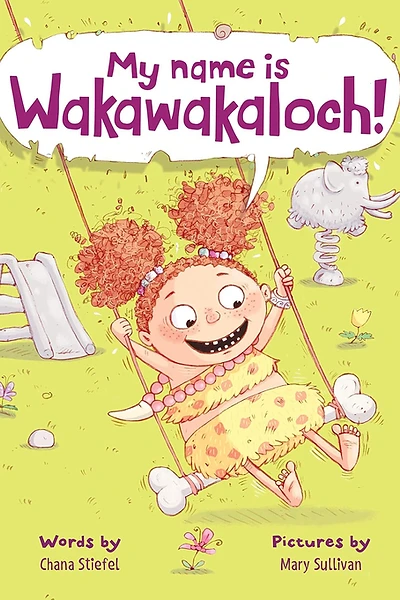
My Name is Wakawakaloch!
by Chana Stiefel, Pictures by Mary Sullivan
Pacing MaterialBig Idea
Our names are a vital part of our identity, and while they may sometimes feel difficult to share, they are worth celebrating and teaching others to appreciate.
Discussion Questions
- 1.Why does Wakawakaloch feel frustrated when her classmates mispronounce her name?
- 2.How does Wakawakaloch change her feelings about her name by the end of the story?
- 3.What does the author mean when she says Wakawakaloch was 'as angry as an erupting volcano'?
- 4.Why is it important to take the time to learn how to say someone's name correctly?
- 5.If you could design a shirt with your name on it, what colors and symbols would you use to show who you are?
Classroom Activity
My Name, My Superpower
Students will create personalized 'name shirts' using art supplies to celebrate the unique sounds and meanings of their own names, mirroring Wakawakaloch's creative solution.
Lesson Plan
Learning Goals
- Students will identify the importance of respecting others' names.
- Students will practice phonological awareness by breaking down the syllables in their own names.
- Students will express their personal identity through visual art and creative writing.
Activity Steps
- 1.Discuss the story and how Wakawakaloch felt when people mispronounced her name.
- 2.Have students clap out the syllables of their own names to understand the rhythm and structure.
- 3.Provide paper shirt templates and markers for students to write their names clearly.
- 4.Encourage students to decorate their shirts with symbols that represent their favorite things.
- 5.Have students present their shirts to a partner, teaching them how to pronounce their name correctly.
Standards Connections
- CCSS.ELA-LITERACY.SL.K.1: Participate in collaborative conversations.
- CCSS.ELA-LITERACY.RF.K.2: Demonstrate understanding of spoken words, syllables, and sounds.
- National Core Arts Standard VA:Cr1.1.K: Engage in exploration and imaginative play with materials.
Pace-Write-Read Study with Pace-Write It!
The Pace-Write-Read study of 'My Name is Wakawakaloch!' focuses on how the author uses rhythmic, repetitive, and often humorous language to mirror the protagonist's internal emotional journey. By examining the text's structure, students learn how word choice and sentence length influence the speed at which a reader moves through a story. In this study, we look at how the author balances the 'fast' moments of frustration—where names are mangled—with the 'slow' moments of pride and creation. This helps students understand that pacing is not just about speed, but about matching the emotional intensity of the character's experience.
| Element | How to notice or teach it in the novel |
|---|---|
| Pace | The pace accelerates during the scenes where classmates mispronounce her name, reflecting her chaotic frustration. |
| Plot | The plot follows a clear arc from the conflict of a difficult name to the resolution of finding pride in it. |
| Prosody | Encourage students to read the mispronounced names with exaggerated, silly voices to emphasize the humor. |
| Word Pause | Use pauses before the reveal of a new, mangled name to build anticipation for the reader. |
| Concept | The central concept is the power of identity and the importance of names. |
| Voice & World View | The story is told from the perspective of a child who feels misunderstood but eventually finds her own voice. |
| Setting & Place | The school setting provides the social pressure that drives the conflict. |
| Point of View | The third-person limited perspective keeps us close to Wakawakaloch's emotional state. |
| Original Characters | The names of the classmates (Oog, Boog, Hoopaloopie) are intentionally silly to contrast with the protagonist's unique name. |
| Dialogue | The dialogue is snappy and repetitive, mimicking the way children tease or play. |
| Details | The specific details of the shirts Wakawakaloch makes show her transition from hiding to sharing. |
| Descriptions | The author uses vivid metaphors, like 'angry as an erupting volcano,' to describe emotions. |
| Strong First Lines | The title itself acts as a hook, immediately introducing the unique name. |
| Immediacy & Engagement | The immediate conflict of a name being mispronounced pulls the reader in right away. |
| Story Scenes & Summaries & Unique Structures | The structure alternates between the frustration of school and the creative sanctuary of her shirt-making. |
| Flashback & Flash Forward & Cliffhangers | The story moves linearly, but each mispronunciation acts as a mini-cliffhanger for how she will react. |
| Tension & Suspense & Surprise | Tension builds as more classmates mispronounce her name, leading to the surprise of her creative solution. |
| Page Turns and Chapter Breaks | Page turns are used to reveal the funny, incorrect versions of her name. |
| Performance | This book is perfect for a read-aloud performance where the reader acts out the different characters' voices. |
| Personality | Wakawakaloch's personality shines through her resilience and creativity. |
| Humor | The humor comes from the absurdity of the mangled names. |
| Pause | Pause after the teacher or classmates speak to let the reader process the 'wrongness' of the name. |
| Poetry and Poetic Devices | The name 'Wakawakaloch' has a rhythmic, poetic quality that is fun to say. |
| Repetition | The repetition of the name-mangling scenes reinforces the protagonist's struggle. |
| Rhythm | The rhythm of the text mimics the 'swing' and 'club' activities mentioned in the book. |
| Punctuation | Exclamation points are used to show the intensity of the classmates' shouting. |
| Questions | The book implicitly asks the reader: 'How would you feel if someone couldn't say your name?' |
| Compare-Contrast | Compare the way the classmates say her name at the beginning versus the end. |
| Objects | The shirts are key objects that represent the character's growth. |
| Threes | The rule of three is used in the list of classmates and their various mispronunciations. |
| Whitespace & Negative Space | The illustrations use space to focus on the character's expressions during moments of frustration. |
| Art & Graphics | The art style is bold and expressive, matching the energy of the text. |
| Interactives & Gamification | The book invites the reader to try and pronounce the name correctly, turning reading into a game. |
Pace-Write It!
Spend 20 minutes having students practice saying their own names with pride. Have them stand up, say their name clearly, and then have the class repeat it back to them in unison to reinforce the correct pronunciation.