 K-3
K-3P BRUSATTE
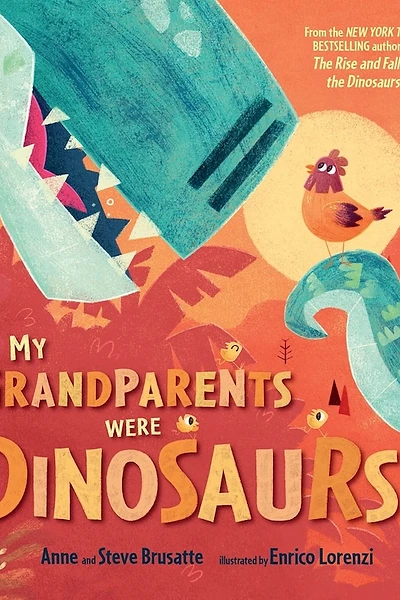
My Grandparents Were Dinosaurs
by Anne and Steve Brusatte
Pacing MaterialA child imagines that their grandparents were actually dinosaurs — and discovers the real prehistoric connections between family and fossils.
Big Idea
We're all connected to the deep past, and curiosity about where we come from leads to amazing discoveries.
Discussion Questions
- 1.What would it be like if your grandparents were dinosaurs?
- 2.What dinosaur do you think they'd be, and why?
- 3.How do scientists learn about the past?
- 4.What do you know about your grandparents' stories?
Classroom Activity
Dino Family Tree
Draw your family as dinosaurs. Choose a dinosaur for each person and explain why it fits.
Lesson Plan
Learning Goals
- Describe how the child in My Grandparents Were Dinosaurs uses imagination to explore grandparents and the prehistoric past.
- Choose dinosaurs to represent family members or other important caregivers and explain each choice using a personal trait.
- Create a labeled Dino Family Tree that communicates connections among important people.
- Distinguish pretend dinosaur relatives from scientific evidence about prehistoric life, such as fossils.
Activity Steps
- 1.Read My Grandparents Were Dinosaurs aloud. Pause to ask: “What is the child imagining about their grandparents?” and “What makes you curious about the distant past?”
- 2.Discuss imagination versus evidence: family members are not literally dinosaurs, while fossils help scientists learn about prehistoric life. Invite children to identify something imagined and something learned from the story.
- 3.Show pictures of several dinosaurs and name one recognizable feature of each, such as Triceratops’s horns or Diplodocus’s long neck. Model a playful comparison: “I would draw my caregiver as Diplodocus because they can reach things on high shelves.” Explain that personality comparisons are imaginary, not scientific facts about dinosaurs.
- 4.Have students draw a Dino Family Tree with themselves and three or more family members or important caregivers. Allow a branching tree, a circle, or another arrangement that fits their family. Students choose a dinosaur for each person and add names or relationship labels.
- 5.Ask students to dictate or write explanations using “I chose ___ for ___ because ___.” Kindergartners may explain one choice orally; older students can write a sentence for each person.
- 6.Invite students to share one dinosaur relative with a partner. Close by asking each child to name one question they still have about their family’s past or prehistoric life.
Standards Connections
- ELA: RL.K.1 / RL.1.1 / RL.2.1 / RL.3.1 — Ask and answer questions about key details in the read-aloud.
- ELA: SL.K.1 / SL.1.1 / SL.2.1 / SL.3.1 — Participate in collaborative conversations about the story and dinosaur choices.
- ELA: W.K.2 / W.1.2 / W.2.2 / W.3.2 — Use drawing, dictation, or informative writing to explain dinosaur-family comparisons.
- Science: NGSS 3-LS4-1 — Build toward understanding that fossils provide evidence of organisms and environments from long ago.
- SEL: Self-awareness and relationship skills — Recognize personal and family traits while respectfully acknowledging different family structures.
Pace-Write-Read Study with Pace-Write It!
Focus question: How can an author slow down and speed up a story to help readers imagine family history in a surprising way? In My Grandparents Were Dinosaurs by Anne and Steve Brusatte, a child playfully imagines that their grandparents might really have been dinosaurs, blending family storytelling with science ideas about fossils and the prehistoric past. The pacing moves between funny, imaginative moments and reflective discoveries, helping young readers linger on clues, wonder, and the connection between people, time, and evidence.
| Element | How to notice or teach it in the novel |
|---|---|
| Pace | Read: Notice how the story moves quickly when the child imagines dinosaur grandparents and then slows down when the book connects family history to fossils and real prehistoric evidence. Classroom Activity: Write 3 sentences that begin with a fast imagining moment and end with a slower discovery moment about someone in your family. |
| Plot | Read: Notice the plot pattern: the child begins with a wild idea about grandparents being dinosaurs, adds playful examples, and then arrives at a deeper understanding about the past and science. Classroom Activity: Make a beginning-middle-end chart for a story called My Family Was from Long Ago and add one event to each part. |
| Prosody | Read: Listen for places where the read-aloud voice should sound excited during dinosaur imagining and softer or more thoughtful during fossil and family connections. Classroom Activity: Choose 2 lines you could read in an excited voice and 2 lines you could read in a calm scientist voice, then write your own matching line for each kind. |
| Word pause | Read: Notice words and ideas that make you pause, such as dinosaur names, fossils, or surprising family comparisons, because they invite thinking time. Classroom Activity: Write one sentence about a family member and add a bold idea word that would make a listener pause and think. |
| Concept | Read: Notice the big concept that family stories and science both help us learn about the past, even when imagination leads us in first. Classroom Activity: Write 2 sentences explaining how a family story and a fossil are alike because they both give clues. |
| Voice & World View | Read: Notice the child narrator’s curious, playful worldview, where dinosaurs feel close to everyday family life and questions are welcomed. Classroom Activity: Write in a curious child voice about an ordinary family object as if it might be connected to something ancient. |
| Setting & Place | Read: Notice how the book shifts between familiar family spaces and imagined prehistoric places, creating a bridge between home and long ago. Classroom Activity: Draw a line down your page and write one detail from a home setting on one side and one detail from a prehistoric setting on the other, then combine them into 2 sentences. |
| Point of View | Read: Notice that the story is told from the child’s point of view, so readers experience the wonder, humor, and discoveries through the child’s thinking. Classroom Activity: Rewrite one imagined dinosaur-grandparent moment from the grandparent’s point of view using I. |
| Original Characters | Read: Notice how the child and grandparents feel original because they are both familiar family figures and part of a funny dinosaur-sized idea. Classroom Activity: Invent a new family character for this style of story, such as an aunt, uncle, or cousin with a prehistoric twist, and write 3 character traits. |
| Dialogue | Read: Notice where dialogue could bring the family relationship alive, such as a grandparent responding to the child’s dinosaur theory. Classroom Activity: Write a 4-line conversation between a child and grandparent about whether the grandparent used to be a dinosaur. |
| Details | Read: Notice the specific details that make the dinosaur imagining vivid and the science connection believable, such as fossils, bones, size, or ancient time. Classroom Activity: List 5 details a child might notice about a grandparent and 5 details about a dinosaur, then use 2 from each list in a paragraph. |
| Descriptions | Read: Notice how descriptions help readers picture both the warmth of family and the strangeness of prehistoric creatures. Classroom Activity: Write one describing sentence for a grandparent’s hands and one describing sentence for a dinosaur’s claws, then connect them in a comparison. |
| Strong First Lines | Read: Notice how a strong opening in a book like this must quickly invite curiosity by mixing family with an unexpected dinosaur idea. Classroom Activity: Write 3 possible first lines for a story about a relative with a surprising secret from long ago. |
| Immediacy & Engagement | Read: Notice how the book grabs readers right away because the idea of dinosaur grandparents is funny, surprising, and easy to imagine. Classroom Activity: Write one opening sentence that makes a reader instantly want to know more about your family story. |
| Story Scenes & Summaries & Unique Structures | Read: Notice how some parts feel like close-up scenes of imagining while other parts summarize bigger ideas about fossils, time, and family history. Classroom Activity: Write one scene sentence showing a child looking closely at a grandparent and one summary sentence explaining what the child believes overall. |
| Flashback & Flash Forward & Cliffhangers | Read: Notice how the story invites thoughts of the distant past, almost like a giant flashback to prehistoric times, while the next page can hold a new surprise. Classroom Activity: Write a cliffhanger sentence ending with a dash, as if the child is just about to discover proof that a grandparent has a dinosaur past. |
| Tension & Suspense & Surprise | Read: Notice that the tension is gentle and playful: Will the child find real proof, or is the truth something different but still amazing? Classroom Activity: Write 2 sentences that build suspense before revealing a surprising family clue. |
| Page Turns and Chapter Breaks | Read: Notice how a picture book like this uses page turns to hold a funny reveal, a new dinosaur comparison, or a science fact connection. Classroom Activity: Fold a paper to make 4 pages and plan what surprise would happen after each page turn in your own mini-book. |
| Performance | Read: Notice how this story works well as a performance with dramatic dinosaur gestures, stomping sounds, and softer voices for thoughtful fossil moments. Classroom Activity: Mark one sentence to read loudly, one to whisper, and one to stretch out slowly, then practice performing them. |
| Personality | Read: Notice the child’s personality—curious, imaginative, confident, and affectionate toward the grandparents—shapes the pace of the whole story. Classroom Activity: Write 3 personality words for your narrator and then write a sentence that sounds like that kind of person. |
| Humor | Read: Notice the humor in treating grandparents as if they might literally be dinosaurs while still keeping the family connection loving and respectful. Classroom Activity: Write one funny but kind comparison between a family member and an animal or ancient creature. |
| Pause | Read: Notice the places where readers may naturally pause to look closely at the illustrations, think about a clue, or absorb a science idea. Classroom Activity: Take a sentence you wrote and add a pause with commas or a line break to make the reader stop and think. |
| Poetry and Poetic Devices | Read: Notice how the language can feel poetic when comparing bones, time, memory, and fossils across generations. Classroom Activity: Write a 3-line poem that compares a family memory to something dug up from long ago. |
| Repetition | Read: Notice how repeated ideas, such as grandparents and dinosaurs being linked again and again, help the pacing feel playful and patterned. Classroom Activity: Write a short piece that repeats the frame Maybe my grandpa was... or Maybe my grandma was... 3 times with different endings. |
| Rhythm | Read: Notice the rhythm created by short playful statements and then longer reflective ideas about the prehistoric past. Classroom Activity: Write one short sentence, one longer sentence, and one short sentence to copy that same rhythm pattern. |
| Punctuation | Read: Notice how question marks, commas, and exclamation points can shape the energy of a book full of wondering and surprise like this one. Classroom Activity: Write the same family-dinosaur sentence 3 ways: as a statement, a question, and an exclamation. |
| Questions | Read: Notice how the whole premise grows from wondering questions about who grandparents were long ago and what clues the present holds. Classroom Activity: Write 4 wondering questions a child in this book might ask after finding a fossil or hearing a family story. |
| Compare-Contrast | Read: Notice how the story compares grandparents and dinosaurs in funny ways, then contrasts imagination with scientific evidence. Classroom Activity: Make a T-chart labeled Same and Different for grandparents and dinosaurs, then write 2 compare-contrast sentences. |
| Objects | Read: Notice how objects such as bones, fossils, photos, or family keepsakes can carry meaning and slow the pacing as readers study them. Classroom Activity: Choose one object from your home and write how it could become a clue in a family-history story. |
| Threes | Read: Notice how ideas often become stronger when grouped in threes, such as three clues, three comparisons, or three moments of imagining. Classroom Activity: Write 3 clues that make a child think a grandparent has a prehistoric secret. |
| Whitespace & Negative Space | Read: Notice how a picture book can use open space on the page to make one funny idea, one fossil, or one important sentence stand out. Classroom Activity: Write one short sentence you would place alone on a page for dramatic effect in a dinosaur-family story. |
| Art & Graphics | Read: Notice how illustrations in a story like My Grandparents Were Dinosaurs help pace the reading by showing visual jokes, family warmth, and prehistoric imagination alongside the words. Classroom Activity: Sketch one scene of a grandparent with a dinosaur feature and label 3 details that your words would mention. |
| Interactives & Gamification | Read: Notice how this book invites readers to play detective by spotting clues that connect family history, imagination, and science. Classroom Activity: Create a Find the Clue challenge by writing 3 clues about an imaginary prehistoric family member and let a partner guess who it is. |
Pace-Write It!
20-Minute Classroom Flow\nRead (5 min): Read aloud a section of My Grandparents Were Dinosaurs by Anne and Steve Brusatte that shows the child imagining dinosaur grandparents and then connecting that idea to fossils and the distant past. Pause once to let students notice where the story feels fast and funny, and once where it feels slower and thoughtful.\nNotice (5 min): Ask: Where did the story speed up? Where did it slow down? Chart student noticings under two headings: Fast Imagination and Slow Discovery. Point out how the child narrator’s voice, the family theme, and the science clues help control pacing.\nWrite (7 min): Students write their own short family-imagination piece using this frame: Maybe my ______ was once a ______. At first, I thought this because ______, ______, and ______. But then I noticed ______. Now I think ______ because ______. Encourage students to include one funny comparison and one real clue or object.\nShare (3 min): Partners read their pieces aloud twice: first with a dramatic, fast voice for the imagining part, then with a slower, thoughtful voice for the discovery part. Invite 2 or 3 volunteers to share a favorite sentence.\nExit ticket: Write one sentence answering: How did you change your pacing from the beginning of your piece to the end?
Pace-Write-Read Connection
Teach this book using the Pace-Write-Read method — Tool 22: Personality.
Open the Mastery Manual