 1-4
1-4C MURRAY
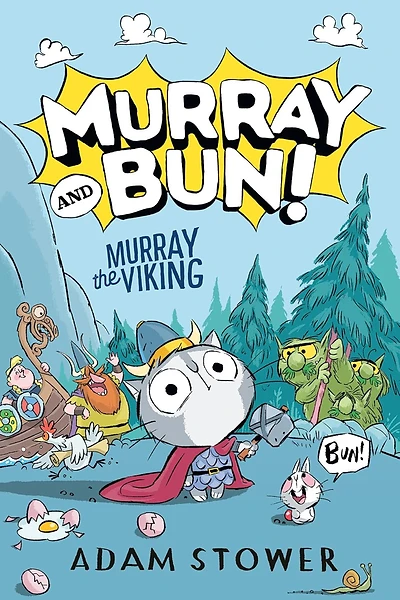
Murray and Bun: Murray the Viking
by Adam Stower
Pacing MaterialMurray the cat and his friend Bun find themselves on an unexpected Viking adventure, proving that courage comes in all shapes and sizes.
Big Idea
Sometimes the best adventures happen when you least expect them — and with the most unlikely friends.
Discussion Questions
- 1.How does Murray react when things don't go as planned?
- 2.What makes Murray and Bun a good team?
- 3.How does the author use humor to tell the story?
- 4.What would you do if you were suddenly a Viking?
Classroom Activity
Adventure Comic Strip
Create your own character who goes on an unexpected adventure, then draw a comic strip of their first encounter.
Lesson Plan
Learning Goals
- Analyze character relationships
- Explore themes of friendship and adaptability
- Practice comic storytelling
Standards Connections
- ELA: RL.1.1 — Ask and answer questions about key details
- ELA: RL.1.2 — Retell stories, including key details
- ELA: RL.1.3 — Describe characters, setting, and events
- ELA: RL.4.6 — Acknowledge differences in characters' points of view
- ELA: SL.1.1 — Participate in collaborative conversations about the text
- ELA: W.1.3 — Write narratives recounting events with descriptive details
- SEL: Relationship Skills
- SEL: Social Awareness
Pace-Write-Read Study with Pace-Write It!
Focus question: How does an author speed up and slow down an adventure so readers feel both excitement and friendship? In Murray and Bun: Murray the Viking by Adam Stower, Murray the cat and Bun are swept into a wild Viking adventure filled with brave choices, funny surprises, and close friendship. Stower uses pacing by mixing quick action, playful dialogue, cliffhanger moments, and slower descriptive beats so readers can feel the rush of danger and the warmth of the friends’ bond.
| Element | How to notice or teach it in the novel |
|---|---|
| Pace | Read: Notice how the story moves quickly when Murray and Bun are pulled into Viking trouble, then slows down for funny reactions and important friendship moments. Classroom Activity: Write 4 sentences about a mini adventure, making sentence 1 calm, sentences 2-3 fast and exciting, and sentence 4 slow again to show how the characters feel. |
| Plot | Read: Track how Murray and Bun go from an ordinary day into an unexpected Viking adventure, facing problems that build toward a brave solution. Classroom Activity: Make a 5-box plot map labeled beginning, problem, bigger problem, brave moment, ending, and fill it in for Murray and Bun before writing your own matching adventure plot. |
| Prosody | Read: Listen to how the story sounds when read aloud, especially during energetic action and silly, warm conversations between Murray and Bun. Classroom Activity: Choose 3 lines or moments and mark them with arrows or symbols to show where your voice should go faster, louder, softer, or slower when reading aloud. |
| Word pause | Read: Notice where a short phrase, line break, or punctuation makes you pause before the next surprise in Murray and Bun’s Viking adventure. Classroom Activity: Write 3 short suspenseful lines about spotting a Viking ship, adding a dramatic pause with a dash or ellipsis in each one. |
| Concept | Read: Think about the big idea that courage comes in all shapes and sizes, especially through Murray and Bun’s choices during the adventure. Classroom Activity: Write 2-3 sentences explaining how a small or unlikely hero can be brave, then invent your own tiny hero for a new adventure. |
| Voice & World View | Read: Notice the playful, humorous voice Adam Stower uses to show that scary adventures can also be silly, surprising, and full of heart. Classroom Activity: Write a short paragraph about a stormy journey in a funny, cheerful voice instead of a serious one. |
| Setting & Place | Read: Pay attention to how the Viking setting shapes the action, making the adventure feel bigger, stranger, and more exciting for Murray and Bun. Classroom Activity: Describe a boat, shore, or hall where your character arrives, using 3 setting details that could make the next scene feel fast or tense. |
| Point of View | Read: Notice how readers stay close to Murray and Bun’s experiences so the surprises unfold as they discover them. Classroom Activity: Rewrite one adventure moment from Bun’s point of view, telling what Bun sees, thinks, and worries about. |
| Original Characters | Read: Look at how Murray and Bun feel distinct and memorable, with Murray’s cat personality and Bun’s loyal friendship helping drive the adventure. Classroom Activity: Invent 2 original adventure friends, give each one a different strength, and write 3 sentences showing how they act differently in danger. |
| Dialogue | Read: Notice how the dialogue between Murray and Bun keeps the story moving while also showing humor, worry, and teamwork. Classroom Activity: Write 6 lines of dialogue between 2 friends who have just landed on a Viking ship, making one friend brave and one friend nervous. |
| Details | Read: Find the small details Adam Stower includes that make the Viking adventure feel lively, funny, and real for young readers. Classroom Activity: List 5 tiny details from an imagined ship scene, then use at least 3 of them in a short paragraph. |
| Descriptions | Read: Notice how description slows the pace just enough for readers to picture the adventure before the next burst of action. Classroom Activity: Write a 4-sentence description of Murray looking at something huge and surprising, using size, sound, and movement words. |
| Strong First Lines | Read: Think about how a strong opening prepares readers for humor, action, and curiosity in a chapter book adventure like Murray and Bun: Murray the Viking. Classroom Activity: Write 3 possible first lines for a new Murray and Bun-style adventure, and make each one create a different feeling: funny, mysterious, or exciting. |
| Immediacy & Engagement | Read: Notice how the book makes readers feel close to the action, as if they are right beside Murray and Bun in the middle of the Viking chaos. Classroom Activity: Write 5 sentences in which a character reacts right away to an unexpected sight, using action verbs like grabbed, stared, ducked, or dashed. |
| Story Scenes & Summaries & Unique Structures | Read: Watch how some parts feel like full scenes with dialogue and action, while other parts move more quickly by summarizing what happens next. Classroom Activity: Write one 3-sentence scene of Murray and Bun meeting a Viking, then one 2-sentence summary that skips ahead to the next problem. |
| Flashback & Flash Forward & Cliffhangers | Read: Notice whether a chapter or moment ends with a problem or question that makes you want to keep reading to see what happens to Murray and Bun. Classroom Activity: Write a 3-sentence chapter ending for an adventure story, and make the last sentence a cliffhanger. |
| Tension & Suspense & Surprise | Read: Notice how danger, uncertainty, and silly surprises work together so the story feels exciting without losing its humor. Classroom Activity: Write a short paragraph in which a character hears something scary, expects one thing, but discovers something surprising and funny instead. |
| Page Turns and Chapter Breaks | Read: Pay attention to where you want to turn the page or start the next chapter because Murray and Bun are in trouble or about to discover something new. Classroom Activity: Plan 3 chapter titles for a Viking adventure and write one final line for each chapter that makes readers want to continue. |
| Performance | Read: Think about how this story would sound acted out, especially the bold Viking moments and the funny exchanges between Murray and Bun. Classroom Activity: In pairs, choose one moment and script 4 lines with stage directions like whispering, gasping, or shouting. |
| Personality | Read: Notice how Murray and Bun’s personalities shape the pacing, since who they are affects how they react during fast and slow moments. Classroom Activity: Write a character card for Murray-like and Bun-like friends, listing what each does when scared, excited, or trying to help. |
| Humor | Read: Notice how Adam Stower uses humor to break up tense moments so the Viking adventure stays fun as well as exciting. Classroom Activity: Write 3 funny comparison sentences about a brave hero, such as being fierce in one way but silly in another. |
| Pause | Read: Find moments when the action pauses so readers can notice feelings, think about the problem, or enjoy a joke between Murray and Bun. Classroom Activity: Write a short action paragraph and then add one pause sentence in the middle to show what the character suddenly realizes. |
| Poetry and Poetic Devices | Read: Listen for playful sound patterns or image-rich language that make the adventure feel vivid and memorable. Classroom Activity: Write 4 lines about a Viking boat using alliteration in at least 2 lines, such as brave boat or windy waves. |
| Repetition | Read: Notice if words, actions, or ideas repeat to build humor, rhythm, or emphasis in Murray and Bun’s adventure. Classroom Activity: Write a short chant for rowers on a ship, repeating one key phrase 3 times to build energy. |
| Rhythm | Read: Hear how short and long sentences create a rhythm that can make a chase feel quick or a description feel steady. Classroom Activity: Write one sentence with 3 quick action beats, then one longer sentence that slows down to describe what the character sees. |
| Punctuation | Read: Notice how commas, exclamation marks, question marks, and dashes help shape the speed and feeling of the Viking adventure. Classroom Activity: Rewrite a plain sentence 3 ways using different punctuation to make it sound excited, worried, and dramatic. |
| Questions | Read: Pay attention to the questions readers ask while reading, such as whether Murray and Bun will stay safe or how they will solve the next problem. Classroom Activity: Write 4 wondering questions a reader might ask in the middle of the adventure, then answer one of them as the author. |
| Compare-Contrast | Read: Compare Murray and Bun’s different reactions to danger and adventure, and notice how those differences add humor and movement to the story. Classroom Activity: Use a T-chart to compare Murray and Bun, then write 3 sentences about how their differences help them as friends. |
| Objects | Read: Notice how important objects in a Viking adventure can carry action, clues, or humor as Murray and Bun move through the story. Classroom Activity: Choose one object such as a helmet, map, oar, or shield and write 4 sentences showing how it causes a problem or helps solve one. |
| Threes | Read: Look for places where actions, details, or events come in threes, which can make the story feel satisfying, funny, or well paced. Classroom Activity: Write a sentence or short paragraph that lists 3 things Murray and Bun notice when entering a Viking place. |
| Whitespace & Negative Space | Read: Notice how shorter paragraphs, breaks, and open space on the page can make dramatic or funny moments stand out in a chapter book. Classroom Activity: Rewrite a 5-sentence paragraph by breaking it into smaller parts to create more suspense before the final sentence. |
| Art & Graphics | Read: Notice how the illustrations support the pacing by adding visual humor, showing expressions, and helping readers understand action quickly. Classroom Activity: Draw a quick sketch of Murray and Bun in a tense Viking moment, then write 2 caption sentences that match the picture’s mood. |
| Interactives & Gamification | Read: Think about how readers could interact with Murray and Bun’s Viking adventure by making predictions, choices, or challenge cards during reading. Classroom Activity: Create a choose-what-happens-next card with 2 possible actions for Murray and Bun, and write one sentence for what might happen after each choice. |
Pace-Write It!
20-Minute Classroom Flow\nRead (5 min): Read aloud a lively section from Murray and Bun: Murray the Viking by Adam Stower that includes action, dialogue, and a funny surprise. Ask students to listen for places where the story speeds up and slows down.\nNotice (5 min): Chart student observations under two headings: Fast Pace and Slow Pace. Prompt with questions like: Where do Murray and Bun face sudden trouble? Where does the author pause to show feelings, setting, or humor?\nWrite (7 min): Students write a short Viking-style mini scene with changing pace. Writing frame: 'Murray and Bun saw ________. First, they ________. Then everything happened fast: ________, ________, and ________! At last, they stopped and noticed ________. Murray said, "________" and Bun said, "________."' Encourage students to use one dash, one exclamation mark, and one funny detail.\nShare (3 min): Partners read their scenes aloud and tell where the writing sped up and where it slowed down. Invite 1-2 volunteers to share examples of strong pacing choices.\nExit ticket: Write one sentence answering: How did Adam Stower use pacing in Murray and Bun: Murray the Viking to make the adventure exciting and funny?
Pace-Write-Read Connection
Teach this book using the Pace-Write-Read method — Tool 20: Play.
Open the Mastery Manual