
 K-3
K-3P KINKZ
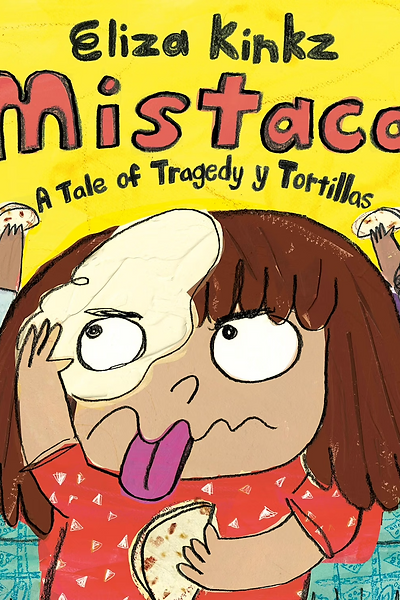
¡Mistaco! A Tale of Tragedy y Tortillas
by Eliza Kinkz
Pacing MaterialA bilingual, laugh-out-loud tale of a kitchen disaster involving a mistaken taco — told with Spanish and English wordplay.
Big Idea
Bilingual wordplay celebrates two languages, and even a kitchen disaster can be a story worth telling.
Discussion Questions
- 1.What words does the author play with in Spanish and English?
- 2.How does the mistake become a story?
- 3.What does it mean to tell a story in two languages?
- 4.Have you ever mixed up words in a funny way?
Classroom Activity
Word Mix-Up Story
Write a short story that plays with a mixed-up word. Illustrate the funny result.
Lesson Plan
Learning Goals
- Identify how Spanish and English wordplay creates humor in ¡Mistaco! A Tale of Tragedy y Tortillas.
- Describe the kitchen mix-up and explain how characters respond to the unexpected result.
- Create a short story with a clear beginning, a funny word mix-up, and an ending.
- Use illustrations and story details to show the humorous result while respecting both languages.
Activity Steps
- 1.Read the book aloud, pausing at Spanish and English wordplay. Invite students to use illustrations and context to explain what makes the kitchen disaster funny.
- 2.Discuss the title ¡Mistaco! and its playful connection to a mistake and a taco. Ask: How can a mixed-up word turn an ordinary kitchen moment into a story?
- 3.Model inventing a word mix-up, such as hearing 'taco boat' instead of 'taco bowl.' Sketch the silly result. Create a class word bank with familiar food words from the book and students’ languages; clarify meanings together.
- 4.Have students choose a mixed-up word or phrase and plan three parts: what a character intended, what happened because of the mix-up, and how the character responded. Encourage playful situations rather than jokes about someone’s language or accent.
- 5.Students write and illustrate their Word Mix-Up Story. Kindergarteners may draw and dictate one or two sentences; older students write three to six sentences. Invite students to include Spanish and English words they understand, with labels or context clues.
- 6.Invite partners to share their stories, explain the mixed-up words, and identify a detail in the illustration that adds humor. Close by discussing how mistakes can inspire creativity and how two languages can enrich storytelling.
Standards Connections
- ELA: RL.K.3 / RL.1.3 — Identify characters and major events; describe characters’ responses to events.
- ELA: RL.K.7 / RL.1.7 — Use illustrations and story details to explain what happens.
- ELA: W.K.3 / W.1.3 / W.2.3 / W.3.3 — Create narratives using drawing, dictation, or writing, with developmentally appropriate event sequencing and details.
- ELA: SL.K.1 / SL.1.1 / SL.2.1 / SL.3.1 — Participate in collaborative conversations about texts and student-created stories.
- SEL: Social awareness — Appreciate linguistic diversity and respond respectfully to classmates’ language choices.
Pace-Write-Read Study with Pace-Write It!
Focus question: How does an author make a funny kitchen mix-up feel fast, surprising, and fun to read aloud? In ¡Mistaco! A Tale of Tragedy y Tortillas by Eliza Kinkz, a small mistake in the kitchen grows into a big, silly problem through bilingual wordplay, lively illustrations, and quick scene changes. The pacing moves briskly with page turns, repeated sounds and phrases, and playful pauses that help readers enjoy the humor while wondering what will happen to the mistaken taco next.
| Element | How to notice or teach it in the novel |
|---|---|
| Pace | Read: Notice how the story moves quickly from one kitchen problem to the next as the taco mistake grows bigger and funnier. The fast pacing matches the chaotic, playful mood of the family cooking scene. Classroom Activity: Write 3 short sentences about a food mistake that gets worse each sentence, using quick action words. |
| Plot | Read: Notice the clear plot: a kitchen mix-up begins, the problem grows through funny misunderstandings, and the story builds toward a silly resolution. In ¡Mistaco!, the mistaken taco drives every part of the action. Classroom Activity: Draw and label beginning, middle, and end for your own funny mix-up story. |
| Prosody | Read: Listen to how the Spanish and English words sound together when read aloud. The rhythm of the language helps the humor land and makes the story feel musical and dramatic. Classroom Activity: Choose one line pattern and write your own bilingual or echo-style sentence to read aloud with expression. |
| Word pause | Read: Notice where a surprising word or phrase makes you stop for a beat before turning the page or laughing. In this book, wordplay around the taco mistake creates tiny pauses that build humor. Classroom Activity: Write one sentence about a kitchen accident and underline the word where a reader should pause for effect. |
| Concept | Read: Notice the big idea that a small mistake can turn into a big story, especially when language is playful. The book also celebrates bilingual storytelling by making Spanish and English part of the fun. Classroom Activity: Write a sentence naming a small mistake and a sentence telling how it becomes a big problem. |
| Voice & World View | Read: Notice the warm, dramatic, funny voice that treats the kitchen disaster like a grand tragedy. The world of the story feels joyful and expressive, showing a family-centered view where food, language, and laughter matter. Classroom Activity: Write 2 sentences about an ordinary problem as if it were the biggest disaster ever. |
| Setting & Place | Read: Notice how the kitchen is the main place where the action happens, with tortillas, cooking tools, and food helping shape the story. The setting feels busy, homey, and full of movement. Classroom Activity: Make a list of 5 kitchen objects, then use 3 of them in a funny scene. |
| Point of View | Read: Notice how the story’s point of view lets readers watch the mix-up unfold and enjoy each new mistake. The narration helps us see the mistaken taco as both a problem and a joke. Classroom Activity: Rewrite one moment from the point of view of the taco, using 'I'. |
| Original Characters | Read: Notice how the characters feel memorable because they react in big, exaggerated ways to the kitchen disaster. Even the mistaken taco feels almost like a character because the whole story revolves around it. Classroom Activity: Invent a character who reacts dramatically to a small problem and write 3 describing words for them. |
| Dialogue | Read: Notice how spoken lines can make the kitchen feel alive and help the pacing move faster. Dialogue in a humorous story like ¡Mistaco! can show surprise, confusion, and family energy in just a few words. Classroom Activity: Write 2 lines of dialogue between a cook and a child after a recipe goes wrong. |
| Details | Read: Notice the small food and kitchen details that make the mistake feel real and funny, such as tortillas, ingredients, and the actions around preparing food. These details help readers picture the scene clearly. Classroom Activity: Write a sentence packed with 4 small details about making a snack. |
| Descriptions | Read: Notice how descriptions make the kitchen mishap vivid without slowing the story too much. The book balances quick action with just enough description to help readers see the tortilla trouble. Classroom Activity: Describe a messy food scene using 3 adjectives and 1 action verb. |
| Strong First Lines | Read: Notice how the opening pulls readers right into the mood of trouble and fun. A strong beginning in a humor book promises that something silly is about to happen. Classroom Activity: Write an opening line for a story about a food mistake that makes the reader want to know more. |
| Immediacy & Engagement | Read: Notice how readers feel close to the action right away because the problem starts quickly and the language sounds lively. The bilingual humor invites readers to join in and respond. Classroom Activity: Write 2 sentences that begin with action so the reader feels dropped into the middle of the scene. |
| Story Scenes & Summaries & Unique Structures | Read: Notice how the book uses short scenes of action rather than long explanations, letting the mistaken taco story unfold moment by moment. Its bilingual humor and dramatic storytelling give it a unique structure. Classroom Activity: Plan a story in 4 tiny scenes instead of one long paragraph. |
| Flashback & Flash Forward & Cliffhangers | Read: Notice that this story mostly stays in the present action, which keeps the pacing quick, but page-by-page suspense can still feel like a mini cliffhanger. Readers want to see how the next part of the kitchen disaster will top the last one. Classroom Activity: End a sentence with a cliffhanger, such as 'But when I opened the tortilla...'. |
| Tension & Suspense & Surprise | Read: Notice how suspense grows because readers know the mistake is getting bigger, but they do not know exactly how silly it will become. Surprise is a big part of the humor in the mistaken taco tale. Classroom Activity: Write 3 sentences that build from normal to surprising in a kitchen scene. |
| Page Turns and Chapter Breaks | Read: Notice how page turns help the jokes land by hiding the next part of the disaster until the reader flips the page. In a picture book like ¡Mistaco!, the page turn works like a punchline reveal. Classroom Activity: Fold a paper into 2 pages and write a setup on page 1 and a surprise on page 2. |
| Performance | Read: Notice how this book begs to be performed with dramatic voices, big pauses, and expressive reading. The humor becomes even stronger when readers act out the kitchen tragedy. Classroom Activity: Practice reading one line in a serious 'tragedy' voice and one line in a silly voice, then write a line for each. |
| Personality | Read: Notice how the story’s personality is bold, playful, and exaggerated. The book treats a taco mistake like a major event, giving the whole story a cheerful, theatrical feeling. Classroom Activity: Write 2 sentences in a big dramatic personality about dropping or spilling food. |
| Humor | Read: Notice how humor comes from wordplay, exaggeration, bilingual language, and the idea that a simple taco mistake becomes a giant problem. The title itself, ¡Mistaco!, signals the joke. Classroom Activity: Invent a food pun title for your own story and write 1 funny sentence to match it. |
| Pause | Read: Notice where a pause before a reveal makes the joke funnier or the surprise stronger. In this story, pauses can happen before a key food word, a reaction, or a page turn. Classroom Activity: Add slash marks to show 2 places a reader should pause in your funny sentence. |
| Poetry and Poetic Devices | Read: Notice the playful sounds, repeated phrases, and dramatic language that make parts of the story feel almost poetic. The mix of Spanish and English adds sound texture and energy. Classroom Activity: Write a 3-line food poem using alliteration or repeated beginning sounds. |
| Repetition | Read: Notice how repeated sounds, words, or ideas can make the kitchen disaster funnier and easier for young readers to join. Repetition also helps build rhythm in bilingual storytelling. Classroom Activity: Write a line with a repeated word or phrase, such as 'Oh no, oh no, my taco!'. |
| Rhythm | Read: Notice the beat of the sentences as the action speeds along from one problem to the next. The rhythm helps the story feel lively and read-aloud friendly. Classroom Activity: Clap the beat of a sentence, then write your own sentence with a strong read-aloud rhythm. |
| Punctuation | Read: Notice how exclamation marks and other punctuation add drama to the kitchen mishap. Punctuation helps readers know when to sound shocked, loud, or worried in this humorous story. Classroom Activity: Write one plain sentence, then rewrite it with punctuation that makes it dramatic. |
| Questions | Read: Notice how readers may start asking what went wrong, what will happen next, and how the family will fix the mistake. Questions help keep the pacing moving forward. Classroom Activity: Write 2 questions a character might ask during a cooking disaster. |
| Compare-Contrast | Read: Notice the contrast between a small mistake and the huge dramatic reaction to it. You can also compare the calm start of cooking with the chaotic middle of the taco trouble. Classroom Activity: Write one sentence comparing before the mistake and one sentence contrasting after the mistake. |
| Objects | Read: Notice how objects like tortillas, ingredients, and kitchen tools help tell the story and move the action. In this book, food objects are central to both the plot and the humor. Classroom Activity: Choose one kitchen object and write about how it causes or solves a problem. |
| Threes | Read: Notice whether the story groups actions or reactions in ways that feel satisfying, such as three attempts, three surprises, or three details. Groups of three often make humor stronger and easier to remember. Classroom Activity: Write 3 connected things that go wrong while making a meal. |
| Whitespace & Negative Space | Read: Notice how open space on a picture-book page can slow a reader down, spotlight a joke, or make a dramatic moment stand out. In ¡Mistaco!, space can help frame the silliness of the taco disaster. Classroom Activity: Write one short sentence and leave space around it to make the line feel important. |
| Art & Graphics | Read: Notice how the illustrations support pacing by showing motion, emotion, and the growing kitchen chaos. The art helps readers understand the humor, especially when the words and pictures work together on the mistaken taco joke. Classroom Activity: Sketch one scene from your own food-mistake story and add a caption. |
| Interactives & Gamification | Read: Notice how readers can join the fun by predicting what the next mistake will be, echoing repeated phrases, or acting out dramatic reactions. The playful style of the book invites participation. Classroom Activity: Create a 'predict the next mishap' box for your story and write 2 possible next events. |
Pace-Write It!
20-Minute Classroom Flow\nRead (5 min): Read ¡Mistaco! A Tale of Tragedy y Tortillas by Eliza Kinkz aloud with dramatic expression. Pause at key page turns so students can predict how the kitchen mistake will grow.\nNotice (5 min): Ask students to notice how the story gets funnier through quick pacing, repeated ideas, exclamation marks, and bilingual wordplay. Chart 3 things: a fast action, a funny pause, and a surprising reveal.\nWrite (7 min): Students write their own tiny 'food mistake' scene. Writing frame: 'First, I was making ____. Then, ____ went wrong. Oh no! ____! Next, the problem got bigger when ____. In the end, ____.' Encourage students to add one dramatic punctuation mark, one repeated word or phrase, and one funny food detail.\nShare (3 min): Partners read their scenes aloud using dramatic voices and a pause before the funniest part. Invite 1-2 volunteers to perform for the class.\nExit ticket: Write one sentence answering: 'How did pacing make the food mistake funnier?'
Pace-Write-Read Connection
Teach this book using the Pace-Write-Read method — Tool 20: Play.
Open the Mastery Manual