 5-8
5-8GN SHEINKIN
Mind vs. Machine
by Steve Sheinkin and Maurice Ashley
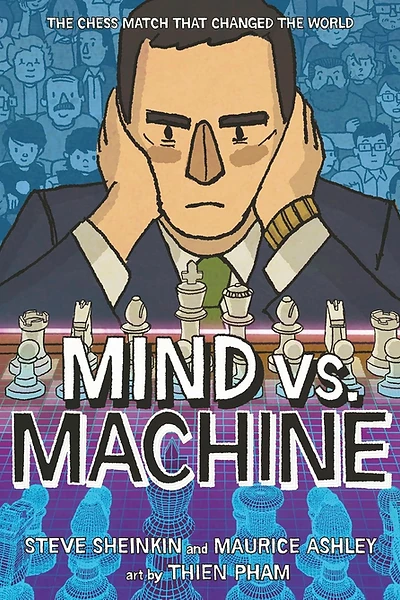
Pacing MaterialMind vs. Machine: The Chess Match That Changed the World tells the true story of Garry Kasparov, one of the greatest chess players in the world, and his famous match against IBM's supercomputer, Deep Blue. Told as a nonfiction graphic novel, the book turns a quiet game of chess into a tense showdown about strategy, intelligence, pride, technology, and the future of artificial intelligence. The story helps readers see that chess is more than moving pieces on a board. It is prediction, pressure, memory, creativity, and risk. As Kasparov faces Deep Blue, readers are invited to think about what makes humans unique and what machines can do.
Big Idea
Human thinking and machine thinking are powerful in different ways. Technology can calculate quickly, but people bring creativity, emotion, intuition, and meaning to the choices they make.
Discussion Questions
- 1.Why did the chess match between Garry Kasparov and Deep Blue matter to people around the world?
- 2.What strengths does a computer have in a chess match? What strengths does a human have?
- 3.How does the graphic novel format help make a quiet game feel exciting?
- 4.What moments in the story create suspense?
- 5.How do facial expressions, panels, and page turns affect the pacing?
- 6.Do you think Deep Blue's win was only about chess, or was it about something bigger?
- 7.How does the book show the difference between knowledge, strategy, and intelligence?
- 8.What questions does this book raise about artificial intelligence today?
Classroom Activity
Human vs. Machine Thinking Chart
Students create a two-column chart comparing Human Mind vs. Machine Logic, then choose one chess moment, classroom challenge, sport, game, or real-life decision and explain which side would have the advantage: human, machine, or both.
Lesson Plan
Learning Goals
- Identify how nonfiction writers and graphic novel artists create suspense through pacing techniques
- Compare and contrast human thinking and machine logic
- Write a short nonfiction suspense scene using pause, page turn, strong verb, contrast, and unanswered question
- Analyze how facial expressions, panels, and page turns affect pacing in graphic novels
Activity Steps
- 1.Create a two-column chart: Human Mind (uses intuition, feels pressure, makes creative leaps, can doubt itself, understands meaning) vs. Machine Logic (uses calculation, follows programming, tests many possibilities, does not feel doubt, processes data).
- 2.Choose one chess moment, classroom challenge, sport, game, or real-life decision.
- 3.Explain which side would have the advantage: human, machine, or both.
- 4.Write a short nonfiction suspense scene using the frame: The room was ___. Everyone watched ___. One choice could ___. The next move was ___. For a moment, no one ___. Then ___.
- 5.Read the scene aloud. Classmates identify the pacing move that created suspense: pause, page turn, strong verb, contrast, or unanswered question.
- 6.Exit Ticket: How does Mind vs. Machine make chess feel exciting? Write one sentence naming one pacing technique from the book.
Standards Connections
- ELA: RI.5-8.3 Explain relationships between events
- ELA: RI.5-8.5 Analyze structure in nonfiction
- ELA: W.5-8.3 Write narratives using pacing and suspense
- ELA: SL.5-8.1 Engage in discussions
- ELA: SL.5-8.2 Analyze information presented in diverse media
- SEL: Self-awareness and responsible decision-making
- Art: Visual storytelling and graphic novel structure
Pace-Write-Read Study with Pace-Write It!
Mind vs. Machine: The Chess Match That Changed the World by Steve Sheinkin and Maurice Ashley, illustrated by Thien Pham, is a nonfiction graphic novel about Garry Kasparov's chess matches against IBM's Deep Blue. The book frames chess as a high-stakes showdown between human thinking and computer power, using sports-style suspense, graphic panels, first-hand chess insight, and AI history to make a quiet game feel intense.
| Element | How to notice or teach it in the novel |
|---|---|
| Pace | The pace alternates between fast match tension and slower explanation of chess, computers, and strategy. |
| Plot | The plot follows a true contest: human champion vs. machine challenger. |
| Prosody | Short panel text can sound sharp, tense, and dramatic. |
| Word pause | Graphic panels create built-in pauses between moves and reactions. |
| Concept | The central idea is human mind versus artificial intelligence. |
| Voice & World View | The voice treats chess as strategy, psychology, sport, and history. |
| Setting & Place | Settings include chessboards, match rooms, computer labs, and media attention. |
| Point of View | The book uses nonfiction narration with expert insight from chess grandmaster Maurice Ashley. |
| Original Characters | The people are real: Garry Kasparov, IBM's team, Maurice Ashley, and Deep Blue's creators. |
| Dialogue | Dialogue and speech bubbles can create immediacy in the graphic format. |
| Details | Chess moves, computer history, match rules, and reactions make the story believable. |
| Descriptions | Description helps readers feel the silence, focus, and pressure of the match. |
| Strong First Lines | A strong opening can begin with the impossible question: can a machine beat the best human mind? |
| Immediacy & Engagement | The match structure gives readers a reason to keep watching every move. |
| Story Scenes, Summaries & Unique Structures | The graphic novel blends scenes, history, explanation, and match-by-match pacing. |
| Flashback, Flash Forward & Cliffhangers | Background sections explain AI and chess history; game moments create cliffhangers. |
| Tension, Suspense & Surprise | Suspense comes from not knowing whether human intuition or machine calculation will win. |
| Page Turns and Chapter Breaks | Page turns can reveal a move, mistake, reaction, or result. |
| Performance | Panels invite dramatic reading through silence, reaction, and short lines. |
| Personality | Kasparov's confidence, intensity, and frustration can shape the pacing. |
| Humor | Humor can come from human reactions, chess culture, or tech confidence. |
| Pause | Pauses matter because chess is built on waiting and thinking. |
| Poetry and Poetic Devices | Contrast, repetition, and metaphor can turn chess into battle, music, or code. |
| Repetition | Repeated moves, clocks, turns, and calculations build rhythm. |
| Rhythm | The rhythm moves: think, move, react, explain, turn page. |
| Punctuation | Ellipses, dashes, and exclamation points can control suspense and reaction. |
| Questions | The book raises questions about intelligence, creativity, machines, and the future. |
| Compare-Contrast | Human intuition contrasts with computer calculation. |
| Objects | Chessboard, pieces, clock, computer, screen, and notation carry meaning. |
| Threes | Three-part pacing can build pressure: move, response, consequence. |
| Whitespace & Negative Space | Empty space can show silence, waiting, and mental pressure. |
| Art & Graphics | Thien Pham's graphic storytelling turns thinking into visible action. |
| Interactives & Gamification | The match naturally invites prediction and strategy. |
Pace-Write It!
Write a nonfiction showdown scene. Use this frame: The room is ___. On one side: ___. On the other: ___. The challenge is ___. One move changes ___. Now everyone waits because ___.