 PreK-2
P GRAZIANO
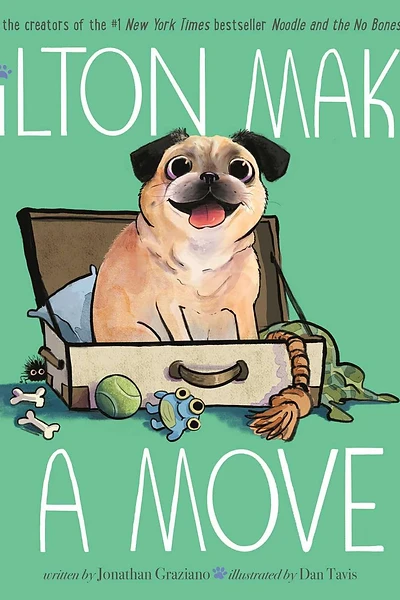
Milton Makes a Move
by Jonathan Graziano
Pacing MaterialMilton the dog faces a big change and discovers that making a move — even a scary one — can lead to wonderful new things.
Big Idea
Change can be scary, but courage and curiosity turn a new beginning into an adventure.
Discussion Questions
- 1.Why is Milton nervous about the move?
- 2.What helps Milton feel brave?
- 3.How do you feel when something changes?
- 4.What new thing could be exciting about a change?
Classroom Activity
My Brave Move
Draw a time you were brave during a change. Write one sentence about what helped you.
Lesson Plan
Learning Goals
- Identify the big change Milton faces and describe how he feels about making a move.
- Explain how courage and curiosity help Milton discover wonderful new things.
- Connect Milton’s experience to a personal or imagined moment of bravery during a change.
- Draw a brave moment and write or dictate one sentence explaining what helped.
Activity Steps
- 1.Introduce “My Brave Move.” Ask, “How might a dog feel when facing a big change?” Explain that a move can mean going somewhere new or trying something unfamiliar.
- 2.Read Milton Makes a Move aloud. Pause at moments of uncertainty and discovery to ask, “What is Milton feeling? What in the words or pictures helps you know?”
- 3.Discuss Milton’s experience: “What felt scary about his change? How did taking a brave step lead to something new?” List children’s ideas about helpful supports, such as a trusted person, curiosity, or taking a small step.
- 4.Invite children to think of a change, such as starting school, joining a group, or visiting a new place. Have them draw themselves taking a brave step. Children may imagine an example if they prefer not to share a personal experience.
- 5.Help children write one sentence using the frame, “I was brave when ____. ____ helped me.” PreK children may dictate; older children can write independently and add labels to their drawings.
- 6.Invite voluntary sharing with a partner or the class. Close by asking, “What could help you make your next brave move?” Connect their responses to Milton’s courage and curiosity.
Standards Connections
- ELA: RL.K.3 / RL.1.3 — Describe Milton and the major events surrounding his change, using story details.
- ELA: W.K.3 / W.1.3 — Use drawing, dictation, or writing to recount a brave moment during a change.
- ELA: SL.K.1 / SL.1.1 — Participate in conversations about Milton’s experience and classmates’ ideas.
- SEL: Self-awareness — Identify feelings associated with change and recognize personal examples of courage.
- SEL: Self-management — Identify supports and strategies for approaching unfamiliar situations.
Pace-Write-Read Study with Pace-Write It!
Focus question: How does an author slow down and speed up a story to help us feel a character’s brave new beginning? In Milton Makes a Move by Jonathan Graziano, Milton the dog faces a big life change and learns that a scary move can lead to comfort, friendship, and discovery. The story’s pacing helps young readers feel both the worry of leaving something familiar and the excitement of what comes next.
| Element | How to notice or teach it in the novel |
|---|---|
| Pace | Read: Notice how the story moves more slowly when Milton is worried about the big move and then feels quicker as he begins to explore new places and new possibilities. Classroom Activity: Write 3 short sentences that slow down a scary moment and 3 short sentences that speed up a happy discovery for a dog character. |
| Plot | Read: Follow Milton’s journey from change, to uncertainty, to courage, to a new beginning. Classroom Activity: Draw and label a 4-part plot map: before the move, the hard part, the brave step, and the good surprise. |
| Prosody | Read: Listen for places where your voice can sound nervous, calm, excited, or relieved as Milton’s feelings change. Classroom Activity: Reread one page aloud in two ways—first with a worried voice, then with a hopeful voice—and write one sentence about which fits Milton best. |
| Word pause | Read: Notice where a reader might naturally stop on an important word like move, new, brave, or home to let the feeling sink in. Classroom Activity: Write a sentence about Milton and circle the one word a reader should pause on for emphasis. |
| Concept | Read: Think about the big idea that new beginnings can feel scary at first, but courage helps us grow. Classroom Activity: Finish this idea in your own words: 'A move can be scary, but ________.' |
| Voice & World View | Read: Notice that the story sees the big change through Milton’s feelings, helping readers understand a dog’s experience of leaving the familiar and trying the new. Classroom Activity: Write 2 sentences in a gentle, caring voice that show how Milton sees his new world. |
| Setting & Place | Read: Pay attention to the places Milton knows and the new places he must learn, and how each place affects his comfort and confidence. Classroom Activity: Make a T-chart labeled 'Old Place' and 'New Place' and list 3 details for each. |
| Point of View | Read: Notice how the story centers Milton’s experience so readers stay close to his emotions during the move. Classroom Activity: Write one sentence from Milton’s point of view beginning with 'I feel...' and one from another character beginning with 'Milton looks...'. |
| Original Characters | Read: Notice what makes Milton memorable as a dog character—his feelings, reactions, and brave steps during a change. Classroom Activity: Invent a new animal friend for Milton and write 3 details that make the character unique. |
| Dialogue | Read: Listen for words that could comfort Milton, encourage him, or show excitement about the new place. Classroom Activity: Write 2 lines of dialogue between Milton and a kind person or new friend on moving day. |
| Details | Read: Notice the small details that help readers understand Milton’s fear and then his growing comfort in a new home or neighborhood. Classroom Activity: Write 4 detail words that could show a moving day scene, such as sounds, sights, or objects. |
| Descriptions | Read: Pay attention to how descriptions can make a place feel unfamiliar at first and welcoming later. Classroom Activity: Describe Milton’s new place in one sentence when it feels scary and one sentence when it feels exciting. |
| Strong First Lines | Read: Think about how the beginning needs to quickly introduce Milton and his big change so readers want to keep going. Classroom Activity: Write a strong first line for a story about an animal facing a new beginning. |
| Immediacy & Engagement | Read: Notice how the story keeps readers close to Milton’s moment-by-moment feelings so the move feels important right away. Classroom Activity: Write 2 sentences that begin with 'Today...' or 'Now...' to make your scene feel immediate. |
| Story Scenes & Summaries & Unique Structures | Read: Notice which parts of Milton’s experience feel like full scenes and which parts are told more quickly to move the story along. Classroom Activity: Write one detailed scene of Milton opening a door and one summary sentence that tells what happened later that day. |
| Flashback & Flash Forward & Cliffhangers | Read: Think about how readers might remember Milton’s old home while he enters a new one, and how a page can end with uncertainty before the next reveal. Classroom Activity: Write a flashback sentence about what Milton misses and a cliffhanger ending such as 'Then Milton heard...'. |
| Tension & Suspense & Surprise | Read: Notice how the tension comes from not knowing whether Milton will feel safe and happy after the move, and how discovery brings surprise. Classroom Activity: Write 3 sentences that build suspense before Milton finds something wonderful in the new place. |
| Page Turns and Chapter Breaks | Read: In a picture book like this one, page turns can hold the question of what Milton will see or feel next. Classroom Activity: Write one sentence for the bottom of a page that makes readers want to turn to see what Milton discovers. |
| Performance | Read: Notice how facial expressions, movement, and voice can help perform Milton’s nervousness and bravery during a read-aloud. Classroom Activity: Choose one moment and add stage directions in parentheses, such as '(whispers)' or '(looks around slowly)'. |
| Personality | Read: Pay attention to what Milton’s choices and reactions show about his personality—careful, sensitive, curious, and brave. Classroom Activity: Write 3 personality words for Milton and a sentence that proves one of them. |
| Humor | Read: Look for gentle, child-friendly humor in the way a dog might react to boxes, new smells, or unfamiliar routines during a move. Classroom Activity: Write a funny but kind sentence about Milton exploring something new. |
| Pause | Read: Notice where the story might pause on a feeling or important moment, like Milton stopping before taking a brave step. Classroom Activity: Write a sentence and add an ellipsis or line break to create a pause before the brave action. |
| Poetry and Poetic Devices | Read: Listen for soft, expressive language that could make Milton’s feelings sound musical or vivid. Classroom Activity: Write a simile for Milton’s feeling, such as 'Milton felt as ______ as ______.' |
| Repetition | Read: Notice how repeating a word or phrase like 'new' or 'brave' could help show the theme of courage and new beginnings. Classroom Activity: Write a 3-line piece that repeats the same starter phrase about Milton. |
| Rhythm | Read: Hear how short and long sentences together can create the beat of worry, waiting, and then joyful movement. Classroom Activity: Write one short sentence, one longer sentence, and one short sentence to match Milton’s changing feelings. |
| Punctuation | Read: Notice how question marks, commas, periods, and exclamation points can shape the feeling of a moving-day moment for Milton. Classroom Activity: Write the same basic sentence two ways, once with a question mark and once with an exclamation point, and tell how the feeling changes. |
| Questions | Read: Notice the questions readers may ask while Milton adjusts: Will he like it here? What will happen next? Classroom Activity: Write 2 questions Milton might be thinking on moving day. |
| Compare-Contrast | Read: Compare how Milton feels at the start of the move and later when the new place begins to feel special. Classroom Activity: Complete this frame: 'At first Milton felt ____, but later he felt ____.' |
| Objects | Read: Pay attention to meaningful objects like boxes, toys, bowls, beds, leashes, or favorite comforts that can help tell Milton’s story. Classroom Activity: Pick one object Milton carries or notices and write 2 sentences about why it matters. |
| Threes | Read: Notice how listing three feelings, places, or discoveries can make the story sound satisfying and complete. Classroom Activity: Write a sentence naming 3 things Milton sees in his new place. |
| Whitespace & Negative Space | Read: In a picture book, open space on a page can make Milton seem small, lonely, thoughtful, or ready for something new. Classroom Activity: Plan one page of your own story and decide where you would leave extra blank space to show a big feeling. |
| Art & Graphics | Read: Notice how the illustrations help show Milton’s emotions, the mood of the move, and the warmth of a new beginning. Classroom Activity: Sketch Milton in two panels—one worried and one brave—and label the feeling in each. |
| Interactives & Gamification | Read: Think about how readers can interact by predicting what Milton will do next or by hunting for clues in the pictures that show he is becoming more comfortable. Classroom Activity: Create a 'Find 3 clues Milton feels braver' picture hunt list for a partner. |
Pace-Write It!
20-Minute Classroom Flow\nRead (5 min): Read aloud a section of Milton Makes a Move by Jonathan Graziano that shows Milton feeling unsure at first and then beginning to explore. Pause briefly at one page turn to ask, 'How is Milton feeling right now?'\nNotice (5 min): Guide students to notice pacing. Ask: 'Where did the story slow down so we could feel Milton’s worry? Where did it speed up when things got better?' Chart two columns: 'Slow moments' and 'Fast moments.' Add student ideas such as scary new place, waiting, first brave step, happy discovery.\nWrite (7 min): Students write their own short 'new beginning' scene for Milton or another animal character. Writing frame: 'At first, ______ felt ______. Everything was ______. Then ______ took one brave step. Soon, ______ discovered ______. Now, ______ feels ______.' Encourage students to use one slow detail sentence and one fast action sentence.\nShare (3 min): Partners read their writing aloud and point to the sentence that slows the moment down and the sentence that speeds it up. Invite 1–2 students to share with the class.\nExit ticket: Complete this sentence on a sticky note: 'Pacing helps readers feel ______ because ______.'
Pace-Write-Read Connection
Teach this book using the Pace-Write-Read method — Tool 30: Contrast.
Open the Mastery Manual