 K-2
K-2P TABOR
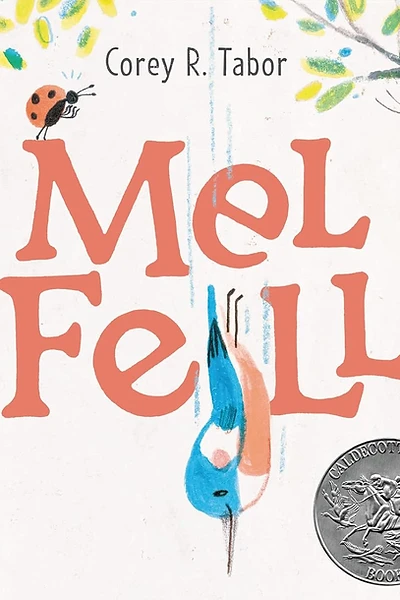
Mel Fell
by Corey R. Tabor
Pacing MaterialA brave little kingfisher takes her first leap from the nest in this Caldecott Honor-winning picture book about courage, growth, and finding your wings.
Big Idea
Sometimes falling is the first step to flying.
Discussion Questions
- 1.What happens when Mel falls from the nest?
- 2.How does the author use vertical space to tell the story?
- 3.What animals does Mel meet on the way down?
- 4.Have you ever been scared to try something new?
Classroom Activity
Falling Adventures
Go on a 'falling' writing adventure — write about something that falls and what happens next, from the perspective of the object.
Lesson Plan
Learning Goals
- Analyze vertical narrative structure
- Explore themes of courage and growth
- Practice perspective writing
Standards Connections
- ELA: RL.K.1 — Ask and answer questions about key details
- ELA: RL.K.2 — Retell stories, including key details
- ELA: RL.K.3 — Describe characters, setting, and events
- ELA: RL.2.6 — Acknowledge differences in characters' points of view
- ELA: SL.K.1 — Participate in collaborative conversations about the text
- ELA: W.K.3 — Write narratives recounting events with descriptive details
- SEL: Self-Management
- SEL: Responsible Decision-Making
- Art: VA:Re7 — Perceive and analyze artistic work
Pace-Write-Read Study with Pace-Write It!
Focus question: How does an author slow down and speed up a character’s brave moment so readers feel the courage grow? In Mel Fell by Corey R. Tabor, a young kingfisher takes her first leap from the nest, and the book’s pacing helps readers feel every second of that big decision. Tabor uses page turns, changing page orientation, short lines, and visual suspense to stretch Mel’s fall into a thrilling moment of growth and triumph.
| Element | How to notice or teach it in the novel |
|---|---|
| Pace | Read: Notice how Mel’s first jump begins with a quick brave decision, then the fall feels long and suspenseful as the pages stretch the moment before her success. Classroom Activity: Write 3-4 sentences about a time a character tries something new, using one quick sentence to start and longer sentences to slow the important moment down. |
| Plot | Read: Track the simple but powerful plot in Mel Fell: Mel wants to fly, leaps from the nest, falls past many animals, and discovers she can fly. Classroom Activity: Make a 4-box plot map labeled beginning, problem, big moment, and ending, then write one sentence for each box about Mel’s adventure. |
| Prosody | Read: Listen to how the lines can be read with changing expression—encouraging at the nest, tense during the fall, and joyful when Mel spreads her wings. Classroom Activity: Choose three lines or moments from the story and practice reading them aloud with a brave voice, a worried voice, and a proud voice, then write one sentence about why your voice changed. |
| Word pause | Read: Notice where the words and line breaks make you stop and hold your breath as Mel drops farther from the nest. Classroom Activity: Write a short 3-line scene about a character jumping, slipping, or trying something scary, and place one line break where you want the reader to pause. |
| Concept | Read: The central concept in this book is that courage does not mean feeling no fear; it means trying and growing anyway, just like Mel. Classroom Activity: Finish the sentence frame: 'Mel is brave because ___,' then add a second sentence explaining what the book teaches about growth. |
| Voice & World View | Read: Notice the warm, playful, encouraging voice that treats Mel’s leap as both scary and exciting, showing a world where young creatures learn by trying. Classroom Activity: Write 2-3 sentences in an encouraging narrator voice telling a tiny animal to keep trying something difficult. |
| Setting & Place | Read: Pay attention to the cliffside nest above the ocean and how the long drop through the air shapes the whole story. Classroom Activity: Draw and label Mel’s setting with the nest, cliff, ocean, and animals below, then write two sentences explaining how the place makes the story more suspenseful. |
| Point of View | Read: Notice that the story is told from an outside narrator, but readers stay closely connected to Mel’s experience as she falls and learns. Classroom Activity: Rewrite one moment from the book from Mel’s point of view using 'I,' such as 'I looked down and ___.' |
| Original Characters | Read: Mel is an original main character because she is tiny, determined, and brave, while the sea creatures below add surprise and humor as witnesses to her fall. Classroom Activity: Invent a new animal character who watches Mel fall and write two sentences describing what that character thinks about her bravery. |
| Dialogue | Read: Listen for how the words spoken to Mel help show support, expectation, and the big moment of trying. Classroom Activity: Write a two-line dialogue between Mel and a family member before the jump, with one line of encouragement and one line showing Mel’s feelings. |
| Details | Read: Notice the small details of Mel’s body, the nest, the drop, and the watching animals that make the story feel real and immediate. Classroom Activity: Write a sentence about Mel’s fall using at least three details, such as what she sees, hears, and feels. |
| Descriptions | Read: Corey R. Tabor uses clear, vivid descriptions and illustrations to help readers picture the height, the motion, and the surprise of Mel’s flight. Classroom Activity: Describe Mel’s jump using the frame 'Mel leaped from ___. She saw ___. She felt ___.' |
| Strong First Lines | Read: Notice how the beginning quickly introduces Mel and her challenge so readers are ready for the important leap. Classroom Activity: Write a strong first line for a new story about a young animal trying something brave for the first time. |
| Immediacy & Engagement | Read: The story feels immediate because readers are pulled right into Mel’s leap and stay close to the action from moment to moment. Classroom Activity: Write 2-3 action sentences that begin with strong verbs, such as 'Mel leaped,' 'Mel dropped,' or 'Mel glided.' |
| Story Scenes & Summaries & Unique Structures | Read: Notice that this picture book stretches one important scene—Mel’s first leap—into the heart of the story instead of summarizing it quickly. Its vertical design makes the structure feel unique and dramatic. Classroom Activity: Write one sentence that summarizes Mel’s whole adventure, then write three short sentences that zoom in on just the falling scene. |
| Flashback & Flash Forward & Cliffhangers | Read: This story does not use flashbacks much, but it does use cliffhanger-like page turns and pauses to keep readers wondering whether Mel will fall or fly. Classroom Activity: Write a page-turn sentence that ends with suspense, such as 'Mel spread her wings, but ___.' |
| Tension & Suspense & Surprise | Read: Feel the tension as Mel drops lower and lower, the suspense as readers wait, and the surprise when the fall becomes flight. Classroom Activity: Write three sentences labeled Tension, Suspense, and Surprise about Mel’s leap. |
| Page Turns and Chapter Breaks | Read: Notice how page turns are very important in Mel Fell because each turn reveals more of the long fall and builds anticipation; as a picture book, it uses page turns instead of chapter breaks. Classroom Activity: Fold a paper into three parts and plan a mini picture book with a page-turn surprise on the second panel. |
| Performance | Read: This book invites performance because readers can tilt the book, gesture the falling motion, and use dramatic voices during the drop and triumphant voices at the end. Classroom Activity: Act out Mel’s leap with your hand moving through the air, then write one sentence about how performing the story changed your understanding of the pace. |
| Personality | Read: Mel’s personality shines through her bold choice to leap, even though she is small and new to flying. Classroom Activity: List three character traits for Mel and write one sentence explaining which trait helps her grow the most. |
| Humor | Read: Notice the gentle humor in the animals below reacting to Mel’s fall and in the surprising way such a scary moment also feels playful. Classroom Activity: Write a funny reaction line that a fish, crab, or gull might say while watching Mel zoom by. |
| Pause | Read: The story uses pauses before and during the leap so readers can feel the wobble between fear and courage. Classroom Activity: Write a two-sentence moment about a character getting ready to try something hard, and put ellipses or a line break where the character pauses. |
| Poetry and Poetic Devices | Read: Even though Mel Fell is a picture book, some lines feel poetic because they are brief, musical, and full of feeling during the long fall. Classroom Activity: Write a 4-line poem about Mel using one comparison, such as 'like a feather' or 'like an arrow.' |
| Repetition | Read: Notice repeated ideas about falling, trying, and flying that help the big moment feel bigger and easier for young readers to follow. Classroom Activity: Write three short lines that repeat the same beginning, such as 'Mel fell past ___. Mel fell past ___. Mel flew over ___.' |
| Rhythm | Read: The rhythm changes from steady at the start to quick and tumbling during the fall, then smooth at the end when Mel finally flies. Classroom Activity: Clap a slow-fast-smooth pattern for the story, then write one sentence for each rhythm part. |
| Punctuation | Read: Look at how punctuation helps control pacing—short stops, exciting marks, and breaks help readers feel alarm, suspense, and success with Mel. Classroom Activity: Write the same Mel action sentence two ways, once with a period and once with an exclamation mark, and discuss how the feeling changes. |
| Questions | Read: Readers naturally ask questions while reading: Will Mel crash? Will she flap? Will she discover her wings? Those questions keep the pages turning. Classroom Activity: Write two reader questions you might ask during Mel’s fall and one answer you learn by the end. |
| Compare-Contrast | Read: Compare Mel at the beginning, when she is preparing to jump, with Mel at the end, when she has learned she can fly. Classroom Activity: Complete a compare-contrast chart with 'Beginning Mel' and 'Ending Mel,' then write one sentence about how she changed. |
| Objects | Read: Important objects include the nest, the cliff, Mel’s wings, and the open air and ocean below, all of which shape the action and meaning. Classroom Activity: Choose one object from the story and write two sentences explaining how it helps tell Mel’s courage story. |
| Threes | Read: Look for ways the story can be retold in three big parts—ready, falling, flying—which makes the pacing easy to remember. Classroom Activity: Retell Mel Fell in exactly three sentences: one for before the leap, one for the fall, and one for the flight. |
| Whitespace & Negative Space | Read: Notice how the open space around Mel during the fall makes her look small, the drop look huge, and the pacing feel stretched and tense. Classroom Activity: On a page, draw a tiny character in a large empty space, then write one sentence about how the empty space changes the feeling. |
| Art & Graphics | Read: The illustrations and book design are essential in Mel Fell, especially the vertical orientation that lets readers experience the long fall visually. Classroom Activity: Create a tall comic strip showing a character moving downward and then upward, and add one caption for each part. |
| Interactives & Gamification | Read: This book feels interactive because readers can physically turn or rotate the book and predict what will happen next to Mel. Classroom Activity: Make a 'Will she fall or fly?' prediction card before the ending, then write one sentence explaining your guess and one sentence telling what really happened. |
Pace-Write It!
20-Minute Classroom Flow\nRead (5 min): Read Mel Fell by Corey R. Tabor aloud, pausing to let students notice the long fall, the page turns, and the moment Mel begins to fly. Briefly tilt or gesture with the book to highlight the vertical design.\nNotice (5 min): Ask: 'Where did the story feel slow? Where did it feel fast?' Chart student observations about short sentences, page turns, open space, animal reactions, and the surprise ending. Revisit the focus question: how does pacing help us feel Mel’s courage grow?\nWrite (7 min): Students write a short brave-moment scene about a young animal or child trying something new. Writing frame: '___ stood at the edge of ___.' 'At first, ___ felt ___. ' 'Then ___ ___.' 'Down/over/through ___, ___ saw ___.' 'For a moment, it seemed ___. But then ___.' Encourage students to use one pause, one strong action verb, and an ending that shows growth.\nShare (3 min): Partners read their brave-moment scenes aloud with expression. Listeners name one place where the writer slowed the action down and one place where the writer made the moment exciting.\nExit ticket: Write one sentence answering: 'How did Corey R. Tabor make Mel’s leap feel exciting and important?'