 3-7
3-7GN LAMOTTE
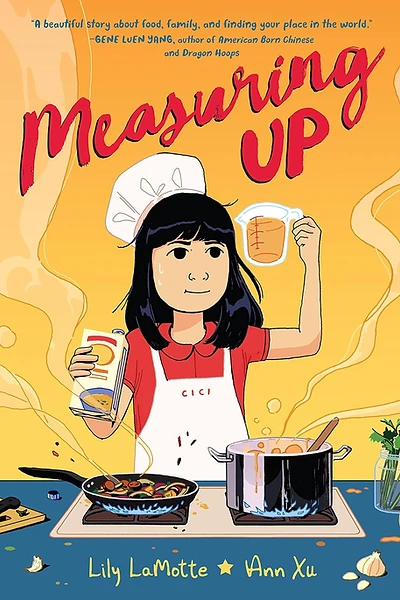
Measuring Up
by Lily LaMotte
Pacing MaterialTwelve-year-old Cici moves from Taiwan to Seattle and enters a cooking competition to win the prize money needed to bring her grandmother to visit, navigating cultural identity, friendship, and the art of cooking along the way.
Big Idea
Food connects us to our culture and family, and sharing our traditions helps us find where we belong.
Discussion Questions
- 1.How does Cici's cooking connect her to her grandmother and her culture?
- 2.What challenges does Cici face adjusting to life in America?
- 3.How does the cooking competition help Cici find confidence?
- 4.What foods connect you to your family or culture?
Classroom Activity
Family Recipe Story
Students write about a family recipe, exploring the cultural and personal significance behind the food.
Lesson Plan
Learning Goals
- Understand how food connects to cultural identity
- Analyze how characters navigate cultural transitions
- Write descriptive personal narratives about family traditions
- Develop empathy for immigrant experiences
Activity Steps
- 1.Discuss how Cici uses cooking to stay connected to her grandmother
- 2.Have students think about a family recipe that has meaning to them
- 3.Students write a short story or essay about the recipe and its significance
- 4.Share stories and discuss how food brings people together
- 5.Reflect on how sharing our culture helps us belong
Standards Connections
- ELA: RL.3.1 — Ask and answer questions about key details
- ELA: RL.3.2 — Retell stories, including key details
- ELA: RL.3.3 — Describe characters, setting, and events
- ELA: RL.7.6 — Acknowledge differences in characters' points of view
- ELA: SL.3.1 — Participate in collaborative conversations about the text
- ELA: W.3.3 — Write narratives recounting events with descriptive details
- SEL: Relationship Skills
- SEL: Social Awareness
- Art: VA:Re7 — Perceive and analyze artistic work
Pace-Write-Read Study with Pace-Write It!
Focus question: How does Lily LaMotte pace Cici’s story so readers feel both the quick pressure of contests and the slower, emotional changes of finding belonging? In Measuring Up by Lily LaMotte, a twelve-year-old girl named Cici moves from Taiwan to Seattle and tries to win a cooking competition so she can bring her grandmother to visit. The graphic novel uses pacing through panels, page turns, dialogue, quiet moments, and cooking scenes to balance the fast excitement of competition with the deeper feelings of homesickness, friendship, and identity.
| Element | How to notice or teach it in the novel |
|---|---|
| Pace | Read: Notice how Measuring Up moves quickly during cooking competition scenes and more slowly during Cici’s reflective moments about missing A-ma and adjusting to Seattle. Classroom Activity: Write two short scenes about the same character goal—one fast-paced with short sentences and one slower-paced with reflection. |
| Plot | Read: Track how Cici’s main plot goal—winning the competition to bring A-ma to Seattle—drives each event, from school friendships to cooking practice to family tension. Classroom Activity: Create a plot ladder with 5 steps for a character chasing an important goal connected to family. |
| Prosody | Read: Listen to how dialogue, captions, and panel flow create a reading rhythm, especially when Cici shifts between excitement, embarrassment, and determination. Classroom Activity: Write a comic-style page with narration and dialogue that changes the sound of reading from nervous to confident. |
| Word pause | Read: Notice where brief lines, pauses in speech, or single-word reactions make Cici’s feelings stand out, especially in awkward social moments or emotional family conversations. Classroom Activity: Write a conversation in which one character uses short pauses to show they feel out of place. |
| Concept | Read: Think about the big idea that food can carry memory, culture, and love, not just taste, in Cici’s journey between Taiwan and Seattle. Classroom Activity: Write a paragraph about an object, meal, or tradition that represents belonging for a character. |
| Voice & World View | Read: Notice how the story presents Cici’s world view as an immigrant kid balancing pride in her Taiwanese background with pressure to fit in with peers in America. Classroom Activity: Write a first-person reflection from a character who sees the same place through two cultural lenses. |
| Setting & Place | Read: Pay attention to how Seattle feels new and unfamiliar to Cici while memories of Taiwan and A-ma make other places feel warm and known. Classroom Activity: Describe two settings for the same character—one that feels lonely and one that feels comforting. |
| Point of View | Read: Notice how the story stays closely connected to Cici’s perspective so readers understand her private worries about money, friendship, and family. Classroom Activity: Rewrite a key moment from Measuring Up-like circumstances from another character’s point of view, such as Mom, Dad, or a friend. |
| Original Characters | Read: Study how Cici stands out as a character who is determined, homesick, creative, and sometimes unsure, while supporting characters shape her sense of belonging. Classroom Activity: Invent an original character whose talent connects to a family relationship and whose problem affects their friendships. |
| Dialogue | Read: Notice how conversations reveal social tension, especially when Cici tries to fit in with classmates while also staying true to herself. Classroom Activity: Write dialogue between two friends where one wants to impress others and the other wants to stay honest. |
| Details | Read: Look closely at small details about ingredients, meals, school life, and family routines that make Cici’s world feel specific and believable. Classroom Activity: Write a sensory list of 8 details for a scene centered on cooking, school, or home. |
| Descriptions | Read: Notice how the descriptions in captions and the visual storytelling work together to show food, facial expressions, and changing emotions. Classroom Activity: Write 4 vivid sentences describing a dish in a way that also reveals the cook’s feelings. |
| Strong First Lines | Read: Think about how the opening quickly introduces Cici’s move, her emotional situation, and the shift in her world. Classroom Activity: Write an opening line for a realistic story that immediately shows a character’s problem after a big life change. |
| Immediacy & Engagement | Read: Notice how readers are pulled in right away because Cici has a clear want, strong feelings, and visible obstacles in both school and family life. Classroom Activity: Write the beginning of a scene where the main character urgently wants something they cannot easily get. |
| Story Scenes & Summaries & Unique Structures | Read: Observe how the graphic novel mixes fully dramatized scenes with quicker summary moments to keep the story moving without losing emotional depth. Classroom Activity: Write one detailed scene and one 3-sentence summary that cover different parts of the same story event. |
| Flashback & Flash Forward & Cliffhangers | Read: Notice how memories of Taiwan and A-ma deepen Cici’s motivations, and how scene endings can make readers want to turn the page to see if she will succeed. Classroom Activity: Add a brief memory and a cliffhanger ending to a scene about a character preparing for an important challenge. |
| Tension & Suspense & Surprise | Read: Track how tension grows around the contest, Cici’s friendships, and the question of whether she can really help bring A-ma to visit. Classroom Activity: Write a scene in which a character’s hopeful plan starts to go wrong because of an unexpected obstacle. |
| Page Turns and Chapter Breaks | Read: In this graphic novel, notice how page turns and chapter shifts often heighten emotion, reveal new information, or pause before an important contest result or friendship moment. Classroom Activity: Plan a 6-panel comic and mark where a page turn or chapter break should come to create suspense. |
| Performance | Read: Notice how Cici must perform in different ways—at school socially, in the kitchen creatively, and in competition under pressure. Classroom Activity: Write about a character who performs a skill in public while hiding a private reason for wanting to succeed. |
| Personality | Read: Study how Cici’s personality shows through her persistence, love for A-ma, mistakes with friends, and growing self-understanding. Classroom Activity: Write a character sketch showing personality through actions instead of labels. |
| Humor | Read: Notice how humorous moments in school interactions and daily misunderstandings balance the more serious feelings of immigration and loneliness. Classroom Activity: Write a realistic scene that includes one funny misunderstanding during a stressful day. |
| Pause | Read: Pay attention to quiet pauses in Measuring Up when Cici reflects, feels left out, or remembers A-ma; these slower beats help the emotional pacing breathe. Classroom Activity: Insert a reflective pause into a scene right before a character makes an important decision. |
| Poetry and Poetic Devices | Read: Even in realistic graphic storytelling, notice how food and memory can be shown with image patterns, similes, and emotionally rich language. Classroom Activity: Write 3 lines comparing a family recipe to a memory or relationship using simile or metaphor. |
| Repetition | Read: Notice repeated ideas about belonging, food, family, and winning, and how these repetitions strengthen Cici’s motivation. Classroom Activity: Write a short paragraph that repeats one meaningful phrase 3 times for emotional effect. |
| Rhythm | Read: Watch how short dialogue exchanges, cooking action, and silent panels create a rhythm that changes depending on whether Cici is anxious, hopeful, or focused. Classroom Activity: Write a scene using a fast-slow-fast rhythm pattern. |
| Punctuation | Read: In speech and captions, notice how exclamation points, ellipses, and question marks help show excitement, hesitation, and uncertainty in Cici’s interactions. Classroom Activity: Revise a short dialogue by changing punctuation to shift the mood from confident to nervous. |
| Questions | Read: Notice the questions raised in readers’ minds: Will Cici win? Will A-ma visit? Will Cici find true friends without hiding who she is? Classroom Activity: Write 3 guiding questions for your own story that keep readers wanting answers. |
| Compare-Contrast | Read: Compare Taiwan and Seattle, home life and school life, fitting in and being authentic, and see how these contrasts shape Cici’s identity journey. Classroom Activity: Write a compare-contrast paragraph about two places that make a character feel different versions of themself. |
| Objects | Read: Notice how food, recipes, ingredients, and competition materials become meaningful objects connected to love, memory, and hope. Classroom Activity: Choose one object and write how it represents a character’s relationship with family. |
| Threes | Read: Look for patterns of three in challenges, attempts, or emotional beats—for example, school, family, and competition pressures working together in Cici’s story. Classroom Activity: Plan a scene with three obstacles that build toward a final choice. |
| Whitespace & Negative Space | Read: In the graphic novel format, notice how open space around panels or quiet visual moments slows the pace and highlights loneliness, reflection, or anticipation. Classroom Activity: Storyboard 4 panels and decide where leaving extra blank space would strengthen the mood. |
| Art & Graphics | Read: Study how the illustrations in Measuring Up communicate expression, setting, food, and pacing, especially when pictures carry meaning beyond the words. Classroom Activity: Create a one-page comic about a family memory using facial expressions and food details to show emotion. |
| Interactives & Gamification | Read: Think about how the competition structure in Measuring Up gives the story game-like stakes, rounds, goals, and rewards that keep readers engaged. Classroom Activity: Design a story challenge chart for a character with levels, setbacks, and a final reward tied to a deeper emotional goal. |
Pace-Write It!
20-Minute Classroom Flow\nRead (5 min): Read a short section from Measuring Up that includes both a cooking or contest moment and a quieter emotional moment about Cici missing A-ma or trying to fit in at school.\nNotice (5 min): Students discuss: Where does the pacing speed up? Where does it slow down? What do the panels, dialogue, and page turns do to help us feel Cici’s emotions? Chart clues such as short dialogue, silent panels, close-up expressions, and scene changes.\nWrite (7 min): Students write a short realistic scene about a character trying to achieve something important for their family while feeling torn between fitting in and being themself. Require one fast-paced section, one pause for reflection, and one object that symbolizes belonging. Writing frame: “I wanted ______ because ______. Everything sped up when ______. Then I paused and noticed ______. The object I held/saw/tasted was ______, and it reminded me ______. By the end of the scene, I realized ______.”\nShare (3 min): Partners read one sentence that feels fast and one sentence that feels slow. They explain how their pacing choices reveal the character’s feelings.\nExit ticket: In 1-2 sentences, explain how Lily LaMotte uses pacing in Measuring Up to help readers understand Cici’s identity and belonging.