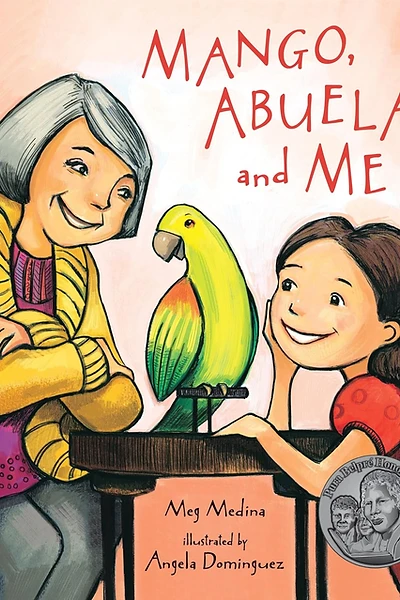
 K-3
K-3P MEDINA
Mango, Abuela, and Me
by Meg Medina, illustrated by Angela Dominguez
Pacing MaterialWhen Mia's abuela comes to live with her family, Mia and Abuela struggle to communicate. With the help of a parrot named Mango, they learn each other's languages and build a loving bond across generations.
Big Idea
Love and patience can bridge the gap between different languages and generations, allowing us to build deep connections through shared effort and empathy.
Discussion Questions
- 1.Why does Mia feel like Abuela is a 'far-away grandmother' even when they are living in the same house?
- 2.How do Mia and Abuela use things other than words to communicate with each other?
- 3.Why is the parrot, Mango, such an important character in helping Mia and Abuela connect?
- 4.What does it feel like to try to learn something new or difficult, like a new language?
- 5.How does the author show that Mia and Abuela's relationship changes from the beginning of the book to the end?
Classroom Activity
The Language of Connection: A Bilingual Bridge
Students will create a 'Bridge of Words' poster where they identify and illustrate key objects or feelings that helped Mia and Abuela communicate, then add their own 'bridge' words in two languages.
Lesson Plan
Learning Goals
- Identify the sequence of events in a narrative.
- Analyze how characters overcome communication barriers.
- Recognize the importance of non-verbal communication and patience in relationships.
- Practice basic vocabulary in a second language to build empathy for language learners.
Activity Steps
- 1.Review the story and identify the specific moments where Mia and Abuela struggle to communicate.
- 2.Create a list of 'bridge' items from the book, such as the parrot, books, and drawings.
- 3.Have students draw a bridge on a large piece of paper, placing the 'bridge' items from the book on one side.
- 4.Ask students to choose three common objects in the classroom and write their names in English and another language (using dictionaries or digital tools).
- 5.Students add these new words to their bridge, illustrating how they can connect with others through shared learning.
Standards Connections
- ELA: RL.K.3 (Describe characters, settings, and major events)
- ELA: SL.1.1 (Participate in collaborative conversations)
- SEL: Relationship Skills (Building and maintaining healthy relationships)
- World Languages: Connections (Connect with other disciplines and information)
Pace-Write-Read Study with Pace-Write It!
Meg Medina’s 'Mango, Abuela, and Me' is a masterclass in using pacing to mirror the slow, deliberate process of building a relationship. Medina uses a steady, gentle rhythm that reflects the quiet, observant nature of Abuela’s transition into a new, wintry environment. By focusing on small, intimate moments—like the shared reading of a book or the training of a parrot—she allows the reader to feel the weight of the language barrier and the gradual relief of connection. For young writers, this book demonstrates how to use 'slow-motion' scenes to emphasize emotional growth. Medina does not rush the development of the relationship; instead, she lingers on the details of daily life, showing that significant change happens in the quiet spaces between big events. This teaches students that a story’s pace should match the emotional intensity of the characters' experiences.
| Element | How to notice or teach it in the novel |
|---|---|
| Pace | The story moves slowly to mirror the patience required for Mia and Abuela to learn each other's languages. |
| Plot | The plot follows a clear arc of adjustment, from the initial distance of the grandmother to their eventual shared understanding. |
| Prosody | The text uses a warm, tender tone that invites the reader to slow down and savor the emotional beats. |
| Word Pause | Medina uses short, simple sentences to represent the 'poquito' (little) Spanish and English the characters know at the start. |
| Concept | The core concept is the bridge between generations and cultures through the medium of language. |
| Voice & World View | The voice is intimate and child-centered, reflecting Mia’s perspective as she navigates her grandmother's arrival. |
| Setting & Place | The contrast between the 'sunny house with parrots' and the 'wintry city' sets the emotional tone for Abuela's displacement. |
| Point of View | The story is told from Mia’s perspective, allowing the reader to experience her curiosity and determination. |
| Original Characters | Mango the parrot acts as a unique, living bridge between the two main characters. |
| Dialogue | Dialogue is sparse and intentional, highlighting the difficulty of communication and the joy of new words. |
| Details | Specific details like the parrot’s feathers and the books they read ground the emotional story in reality. |
| Descriptions | Descriptions focus on sensory details, like the cold city air versus the warmth of the home. |
| Strong First Lines | The opening establishes the premise of the 'far-away grandmother' immediately, creating instant empathy. |
| Immediacy & Engagement | The immediate challenge of the language barrier keeps the reader engaged in the characters' success. |
| Story Scenes & Summaries & Unique Structures | The book uses a linear structure that builds toward the climax of their first full conversation. |
| Flashback & Flash Forward & Cliffhangers | The story relies on the 'flashback' of Abuela’s life in her sunny home to explain her current sadness. |
| Tension & Suspense & Surprise | Tension is built through the quiet, daily struggle to communicate, rather than external conflict. |
| Page Turns and Chapter Breaks | Page turns are used to reveal the progress of the parrot’s training and the characters' growing bond. |
| Performance | The text is perfect for read-alouds, encouraging readers to use different voices for Mia, Abuela, and Mango. |
| Personality | Abuela’s personality is shown through her actions and her quiet, observant nature. |
| Humor | The parrot’s attempts to mimic words provide lighthearted moments of humor. |
| Pause | The author uses white space and illustrations to create pauses that allow the reader to reflect on the characters' feelings. |
| Poetry and Poetic Devices | The language is lyrical and simple, almost like a poem about the nature of love. |
| Repetition | The repetition of words in both Spanish and English reinforces the theme of learning. |
| Rhythm | The rhythm of the prose is steady and comforting, mirroring the routine of the household. |
| Punctuation | The use of Spanish words in italics provides a visual cue for the reader to slow down and learn. |
| Questions | Mia’s internal questions about how to reach her grandmother drive the narrative forward. |
| Compare-Contrast | The book constantly compares the two languages and the two different worlds the characters come from. |
| Objects | Objects like books and the parrot are essential tools for the characters to bridge their gap. |
| Threes | The trio of Mia, Abuela, and Mango forms the heart of the story’s structure. |
| Whitespace & Negative Space | The illustrations use space to show the distance between the characters before they connect. |
| Art & Graphics | The art captures the emotional nuance of Abuela’s face, showing her transition from doubt to joy. |
| Interactives & Gamification | The book invites the reader to learn along with the characters, making the reading experience interactive. |
Pace-Write It!
Students will write a 3-sentence 'slow-motion' scene about a time they tried to teach someone something new, focusing on using one specific detail to show the emotion of the moment.