 K-4
K-4R PINCUS
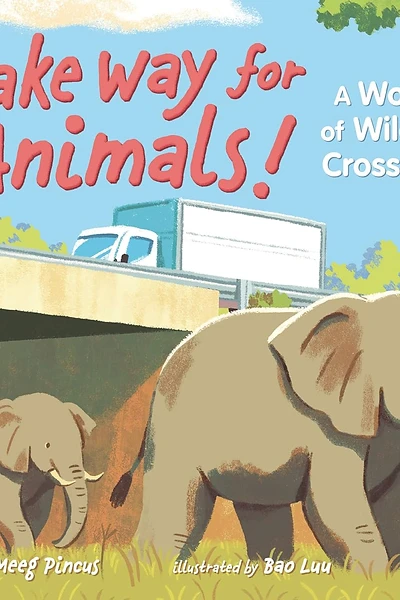
Make Way for Animals! A World of Wildlife Crossings
by Meeg Pincus
Pacing MaterialA fascinating look at wildlife crossings around the world — bridges, tunnels, and corridors that help animals safely cross roads and reconnect with their habitats.
Big Idea
Humans and animals can share the planet — and creative engineering can help protect wildlife.
Discussion Questions
- 1.What is a wildlife crossing?
- 2.Why do animals need safe ways to cross roads?
- 3.Which wildlife crossing surprised you the most?
- 4.How could we help wildlife in our own community?
Classroom Activity
Design a Wildlife Crossing
Design a wildlife crossing for an animal in your area. Draw the crossing, label its features, and explain how it helps animals stay safe.
Lesson Plan
Learning Goals
- Explain how roads can separate animals from food, shelter, and other parts of their habitats.
- Identify bridges, tunnels, and habitat corridors featured in Make Way for Animals! and describe how they help wildlife travel safely.
- Design a wildlife crossing suited to a local animal’s size, movement, and habitat needs.
- Use drawings, labels, and an oral or written explanation to communicate how the design protects animals.
Activity Steps
- 1.Read Make Way for Animals! aloud, pausing to examine examples of wildlife crossings around the world. Ask: What problem does each crossing solve? Why might different animals need different crossings?
- 2.Choose a local wild animal, such as a deer, turtle, frog, or squirrel. Discuss where it lives, how it moves, and what it might need to reach across a road. Use a teacher-provided fact sheet or familiar local observations.
- 3.Sketch a simple scene with a road separating two habitat areas. Select a bridge, tunnel, or connected corridor that would help the chosen animal move between them without entering traffic.
- 4.Draw and label the crossing’s safety features, such as fencing that guides animals toward the crossing, plants for cover, or a tunnel opening large enough for the animal. Add arrows showing the animal’s route.
- 5.Share designs with a partner. Explain: “My crossing helps ___ reach ___ safely because ___.” Partners ask one question about how the crossing meets the animal’s needs.
- 6.Revise one feature after partner feedback and display the designs. Have younger students dictate labels and explanations; have older students write a short explanation connecting their design to an example from the book.
Standards Connections
- ELA: CCSS RI.1.3 — Describe connections between ideas or events in an informational text, such as roads dividing habitats and crossings reconnecting them.
- ELA: CCSS SL.2.5 — Add drawings or other visual displays to clarify ideas when explaining a crossing design.
- Science/Engineering: NGSS K-2-ETS1-1 — Ask questions and gather information to define a problem that can be solved through engineering.
- Science/Engineering: NGSS K-2-ETS1-2 — Develop a sketch or drawing showing how an object's shape helps it function.
- Science/Engineering: NGSS 3-5-ETS1-1 — Define a design problem with criteria and constraints, including the animal’s needs, road location, and available space.
Pace-Write-Read Study with Pace-Write It!
Focus question: How does an author slow down and speed up information to help readers care about animals and understand a real-world problem? In Make Way for Animals! A World of Wildlife Crossings, Meeg Pincus introduces real animals, roads, and human-made crossings that help wildlife survive. The book uses pacing by moving between quick facts and vivid moments, letting readers pause to picture elk, crabs, frogs, and other animals as they travel through bridges, tunnels, and corridors.
| Element | How to notice or teach it in the novel |
|---|---|
| Pace | Read: Notice how Meeg Pincus moves quickly through big ideas about roads and habitats, then slows down to highlight a specific wildlife crossing and the animals using it. Classroom Activity: Write 3-4 sentences that begin with a fast overview of a habitat problem and then slow down to describe one animal crossing safely. |
| Plot | Read: Even though this is nonfiction, the book has a clear progression: animals need to move, roads create danger, and people build crossings to help. Classroom Activity: Write a simple beginning-middle-end plan for a real animal trying to reach food, water, or family across a road. |
| Prosody | Read: Listen for places where the sentences sound energetic and hopeful as the text names animals and explains solutions. Classroom Activity: Read one page aloud with expression, then write two sentences about wildlife crossings that are meant to sound exciting when spoken. |
| Word pause | Read: Notice how key words such as bridge, tunnel, crossing, and habitat make readers stop and think about the problem and solution. Classroom Activity: Write a short informational paragraph and use one powerful word or phrase that should make the reader pause and picture the scene. |
| Concept | Read: The big concept in this book is that roads can divide habitats, but design can reconnect nature. Classroom Activity: Write one sentence explaining the concept of a wildlife crossing and one sentence telling why it matters for animals in this book. |
| Voice & World View | Read: Meeg Pincus uses a caring, curious voice that shows animals matter and that humans can help repair environmental harm. Classroom Activity: Write 3 sentences in a hopeful nonfiction voice about how people can protect animals near roads. |
| Setting & Place | Read: Notice that the book travels to different places around the world, showing that wildlife crossings are needed in many habitats and countries. Classroom Activity: Choose one place from the book or invent a realistic habitat and write a setting description for where animals need a safe crossing. |
| Point of View | Read: The book is told from an outside nonfiction point of view, but it keeps readers thinking about what animals need to survive. Classroom Activity: Rewrite one idea from the book from the point of view of an animal approaching a road. |
| Original Characters | Read: The standout 'characters' are the real animals—such as hoofed animals, amphibians, and other wildlife—plus the humans who design crossings for them. Classroom Activity: Pick one real animal from the book and create a short character card with its need, danger, and safe path. |
| Dialogue | Read: This book is mostly explanatory, so readers notice meaning without character conversations. Classroom Activity: Write a short imagined dialogue between an animal and an engineer about why a crossing is needed, using facts from the book. |
| Details | Read: Meeg Pincus includes concrete details about bridges, tunnels, and pathways that help readers understand how crossings work. Classroom Activity: Write 4 factual details about a wildlife crossing and explain how each detail helps an animal stay safe. |
| Descriptions | Read: Notice how descriptions help readers picture animals moving through natural spaces and human-built structures. Classroom Activity: Describe an animal using a crossing with sensory language, including what it sees, hears, or feels. |
| Strong First Lines | Read: Pay attention to how the opening invites readers into the problem of animals needing a safe way through their world. Classroom Activity: Write a strong first line for your own nonfiction piece about an animal facing a road. |
| Immediacy & Engagement | Read: The book keeps readers engaged by showing that this issue affects real animals right now and that crossings make a real difference. Classroom Activity: Write 2-3 urgent sentences that make a reader care immediately about helping wildlife cross safely. |
| Story Scenes & Summaries & Unique Structures | Read: Notice how the book blends scene-like moments of animals moving with summary information about many crossings around the world. Classroom Activity: Write one scene sentence about an animal at a road and two summary sentences explaining the larger problem. |
| Flashback & Flash Forward & Cliffhangers | Read: The book may hint at what habitats were like before roads and what can happen in the future when crossings are built. Classroom Activity: Write one sentence about the past, one about the danger now, and one about a safer future for animals. |
| Tension & Suspense & Surprise | Read: The tension comes from the danger roads create, while the surprise comes from creative crossings built for many kinds of animals. Classroom Activity: Write a short paragraph that builds tension as an animal nears a road, then reveals a surprising safe crossing. |
| Page Turns and Chapter Breaks | Read: Notice how each new page or section can introduce a new animal, place, or type of crossing, keeping the reading moving. Classroom Activity: Plan a 4-page mini-book, with each page turn revealing a new fact or a new animal crossing. |
| Performance | Read: This text works well as a read-aloud because readers can emphasize problem words and solution words. Classroom Activity: Practice performing a short section aloud, then write a sentence with words you would stress in your performance. |
| Personality | Read: The book gives personality to the topic by making animal movement feel lively, important, and worth noticing. Classroom Activity: Write a few lines that give an animal in the book a lively personality while staying truthful to real animal behavior. |
| Humor | Read: While the topic is serious, some readers may smile at the idea of animals using bridges and tunnels made with their needs in mind. Classroom Activity: Write one gentle, respectful humorous sentence about an animal using a crossing, while keeping the facts accurate. |
| Pause | Read: Notice where illustrations, facts, or surprising examples make you stop and reflect on how humans and animals share space. Classroom Activity: Add a pause to your writing with a dash, line break, or short sentence that makes the reader stop and think. |
| Poetry and Poetic Devices | Read: Even in nonfiction, the language can sound poetic when it repeats key ideas and paints pictures of movement through the natural world. Classroom Activity: Write a 4-line poem about a wildlife crossing using imagery and alliteration. |
| Repetition | Read: Notice how repeated ideas—animals move, roads block, crossings help—build understanding and momentum. Classroom Activity: Write three sentences that repeat a key phrase such as 'Make way' or 'Safe passage' to create emphasis. |
| Rhythm | Read: The rhythm of the book often comes from lists of animals, places, and crossing types that create a steady flow. Classroom Activity: Write a rhythmic sentence that names three animals and the crossing each one might use. |
| Punctuation | Read: Notice how punctuation helps control speed, especially when facts are listed or important ideas are set apart. Classroom Activity: Write two nonfiction sentences about wildlife crossings, using commas or dashes to control pacing. |
| Questions | Read: As you read, questions naturally arise: How do animals know where to go? Why do different animals need different crossings? Classroom Activity: Write three research questions inspired by this book and answer one with a fact-based sentence. |
| Compare-Contrast | Read: The book invites readers to compare different crossings, habitats, and animal needs across the world. Classroom Activity: Write a compare-contrast paragraph about two kinds of wildlife crossings from the book, explaining which animals each one helps. |
| Objects | Read: Important objects in this book include roads, fences, bridges, tunnels, signs, and habitats that shape the problem and solution. Classroom Activity: Choose one object from the book and write about how it can be dangerous or helpful depending on how humans use it. |
| Threes | Read: Notice how grouping ideas in threes can make information easier to remember, such as three problems, three animals, or three solutions. Classroom Activity: Write a set of three facts about wildlife crossings and arrange them from problem to solution to hope. |
| Whitespace & Negative Space | Read: Pay attention to how space on the page and around illustrations can help readers pause and focus on a key fact or image. Classroom Activity: Create a short page layout for one fact about animal crossings, leaving space to help the most important idea stand out. |
| Art & Graphics | Read: The illustrations and design help readers understand animal movement, geography, and how crossings fit into the environment. Classroom Activity: Draw and label a wildlife crossing for one animal from the book, then write a caption explaining how the design helps. |
| Interactives & Gamification | Read: The book encourages active thinking because readers can match animals to the kinds of crossings they need. Classroom Activity: Make a matching game with cards for animals, habitats, and crossing types based on examples from the book, then write one explanatory sentence for a match. |
Pace-Write It!
20-Minute Classroom Flow\nRead (5 min): Read aloud a section of Make Way for Animals! A World of Wildlife Crossings by Meeg Pincus that introduces the problem of roads and then shows one or two specific wildlife crossings. Ask students to listen for where the text goes fast with facts and where it slows down to focus on an animal or place.\nNotice (5 min): Make a quick T-chart labeled 'Speeds Up' and 'Slows Down.' Students name examples, such as broad facts about habitats under threat and slower descriptive moments about animals crossing safely. Discuss how pacing helps readers learn and care.\nWrite (7 min): Students write a short nonfiction paragraph about an animal that needs help crossing a road. Writing frame: 'Animals need to move to find ____. But a ____ is in the way. At first, ____. Then people build a ____. Now the ____ can ____ safely.' Encourage students to begin with one big fact and then zoom in on one vivid moment.\nShare (3 min): Partners read their paragraphs aloud and point out one place where the writing speeds up and one place where it slows down. Invite 1-2 students to share with the class.\nExit ticket: Write one sentence answering this question: How does slowing down on one animal moment help the reader understand the big idea of wildlife crossings?
Pace-Write-Read Connection
Teach this book using the Pace-Write-Read method — Tool 29: Questions.
Open the Mastery Manual