 2-5
2-5R WINTERBOTTOM
Magic in a Drop of Water: How Ruth Patrick Taught the World about Water Pollution
by Julie Winterbottom
Pacing MaterialThe inspiring story of Ruth Patrick, a scientist who studied a single drop of water and discovered how to measure the health of entire rivers.
Big Idea
One scientist's curiosity about tiny things changed how the world understands and protects water.
Discussion Questions
- 1.What did Ruth Patrick discover in a drop of water?
- 2.How can tiny organisms tell us about a river's health?
- 3.What barriers did Ruth face as a woman in science?
- 4.Why is clean water important for everyone?
- 5.How could you test the health of water near you?
Classroom Activity
Drop of Water Investigation
Draw a drop of water and label six things a scientist might find in it. Explain what each tells us about water health.
Lesson Plan
Learning Goals
- Describe how Ruth Patrick’s curiosity about microscopic life helped scientists understand river health.
- Identify six organisms or materials that scientists might find in a water sample.
- Explain how the variety of living things and evidence of pollution can provide clues about water health.
- Create a labeled scientific drawing and support explanations with information from the book.
Activity Steps
- 1.Read the book aloud or revisit key passages about Ruth Patrick’s water investigations. Discuss: Why did she study tiny living things, and what could they reveal about an entire river?
- 2.Explain that Patrick studied diatoms—microscopic algae—and other aquatic life. Scientists examine the kinds and variety of organisms, along with other evidence, rather than judging water by its appearance alone.
- 3.Create a class reference chart with six possible findings: diatoms, other algae, bacteria, tiny animals such as rotifers, sediment, and tiny plastic fragments. Discuss their clues: diatom communities help indicate water conditions; abundant algae can suggest excess nutrients; some bacteria may indicate contamination; tiny animals contribute evidence about the living community; excess sediment can reduce light; and plastic fragments indicate pollution. Emphasize that not all organisms or sediment are harmful.
- 4.Have students draw a large, magnified water drop and label all six findings. Explain that this is a model of possible findings across water samples, not a claim that every drop contains all six.
- 5.Beside each label, have students explain what the finding might tell a scientist about water health. Grades 2–3 may use sentence frames such as 'A scientist might find ___. This could show ___.' Grades 4–5 should add why one finding alone cannot prove that water is healthy or polluted.
- 6.Invite students to share their drawings. Close with a written or oral response: 'How did Ruth Patrick’s attention to tiny things help people protect rivers?'
Standards Connections
- ELA: CCSS RI.2.3 — Describe connections among scientific ideas and events, including how Patrick’s observations contributed to understanding water pollution.
- ELA: CCSS RI.3.3 — Describe relationships among scientific ideas using language of cause and effect.
- ELA: CCSS W.4.2 — Write informative explanations that clearly convey scientific ideas.
- ELA: CCSS SL.5.1 — Participate in collaborative discussions, building on others’ ideas and explaining one’s thinking.
- Science: NGSS 5-ESS3-1 — Connect Patrick’s research to ways communities use science to protect Earth’s resources and environment.
Pace-Write-Read Study with Pace-Write It!
Focus question: How can an author slow down one tiny scientific discovery and speed up big life events to help readers understand why it matters? In Magic in a Drop of Water: How Ruth Patrick Taught the World about Water Pollution by Julie Winterbottom, the author tells the real story of Ruth Patrick, a scientist who studied organisms in a single drop of water to understand the health of rivers. The book uses pacing by zooming in on careful moments of observation and then moving more quickly through larger stretches of time, helping readers feel both the patience of science and the urgency of protecting the environment.
| Element | How to notice or teach it in the novel |
|---|---|
| Pace | Read: Notice how Julie Winterbottom slows the story when Ruth Patrick closely studies a drop of water, then speeds up when explaining how her ideas changed the way people understood polluted rivers. Classroom Activity: Write 4-5 sentences about a small object you observed, slowing down the exact moment you noticed something important and speeding up the rest. |
| Plot | Read: Track the main problem and solution in Ruth Patrick’s life story: people did not fully understand water pollution, and Ruth’s scientific method helped reveal river health through tiny living things. Classroom Activity: Make a beginning-middle-end plot map of Ruth’s story, then write one sentence for each part. |
| Prosody | Read: Listen to how the sentences sound when the book describes water, microscopes, and living organisms; some lines flow gently, matching the topic of rivers and streams. Classroom Activity: Read a favorite page aloud and then write 3 flowing sentences about water using smooth, musical language. |
| Word pause | Read: Notice where key science words or important ideas make you naturally pause, such as when the text explains what Ruth saw in water samples or what those findings meant. Classroom Activity: Choose one sentence about science and rewrite it so a reader pauses before the most important word or idea. |
| Concept | Read: Focus on the big idea that a tiny drop of water can tell a much bigger story about an entire river’s health. Classroom Activity: Write 2-3 sentences explaining the concept 'small clues can reveal big truths' using Ruth Patrick’s work as your example. |
| Voice & World View | Read: Notice the book’s respectful, curious voice and its world view that science can help people care for nature and make better choices for the environment. Classroom Activity: Write a short paragraph in an encouraging voice about why scientists like Ruth Patrick matter. |
| Setting & Place | Read: Pay attention to the watery settings—rivers, streams, and places where Ruth collected samples—and how these places shape the story’s scientific discoveries. Classroom Activity: Describe a river, pond, or creek setting in 5 senses language and explain what a scientist might discover there. |
| Point of View | Read: Notice that the book is told from an outside narrator’s point of view, but it stays close to Ruth Patrick’s experiences, questions, and discoveries. Classroom Activity: Rewrite one moment from the book from Ruth Patrick’s first-person point of view using 'I noticed...' and 'I wondered...'. |
| Original Characters | Read: Study how the real person Ruth Patrick stands out as a determined, observant scientist who looks closely at tiny forms of life when others may have overlooked them. Classroom Activity: Write a character sketch of Ruth Patrick with 3 traits and a piece of evidence for each trait. |
| Dialogue | Read: Notice whether the book uses little or no direct dialogue and instead relies on narration, facts, and scenes to tell Ruth Patrick’s story. Classroom Activity: Invent a short 4-line dialogue between Ruth Patrick and a student who asks why one drop of water matters. |
| Details | Read: Look for precise details about microscopes, water samples, and the tiny organisms Ruth Patrick studied to measure river health. Classroom Activity: Write a factual mini-paragraph using at least 3 specific details to explain what Ruth might see in one drop of water. |
| Descriptions | Read: Notice how descriptions help readers picture both the tiny world inside water and the larger rivers affected by pollution. Classroom Activity: Write 3 descriptive sentences that zoom from a tiny drop of water out to a whole river. |
| Strong First Lines | Read: Examine how the opening invites readers into the surprising idea that something as small as a drop of water could hold important answers. Classroom Activity: Write your own strong first line for a nonfiction story about a young scientist discovering something tiny but powerful. |
| Immediacy & Engagement | Read: Notice how the author keeps readers engaged by making science feel active and important, not distant, as Ruth Patrick’s observations connect directly to real polluted waterways. Classroom Activity: Write 2-4 sentences that make a science moment feel exciting right now by using vivid action words. |
| Story Scenes & Summaries & Unique Structures | Read: Watch how the book mixes scene-like moments of Ruth working and observing with summary sections that explain her impact on science and environmental activism. Classroom Activity: Write one scene of Ruth peering into a microscope and one summary sentence explaining why her work changed people’s thinking. |
| Flashback & Flash Forward & Cliffhangers | Read: Notice whether the book mostly moves forward in time, and where it hints at future impact by showing how Ruth Patrick’s discoveries would later help the world understand pollution. Classroom Activity: Write a flash-forward sentence beginning with 'Years later...' to show the importance of one discovery. |
| Tension & Suspense & Surprise | Read: Look for tension in the question of whether people can truly know if a river is healthy, and surprise in the answer that tiny organisms provide the clues. Classroom Activity: Write 3-4 sentences building suspense before revealing an unexpected scientific discovery. |
| Page Turns and Chapter Breaks | Read: Notice where a page turn likely makes you want to learn the next step in Ruth Patrick’s investigation or see what she discovers in the water sample. Classroom Activity: End a short paragraph with a sentence that makes a reader want to turn the page to learn what a scientist sees next. |
| Performance | Read: Think about how this book could be performed aloud with a calm, wondering tone during observation parts and a stronger, more urgent tone during environmental message parts. Classroom Activity: Mark one short passage with cues such as 'slow,' 'pause,' or 'strong voice,' then practice reading it aloud. |
| Personality | Read: Notice how Ruth Patrick’s personality comes through as patient, curious, careful, and persistent in her scientific work. Classroom Activity: Write a paragraph explaining how Ruth’s personality helped her make an important discovery. |
| Humor | Read: Notice that the tone is mostly serious and inspiring rather than silly, which fits the real-life topic of science and water pollution. Classroom Activity: Write one light, respectful sentence that adds a little humor to a scene about staring at tiny creatures through a microscope. |
| Pause | Read: Notice places where the text invites you to stop and think, especially after a big idea like how one drop of water can reveal the condition of an entire river. Classroom Activity: Add a thoughtful pause line to your writing, such as 'And that changed everything.' |
| Poetry and Poetic Devices | Read: Listen for poetic comparisons, vivid imagery, or language that makes science sound beautiful, especially when describing water and the hidden life inside it. Classroom Activity: Write 2 lines about a drop of water using personification or simile. |
| Repetition | Read: Notice if key ideas repeat, such as water, tiny life, rivers, pollution, and careful observation, to reinforce the book’s main message. Classroom Activity: Write a short paragraph that repeats one important phrase, such as 'In one drop,' to create emphasis. |
| Rhythm | Read: Feel how some sentences may be short and clear for facts, while others are longer and flowing when describing rivers and discovery. Classroom Activity: Write 3 sentences with different rhythms: one short, one medium, and one long, all about Ruth Patrick’s work. |
| Punctuation | Read: Notice how punctuation helps organize facts and ideas, especially when the author explains science clearly for readers in grades 2-5. Classroom Activity: Write 3 sentences about water pollution using commas or a dash to add extra information. |
| Questions | Read: Think about the questions the book raises, such as How can we tell if water is healthy? and Why do tiny organisms matter so much? Classroom Activity: Write 3 inquiry questions Ruth Patrick might have asked before studying a water sample. |
| Compare-Contrast | Read: Notice opportunities to compare clean and polluted water, tiny organisms and whole rivers, or what people believed before and after Ruth Patrick’s research. Classroom Activity: Use a compare-contrast frame to write 4 sentences about a healthy river and a polluted river. |
| Objects | Read: Pay attention to meaningful objects such as the drop of water, microscope, sample containers, and scientific tools that support Ruth Patrick’s discoveries. Classroom Activity: Choose one object from Ruth’s work and write a short paragraph explaining how it helped change science. |
| Threes | Read: Notice groups of three ideas you can gather from the story, such as Ruth being curious, careful, and determined, or rivers being observed, tested, and understood. Classroom Activity: Write a sentence with a set of three that describes Ruth Patrick or her process. |
| Whitespace & Negative Space | Read: Notice how the spacing on pages and around illustrations can give readers time to think about a scientific idea or an important discovery. Classroom Activity: Create a mini page layout for one sentence from your writing, leaving extra space before the most important line. |
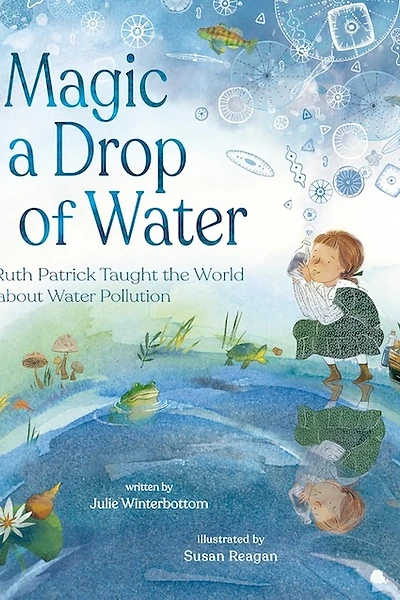
| Art & Graphics | Read: Study how the illustrations and visual design help readers see both the tiny organisms in water and the larger environmental problem Ruth Patrick worked to solve. Classroom Activity: Draw and label a simple diagram showing a drop of water, tiny organisms, and the river they help explain, then add 2 caption sentences. |
| Interactives & Gamification | Read: Imagine how this book invites investigation by encouraging readers to observe closely, sort clues, and act like scientists studying evidence from nature. Classroom Activity: Create a 'River Health Detective' checklist with 4 clues a student scientist could look for after reading about Ruth Patrick. |
Pace-Write It!
20-Minute Classroom Flow\nRead (5 min): Read aloud a section of Magic in a Drop of Water: How Ruth Patrick Taught the World about Water Pollution by Julie Winterbottom that shows Ruth closely observing water and learning from tiny organisms. Ask students to listen for places where the author slows down to focus on one small moment and speeds up to explain a bigger idea.\n\nNotice (5 min): Discuss: Where did the story zoom in? Where did it zoom out? Chart two columns: 'Slow moment' and 'Fast summary.' Add examples such as Ruth studying a drop of water up close versus the text explaining how her work helped people understand rivers and pollution.\n\nWrite (7 min): Students write a short nonfiction-style paragraph about observing something small that reveals something big. Writing frame: 'I looked closely at ____. At first, I noticed ____. Then I saw ____. This small detail mattered because ____. It helped me understand ____.' Encourage students to slow down the observation sentence and speed up the explanation sentence.\n\nShare (3 min): Partners read their paragraphs aloud and point out one place where the writer used slow pacing and one place where the writer used fast pacing. Invite 1-2 volunteers to share with the class.\n\nExit ticket: Write one sentence answering: How did Julie Winterbottom use pacing to help readers understand why Ruth Patrick’s science was important?
Pace-Write-Read Connection
Teach this book using the Pace-Write-Read method — Tool 11: Details.
Open the Mastery Manual