 3-7
3-7GN BROWN
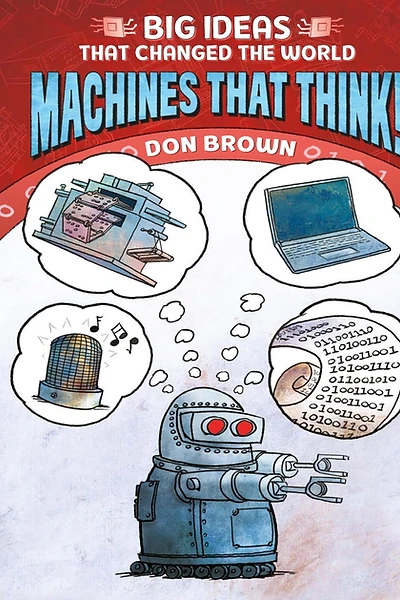
Machines That Think!
by Don Brown
Pacing MaterialA graphic novel history of artificial intelligence and computing, from early calculating machines and Ada Lovelace's algorithms to Alan Turing, modern computers, and the future of AI.
Big Idea
Computers have evolved from simple calculators to thinking machines, and understanding their history helps us navigate their future.
Discussion Questions
- 1.How did early calculating machines pave the way for modern computers?
- 2.What was Alan Turing's contribution to computing, and why was it significant?
- 3.How has AI changed the way we live and work?
- 4.What ethical questions arise as machines become more intelligent?
Classroom Activity
Timeline of Computing
Students build a timeline of computing milestones, from the abacus to modern AI, and predict future developments.
Lesson Plan
Learning Goals
- Trace the evolution of computing from mechanical calculators to AI
- Understand the contributions of key figures in computer science
- Examine how technology shapes society
- Develop informed perspectives on the future of AI
Activity Steps
- 1.Introduce key figures: Ada Lovelace, Charles Babbage, Alan Turing
- 2.Have students research one milestone in computing history
- 3.Students create timeline cards with illustrations and descriptions
- 4.Assemble the timeline and have students present their findings
- 5.Discuss as a class: What might the next milestone be?
Standards Connections
- ELA: RL.3.1 — Ask and answer questions about key details
- ELA: RL.3.2 — Retell stories, including key details
- ELA: RL.3.3 — Describe characters, setting, and events
- ELA: RL.7.6 — Acknowledge differences in characters' points of view
- ELA: SL.3.1 — Participate in collaborative conversations about the text
- ELA: W.3.3 — Write narratives recounting events with descriptive details
- SEL: Responsible Decision-Making
- Art: VA:Re7 — Perceive and analyze artistic work
Pace-Write-Read Study with Pace-Write It!
Focus question: How does Don Brown use quick scenes, graphic panels, and shifts across time to help readers understand the history of thinking machines? In Machines That Think! by Don Brown, readers move from early inventions and Ada Lovelace’s ideas to Alan Turing, modern computers, and the future of AI. The pacing feels brisk because Brown combines short bursts of text, dialogue, and illustrations to speed through big ideas while still pausing on important moments in scientific discovery.
| Element | How to notice or teach it in the novel |
|---|---|
| Pace | Read: Notice how Machines That Think! moves quickly across the history of computing, using short scenes and graphic-novel panels to cover many inventors and inventions without slowing down too much. Classroom Activity: Write a 6-panel mini-comic that races through the history of one invention, using only 1-2 sentences per panel. |
| Plot | Read: Notice that the plot is not one made-up adventure but a sequence of real discoveries, from early calculating tools to AI, connected by the big idea of humans trying to make machines think. Classroom Activity: Create a timeline paragraph that shows the ‘plot’ of computing history using first, next, then, and finally. |
| Prosody | Read: Listen to how the wording in the speech bubbles and narration can sound clipped, dramatic, or excited, especially when major breakthroughs or warnings about AI appear. Classroom Activity: Choose one page and rehearse reading it aloud with expression, then write 3 lines of narration that match that dramatic rhythm. |
| Word pause | Read: Notice where a single important word or short phrase in the narration makes you stop and think, such as moments about ‘thinking,’ ‘code,’ or ‘intelligence.’ Classroom Activity: Write 4 short lines about a new invention, putting one powerful word on a line by itself for emphasis. |
| Concept | Read: Notice how Don Brown turns a difficult concept—artificial intelligence—into understandable pieces by showing people, machines, and historical steps. Classroom Activity: Write a kid-friendly explanation of AI in 3-5 sentences using one example from the book. |
| Voice & World View | Read: Notice how the author’s voice is curious, energetic, and thoughtful, celebrating discovery while also questioning what AI might mean for the future. Classroom Activity: Write a short response in a voice that is either excited about AI or cautious about AI, using one fact from the book. |
| Setting & Place | Read: Notice how the book shifts across different times and places—workshops, labs, wartime codebreaking spaces, and modern tech settings—to show that computing grew in many worlds. Classroom Activity: Choose one historical setting from the book and describe it in 5 sensory details. |
| Point of View | Read: Notice that the story is mostly told from an outside narrator’s point of view, but the panels help readers imagine the experiences of people like Ada Lovelace and Alan Turing. Classroom Activity: Rewrite one moment from the book in first person from Ada Lovelace’s or Alan Turing’s point of view. |
| Original Characters | Read: Notice how real historical figures such as Ada Lovelace and Alan Turing are presented as vivid characters with important ideas, questions, and challenges. Classroom Activity: Invent an original young coder character who meets one real person from the book and write their conversation. |
| Dialogue | Read: Notice how dialogue and speech bubbles help explain complicated ideas quickly and make scientists feel alive on the page. Classroom Activity: Write 6 lines of dialogue between Alan Turing and a modern robot about what it means to ‘think.’ |
| Details | Read: Notice the small historical and scientific details that make the information feel trustworthy, such as references to machines, codes, algorithms, and computer development. Classroom Activity: Write a fact-rich caption for an illustration of an early computer, including at least 3 specific details. |
| Descriptions | Read: Notice how Brown uses brief descriptions instead of long explanations, letting a few strong words and images carry the meaning. Classroom Activity: Describe a machine from the book in 3 concise sentences that help a reader picture it clearly. |
| Strong First Lines | Read: Notice how the opening quickly pulls readers into the big topic of machines and intelligence, setting an energetic tone right away. Classroom Activity: Write 3 different strong opening lines for a nonfiction comic about a future invention. |
| Immediacy & Engagement | Read: Notice how the short panels, direct language, and dramatic moments make distant history feel immediate and important now. Classroom Activity: Write a short paragraph that makes a past invention feel urgent to today’s readers by connecting it to modern life. |
| Story Scenes & Summaries & Unique Structures | Read: Notice how the book mixes scene-like moments, quick summaries, and a graphic nonfiction structure to move efficiently through a long history. Classroom Activity: Write one full scene and one 2-sentence summary about the same invention, then compare how each changes the pacing. |
| Flashback & Flash Forward & Cliffhangers | Read: Notice how the book looks back to early calculating ideas and forward to the future of AI, creating anticipation about what machines may do next. Classroom Activity: Write a short passage that begins in the past with Ada Lovelace and ends with a cliffhanger about future AI. |
| Tension & Suspense & Surprise | Read: Notice how tension builds around whether machines can truly think and what could happen if AI becomes too powerful or unpredictable. Classroom Activity: Write a suspenseful 5-sentence scene in which a scientist waits to see whether a machine will answer correctly. |
| Page Turns and Chapter Breaks | Read: Notice how page turns in a graphic novel can reveal a new inventor, a surprising fact, or a leap forward in technology. Classroom Activity: Plan a 2-page spread and write what readers see before the page turn and what surprise appears after it. |
| Performance | Read: Notice how the speech bubbles and dramatic historical moments invite expressive reading, especially in scenes with inventors defending their ideas. Classroom Activity: Perform a short dramatic reading of a scene, then write stage directions for voice, pause, and expression. |
| Personality | Read: Notice how figures like Ada Lovelace and Alan Turing are shown with determination, intelligence, and imagination, giving personality to the history of science. Classroom Activity: Write a character sketch of one person from the book, focusing on how their personality shaped their work. |
| Humor | Read: Notice any playful moments in the art or wording that make a serious science topic more approachable for readers. Classroom Activity: Create a 4-panel comic that teaches a computing fact with one humorous moment. |
| Pause | Read: Notice where the book slows down to let readers reflect on a big idea, such as whether a machine can think like a human. Classroom Activity: Write a paragraph that includes a reflective pause after a major invention is introduced. |
| Poetry and Poetic Devices | Read: Notice how repeated ideas, vivid phrasing, and strong image-word connections can feel poetic even in nonfiction panels. Classroom Activity: Write a free-verse poem called ‘Thinking Machine’ using at least one metaphor and one repeated phrase. |
| Repetition | Read: Notice how key ideas—thinking, coding, intelligence, invention, future—return across the book to connect many moments in history. Classroom Activity: Write a paragraph about AI that repeats one important phrase 3 times for emphasis. |
| Rhythm | Read: Notice the rhythm created by short narration boxes, quick dialogue, and panel-to-panel movement through time. Classroom Activity: Write 5 short sentences and 2 longer sentences about a scientific discovery to create a varied rhythm. |
| Punctuation | Read: Notice how question marks, dashes, exclamation points, and ellipses help shape surprise, curiosity, and urgency in the graphic text. Classroom Activity: Rewrite a plain sentence about a robot three ways using different punctuation to change the pacing. |
| Questions | Read: Notice how the book raises big questions about intelligence, invention, and the future, encouraging readers to keep thinking after each section. Classroom Activity: Write 5 open-ended questions a reader could ask after finishing the book. |
| Compare-Contrast | Read: Notice how the book invites readers to compare early calculating machines with modern computers and human thinking with machine processing. Classroom Activity: Write a compare-contrast paragraph about Ada Lovelace’s era and today’s AI tools. |
| Objects | Read: Notice how machines, gears, code sheets, and computers act as important objects that carry the story of discovery forward. Classroom Activity: Choose one object from the book and write from its point of view as it ‘watches’ history change. |
| Threes | Read: Notice how ideas can be grouped in threes—three inventors, three inventions, or three stages in computing history—to help readers organize information. Classroom Activity: Write a short explanation of AI using a list of three examples from the book. |
| Whitespace & Negative Space | Read: Notice how open space around panels or text can slow the reader down and make a key fact or image stand out. Classroom Activity: Design a comic page layout that uses one mostly empty panel to highlight a major idea about AI. |
| Art & Graphics | Read: Notice how the illustrations do more than decorate; they explain machines, emotions, and shifts across time in a fast, engaging way. Classroom Activity: Draw and label a simple graphic panel that teaches one computing idea from the book. |
| Interactives & Gamification | Read: Notice how the book could inspire readers to test ideas, solve code-like puzzles, or imagine future machines, even though it is a print graphic novel. Classroom Activity: Create a 3-question ‘Can You Think Like a Computer?’ challenge based on facts from the book. |
Pace-Write It!
20-Minute Classroom Flow\nRead (5 min): Read aloud 2-4 pages from Machines That Think! that show a shift from an early computing idea to a later AI development. Ask students to track how quickly the book moves through time and where it slows down for an important person like Ada Lovelace or Alan Turing.\nNotice (5 min): Students turn and talk: Where did Don Brown speed up the history? Where did he pause? What did the panels, speech bubbles, and page layout do to help the pacing? Chart student noticings under: quick summary, important pause, visual surprise, big question.\nWrite (7 min): Students write a short graphic-novel-style passage about an invention from the past, present, or future. Writing frame: ‘At first, __________. Then, __________. Soon, people realized __________. But one big question remained: __________. In the future, __________.’ Encourage students to use one short line for emphasis and one question to create suspense.\nShare (3 min): Partners read their passages aloud with expression and point out one place where they intentionally sped up or slowed down the pacing. Invite 1-2 volunteers to share examples with the class.\nExit ticket: In one sentence, explain how pacing in a graphic nonfiction book can help readers understand a big idea like artificial intelligence.