 K-3
K-3P TOURVILLE
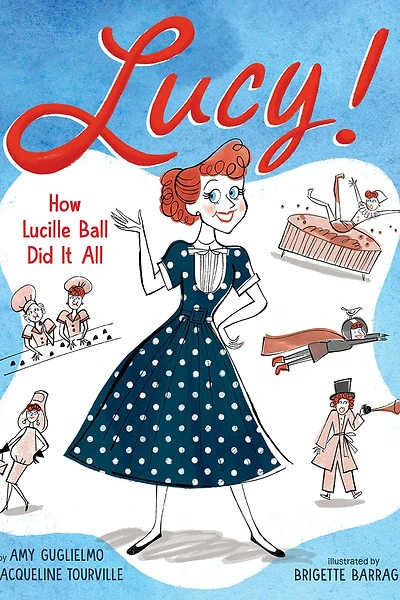
Lucy! How Lucille Ball Did It All
by Amy Guglielmo and Jacqueline Tourville
Pacing MaterialThe story of Lucille Ball, the trailblazing comedian who made America laugh and proved that funny women could run the show.
Big Idea
Lucille Ball proved that comedy is serious business — laughter can break barriers and change the world.
Discussion Questions
- 1.What obstacles did Lucille Ball face as a woman in comedy?
- 2.How did Lucille Ball use humor to connect with people?
- 3.What does it mean to 'do it all'?
- 4.How did Lucille Ball change television?
Classroom Activity
Funny & Brave Comics
Create a comic strip showing a famous person from history doing something funny and brave at the same time.
Lesson Plan
Learning Goals
- Understand biographical narrative
- Explore themes of perseverance and breaking barriers
- Connect humor to storytelling
Standards Connections
- ELA: RL.K.1 — Ask and answer questions about key details
- ELA: RL.K.2 — Retell stories, including key details
- ELA: RL.K.3 — Describe characters, setting, and events
- ELA: RL.3.6 — Acknowledge differences in characters' points of view
- ELA: SL.K.1 — Participate in collaborative conversations about the text
- ELA: W.K.3 — Write narratives recounting events with descriptive details
- SEL: Self-Management
- SEL: Responsible Decision-Making
- Art: VA:Re7 — Perceive and analyze artistic work
Pace-Write-Read Study with Pace-Write It!
Focus question: How does a writer speed up and slow down a true story to show a character’s perseverance and humor? In Lucy! How Lucille Ball Did It All by Amy Guglielmo and Jacqueline Tourville, readers follow Lucille Ball from a determined young girl to a groundbreaking comedy star. The authors use lively scenes, funny moments, and well-timed pauses to make Lucy’s hard work and big successes feel exciting, surprising, and full of laughter.
| Element | How to notice or teach it in the novel |
|---|---|
| Pace | Read: Notice how the story moves quickly through Lucille Ball’s life but slows down for important funny and brave moments, showing both her perseverance and her humor. Classroom Activity: Write 3 short sentences that race through a character’s practice or struggle, then 1 longer sentence that slows down for the big moment when the character shines. |
| Plot | Read: Notice the plot pattern in Lucy! How Lucille Ball Did It All: Lucy wants to perform, faces setbacks, keeps going, and finally changes television comedy. Classroom Activity: Make a 4-box plot map labeled dream, problem, keep going, success, and fill it in for Lucy or for your own character. |
| Prosody | Read: Listen to how the words sound playful and energetic when the authors describe Lucy’s comic spirit and determination. Classroom Activity: Read one page aloud with expression, then write 2 sentences meant to sound bouncy and funny when read aloud. |
| Word pause | Read: Notice places where a strong word or short phrase makes you stop and feel Lucy’s determination or the punch of a joke. Classroom Activity: Write a sentence about a performer or dreamer and add a one- or two-word pause line for emphasis, such as 'She tried again. Again.' |
| Concept | Read: Notice the big idea that funny people can also be leaders, workers, and trailblazers, just like Lucille Ball. Classroom Activity: Write 2 sentences explaining the lesson this biography teaches about perseverance and humor. |
| Voice & World View | Read: Notice how the authors’ voice celebrates Lucy as bold, creative, and hardworking, showing a world where girls can be funny and run the show. Classroom Activity: Write a short paragraph in an admiring voice about someone who breaks a rule or expectation in a positive way. |
| Setting & Place | Read: Notice how different places in Lucy’s life help pace the story, from her early years to stages and television studios where her talent grows. Classroom Activity: Choose one place from Lucy’s life and write 3 details showing how that place helped shape her dream. |
| Point of View | Read: Notice that this biography is told from an outside point of view, but it still helps us understand Lucy’s feelings, goals, and determination. Classroom Activity: Rewrite one moment as if Lucy herself is telling it by starting with 'I wanted...' or 'I knew...'. |
| Original Characters | Read: Notice how Lucille Ball stands out as an unforgettable real-life character because she is funny, daring, and persistent. Classroom Activity: Create a character list for Lucy with 4 traits and add one action from the book that proves each trait. |
| Dialogue | Read: Notice how any quoted words or talk-like lines help the story feel lively, theatrical, and close to Lucy’s world of performance. Classroom Activity: Write 4 lines of dialogue between Lucy and a person who doubts her, showing her humor and determination. |
| Details | Read: Notice the specific details that help readers see Lucy not just as famous, but as a person who practiced, struggled, and kept going. Classroom Activity: Write 3 specific details about a time someone worked hard to get better at something. |
| Descriptions | Read: Notice how descriptions help readers picture Lucy’s expressions, energy, and comic style. Classroom Activity: Describe a funny performance moment using 3 vivid describing words and 1 action verb. |
| Strong First Lines | Read: Notice how the opening quickly introduces Lucille Ball as someone readers want to know more about. Classroom Activity: Write an opening line for a biography about a person who made others laugh or think, making readers curious right away. |
| Immediacy & Engagement | Read: Notice how the authors keep readers close to Lucy’s journey by focusing on active moments of trying, failing, and performing. Classroom Activity: Write 3 sentences about a challenge using action words so the reader feels like it is happening now. |
| Story Scenes & Summaries & Unique Structures | Read: Notice how the book mixes scene-like moments from Lucy’s life with quick summaries that move readers through time. Classroom Activity: Write 1 scene from a character’s life in 3 sentences, then add 2 summary sentences that move the story ahead several years. |
| Flashback & Flash Forward & Cliffhangers | Read: Notice how a biography about Lucy’s whole life naturally moves across time, showing earlier struggles before later success. Classroom Activity: Write a mini biography beginning with a success, then flash back to an earlier hard moment by using the words 'Before that...'. |
| Tension & Suspense & Surprise | Read: Notice how readers wonder whether Lucy will be accepted, succeed, or prove others wrong, which builds tension in a true story. Classroom Activity: Write 3 sentences that build suspense before a character’s big chance to perform or speak. |
| Page Turns and Chapter Breaks | Read: Notice how each page turn can reveal a new problem, a funny twist, or a new step in Lucille Ball’s journey. Classroom Activity: Plan a 4-page picture book biography and write what surprise or change will happen after each page turn. |
| Performance | Read: Notice that performance is at the center of Lucy! How Lucille Ball Did It All, because Lucy uses timing, movement, and expression to make people laugh. Classroom Activity: Write a short scene in which a character performs on stage or in class, showing what the audience sees and hears. |
| Personality | Read: Notice how Lucy’s personality feels bigger than life: brave, funny, determined, and ready to take creative risks. Classroom Activity: Write a paragraph about a character whose strong personality helps solve a problem. |
| Humor | Read: Notice how the book highlights Lucille Ball’s humor not only as entertainment but as a talent that changed what people believed women could do. Classroom Activity: Write a funny moment in which a character turns an embarrassing problem into a success. |
| Pause | Read: Notice how the story sometimes pauses on important turning points so readers can feel Lucy’s struggle or triumph more deeply. Classroom Activity: Write a 5-sentence paragraph and make sentence 4 a very short pause sentence for emphasis. |
| Poetry and Poetic Devices | Read: Notice any playful language, sound patterns, or repeated phrases that match Lucy’s lively comic energy. Classroom Activity: Write 2 alliterative sentences about Lucy or another performer, such as 'Lucy leaped into laughter.' |
| Repetition | Read: Notice how repeated ideas about trying again can emphasize Lucy’s perseverance. Classroom Activity: Write a 4-line piece that repeats the same beginning words, such as 'She kept...' to show determination. |
| Rhythm | Read: Notice how sentence lengths can create a rhythm that feels snappy during funny parts and calmer during reflective parts. Classroom Activity: Write 2 short sentences and 1 longer sentence about the same event to create a performance-like rhythm. |
| Punctuation | Read: Notice how punctuation can help show excitement, surprise, and comic timing in a story about Lucille Ball. Classroom Activity: Write 3 sentences about a big moment and use an exclamation point, ellipsis, or dash to control the pace. |
| Questions | Read: Notice how readers may keep asking, 'Will Lucy make it?' or 'How will she prove them wrong?' as the story moves forward. Classroom Activity: Write 3 question sentences a reader might ask during a biography of a person chasing a dream. |
| Compare-Contrast | Read: Notice the contrast between people’s expectations of women comedians and what Lucy actually achieved. Classroom Activity: Write 2 compare-contrast sentences using 'At first... but later...' about Lucy’s journey. |
| Objects | Read: Notice any meaningful objects connected to Lucy’s performing life that help readers understand her work and success in entertainment. Classroom Activity: Choose one object a performer might use and write 3 sentences explaining how it tells part of the story. |
| Threes | Read: Notice how groups of three details can make Lucy’s character and achievements feel strong and memorable. Classroom Activity: Write a sentence listing 3 traits or actions that show a character’s perseverance. |
| Whitespace & Negative Space | Read: Notice how space on the page can give readers time to pause, laugh, or focus on an important part of Lucy’s story. Classroom Activity: Create a mini picture-book page with one short sentence at the top and one at the bottom, leaving space in the middle for the key moment. |
| Art & Graphics | Read: Notice how the illustrations support pacing by showing Lucy’s expressions, movement, and growing confidence as a performer and leader. Classroom Activity: Sketch one scene from Lucy’s life and label 3 visual details that help tell the story quickly. |
| Interactives & Gamification | Read: Notice how readers can interact with the biography by acting out Lucy’s expressions, predicting the next setback, or spotting moments of perseverance and humor. Classroom Activity: Make a 'Perseverance and Humor Hunt' chart with two columns and add 3 examples from the book to each column. |
Pace-Write It!
20-Minute Classroom Flow\nRead (5 min): Read aloud a section of Lucy! How Lucille Ball Did It All that shows Lucy facing a challenge and then using humor or determination to move forward. Ask students to listen for where the story goes fast and where it slows down.\nNotice (5 min): Discuss: Where did the authors speed through time? Where did they pause on an important moment? Chart student ideas under 'Fast' and 'Slow.' Point out how pacing helps readers feel Lucy’s perseverance and comic spark.\nWrite (7 min): Students write a short true-to-life or imagined mini biography scene about a person working hard to do something special. Writing frame: '_____ had a dream. First, _____. Then, _____. It was not easy because _____. But _____ kept going. Finally, _____, and everyone _____.' Encourage students to add one short pause sentence, such as 'Not yet.' or 'Then—success!'\nShare (3 min): Partners read their writing aloud and identify one place where the pacing feels fast and one place where it slows down for emphasis.\nExit ticket: Write one sentence answering: How did Amy Guglielmo and Jacqueline Tourville use pacing in Lucy! How Lucille Ball Did It All to show perseverance and humor?
Pace-Write-Read Connection
Teach this book using the Pace-Write-Read method — Tool 20: Play.
Open the Mastery Manual