 7-12
7-12GN NOVGORODOFF
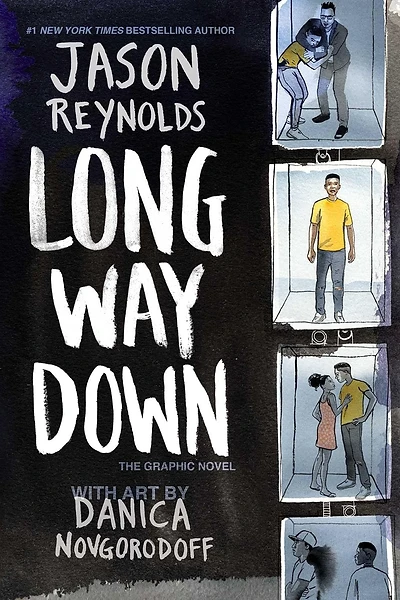
Long Way Down: The Graphic Novel
by Jason Reynolds, art by Danica Novgorodoff
Pacing MaterialThe award-winning verse novel reimagined as a graphic novel. Will's elevator descent is brought to life through watercolor panels, each ghost a visual echo of the violence that haunts his family.
Big Idea
The graphic format deepens the verse novel's emotional weight — every panel is a heartbeat in Will's sixty-second decision.
Discussion Questions
- 1.How does the visual medium change your understanding of the story?
- 2.What do the watercolor washes and sketchy lines convey about Will's state of mind?
- 3.Compare the elevator panels across pages — how does the art build tension?
- 4.What does the graphic format reveal that the verse format does not?
Classroom Activity
Verse-to-Panel Adaptation
Students select a stanza from the verse novel and translate it into a single comic panel, then discuss what each medium reveals that the other cannot.
Lesson Plan
Learning Goals
- Compare graphic and verse storytelling formats
- Analyze visual techniques that convey emotion
- Understand adaptation as an interpretive act
Standards Connections
- ELA: RL.7.1 — Ask and answer questions about key details
- ELA: RL.7.2 — Retell stories, including key details
- ELA: RL.7.3 — Describe characters, setting, and events
- ELA: RL.8.6 — Acknowledge differences in characters' points of view
- ELA: SL.7.1 — Participate in collaborative conversations about the text
- ELA: W.7.3 — Write narratives recounting events with descriptive details
- SEL: Social Awareness
- SEL: Relationship Skills
- Art: VA:Re7 — Perceive and analyze artistic work
Pace-Write-Read Study with Pace-Write It!
Focus question: How do short verse lines, watercolor panels, and the elevator’s downward movement control the speed of Will’s thinking and our understanding of his choices? In Long Way Down: The Graphic Novel by Jason Reynolds, illustrated by Danica Novgorodoff, a 15-year-old boy rides an elevator after his brother Shawn’s murder, planning revenge according to the “Rules.” The book uses pacing through spare verse, page turns, silence, and ghostly visual reveals so readers feel grief, pressure, and hesitation one floor at a time.
| Element | How to notice or teach it in the novel |
|---|---|
| Pace | Read: Notice how the elevator ride lasts about a minute, yet Jason Reynolds stretches that short trip into a full emotional journey through brief poems, pauses, and ghost arrivals on each floor. Watch how Danica Novgorodoff’s watercolor panels slow time so Will’s decision feels suspended. Classroom Activity: Write a one-minute scene from a character’s life stretched across 8-10 short lines or panels, using pauses to make a fast event feel long and intense. |
| Plot | Read: Track the simple outer plot—Will gets on the elevator with a gun after Shawn is killed—but notice how each stop complicates that revenge plan through encounters with Buck, Dani, Uncle Mark, Mikey, Frick, and Shawn. The plot moves downward physically while emotionally opening upward into family history and consequences. Classroom Activity: Create a plot ladder with 6 stops; at each stop, add one memory, visitor, or revelation that changes your main character’s original plan. |
| Prosody | Read: Listen to the sound of Reynolds’s verse: clipped lines, strategic breaks, and emphasis that mimic breathing, heartbeat, and shock. The prosody makes Will’s thoughts feel both controlled and on the verge of breaking. Classroom Activity: Write 6-8 lines of free verse about fear or grief, using line breaks to control where a reader slows down, speeds up, or feels a punch. |
| Word pause | Read: Notice how single words or very short lines in Will’s narration create pauses that make readers stop on ideas like the Rules, Shawn, or the sight of each ghost. These word-level pauses add weight without long explanation. Classroom Activity: Draft a short paragraph, then revise it into verse by isolating 5 important words on their own lines to increase tension. |
| Concept | Read: The central concept is brilliant and compressed: an elevator ride becomes a moral crossroads, and the dead literally enter the confined space with Will. Notice how this high-concept structure helps explore grief, revenge, masculinity, and inherited violence. Classroom Activity: Invent a story concept in which one ordinary place—bus stop, hallway, stairwell, laundromat—becomes the stage for a life-changing decision. |
| Voice & World View | Read: Will’s voice is direct, observant, skeptical, and shaped by the neighborhood Rules: no crying, no snitching, get revenge. Notice how his worldview starts as certainty and becomes less stable as the ghosts challenge what he thinks he knows. Classroom Activity: Write a monologue from a character who believes one hard rule about life; then let that rule start to crack by the final line. |
| Setting & Place | Read: Pay attention to the apartment building elevator as a tight, pressurized setting, and to how hints of the neighborhood beyond it shape the story’s danger and grief. The small space intensifies every glance, memory, and question. Classroom Activity: Describe a tiny setting where two or more people cannot leave, and show how the place increases emotional pressure. |
| Point of View | Read: The story stays close to Will’s point of view, so readers learn information when he does and share his confusion, defensiveness, and grief. Notice how the limited perspective builds suspense because we cannot see beyond what Will understands. Classroom Activity: Write a scene in first person where the narrator misreads a situation at first, then begins to understand more by the end. |
| Original Characters | Read: Study how each ghost—Buck, Dani, Uncle Mark, Mikey, Frick, and Shawn—arrives with a distinct connection to Will and to the chain of violence. Though briefly sketched, they feel memorable because each carries a different emotional truth or challenge. Classroom Activity: Create 3 brief character entries for visitors who appear one at a time to confront your protagonist; give each one a specific link to the protagonist’s past. |
| Dialogue | Read: Notice how dialogue in the elevator is spare, tense, and loaded with subtext, especially when the ghosts ask Will questions or reveal hidden history. What is unsaid often matters as much as what is spoken. Classroom Activity: Write 10-12 lines of dialogue between a teen and an unexpected visitor, where the real topic is guilt even though neither character says the word directly. |
| Details | Read: Look for concrete details—the gun, cigarette smoke, elevator buttons, Shawn’s presence, Dani’s memory—that anchor the surreal premise in physical reality. These details keep the emotional story believable. Classroom Activity: Write a short scene about loss using at least 5 small physical details instead of explaining feelings directly. |
| Descriptions | Read: Reynolds’s descriptions are economical, while Novgorodoff’s watercolor art expands mood, memory, and emotion through color and blur. Notice how description is shared between words and images rather than carried by prose alone. Classroom Activity: Describe one character in only 4 lines of text, then add notes for 3 visual choices—color, posture, and facial expression—that would deepen the mood. |
| Strong First Lines | Read: Examine how the opening immediately places readers inside Will’s grief, anger, and purpose after Shawn’s death. The beginning does not delay; it drops us into urgency and emotional stakes. Classroom Activity: Write 3 possible opening lines for a story about a character who thinks they know exactly what they must do after a loss. |
| Immediacy & Engagement | Read: Notice how the countdown feeling of the elevator ride creates instant engagement: readers want to know what happens before the doors open. Will’s age, voice, and urgent mission keep the story immediate. Classroom Activity: Write a scene that unfolds during a countdown—before a bell rings, train stops, timer ends, or door opens—and make the reader feel the clock. |
| Story Scenes & Summaries & Unique Structures | Read: The book mixes live elevator scenes with quick summaries of backstory and memory, all within a unique floor-by-floor structure. Notice how the structure lets the story reveal family history in controlled bursts. Classroom Activity: Plan a story using a repeating structure—floors, stations, innings, texts, or checkpoints—and decide where you will slow into a full scene versus summarize quickly. |
| Flashback & Flash Forward & Cliffhangers | Read: Watch how memories and ghost stories function like flashbacks, revealing Shawn, Dani, and earlier acts of violence. Each new floor often works like a cliffhanger because a door opens and readers wonder who or what will enter next. Classroom Activity: Write a present-time scene interrupted twice by short flashbacks, ending each section with a question or reveal that pulls the reader onward. |
| Tension & Suspense & Surprise | Read: Tension builds because Will is armed, grieving, and committed to revenge, yet every ghost encounter introduces doubt. Surprise comes from who appears, what they know, and how the past turns out to be more tangled than Will believed. Classroom Activity: Draft a suspense scene in which your protagonist starts certain about an action, but three surprises make that certainty wobble. |
| Page Turns and Chapter Breaks | Read: In this graphic novel, page turns and poem breaks act like elevator dings: each transition can delay or reveal a ghost, expression, or truth. Notice how the creators use the turn of a page to sharpen suspense. Classroom Activity: Storyboard 4 pages of a graphic or prose scene, marking exactly what information you will hide until after each page turn or section break. |
| Performance | Read: Because the book is written in verse, it invites oral reading; pauses, emphasis, and silence matter. Notice how Will’s lines and the ghosts’ words would sound different if performed aloud. Classroom Activity: Choose 6-8 lines from a scene you write and add performance directions in brackets, such as [whisper], [pause], [faster], or [long silence]. |
| Personality | Read: Will’s personality emerges through his coolness, vulnerability, grief, and effort to live by the Rules, while each ghost’s personality comes through quickly in gesture, speech, and memory. Notice how personality affects pacing because some characters provoke, some comfort, and some unsettle. Classroom Activity: Write two short character sketches of people responding to the same crisis in totally different ways—one guarded, one talkative. |
| Humor | Read: Even in a story about murder and grief, there are moments of dark humor, awkwardness, and human surprise in the elevator exchanges. These moments do not erase pain; they create contrast and make the characters feel real. Classroom Activity: Write 5-7 lines in which a serious scene includes one unexpected humorous detail or response that deepens, rather than cancels, the emotion. |
| Pause | Read: Notice the larger pauses in the story—silences after revelations, moments when Will does not answer, and panels where expression carries meaning. These pauses let grief and uncertainty breathe. Classroom Activity: Revise a scene by adding three intentional pauses—an empty line, an unfinished sentence, or a beat of silence—to heighten emotion. |
| Poetry and Poetic Devices | Read: Look for metaphor, imagery, repetition, enjambment, and compressed phrasing in Reynolds’s verse. The poetry makes grief and memory feel sharper and more layered than straightforward narration might. Classroom Activity: Write a 10-line poem about a hard choice using at least two poetic devices, such as repetition, metaphor, or enjambment. |
| Repetition | Read: The Rules repeat as a moral drumbeat, and repeated images, phrases, and patterns reinforce the cycle of violence haunting Will’s family and community. Notice how repetition becomes pressure. Classroom Activity: Write a piece that repeats one sentence or phrase three times, with the meaning changing each time as new information appears. |
| Rhythm | Read: The rhythm of the verse shifts between quick, sharp lines and slower reflective moments, echoing elevator movement, nervous thought, and emotional shock. Notice how rhythm helps control suspense. Classroom Activity: Compose two versions of the same 6-line scene—one with short, rapid lines and one with longer, slower lines—then compare the effect. |
| Punctuation | Read: Pay attention to how punctuation, fragments, dashes, and line endings shape Will’s voice and the speed of reading. Small marks help create hesitation, urgency, and impact. Classroom Activity: Take a plain paragraph and revise it twice: once to increase urgency with fragments and dashes, and once to slow it with commas and full stops. |
| Questions | Read: Questions drive the book: what really happened, who was responsible, what do the Rules demand, and what choice will Will make when the elevator reaches the lobby? Notice how characters ask questions that expose what Will has not fully faced. Classroom Activity: Write a scene built around 5 questions a visitor asks your protagonist, with each question pushing deeper into the truth. |
| Compare-Contrast | Read: Compare Will at the start of the ride with Will near the end; compare Shawn as loving brother versus symbol of the Rules; compare the living and the dead, certainty and doubt, action and reflection. These contrasts sharpen the book’s theme about choices. Classroom Activity: Make a two-column chart comparing your protagonist’s beliefs before and after a key encounter, then turn it into a paragraph or poem. |
| Objects | Read: Objects carry emotional and thematic weight here, especially the gun, the elevator, cigarette smoke, and remembered items connected to Shawn and the ghosts. Notice how objects hold memory and choice. Classroom Activity: Choose one object your character carries and write 8 lines showing how it represents both comfort and danger. |
| Threes | Read: The three Rules shape the story’s logic and pacing, giving Will a framework that feels simple but proves devastating. Notice how sets of three create memorability and pressure. Classroom Activity: Give your protagonist three rules, promises, or warnings, then write a scene where following them becomes harder than expected. |
| Whitespace & Negative Space | Read: In both the verse layout and the art, empty space matters. Whitespace slows reading, highlights emotion, and mirrors absence—especially the absence left by Shawn and others lost to violence. Classroom Activity: Create a one-page poem or comic script that intentionally leaves blank space after the most important line or image, then explain what the silence adds. |
| Art & Graphics | Read: Study how Novgorodoff’s watercolor images blur memory, emotion, and haunting, making the ghosts feel both present and untouchable. Color, scale, facial expression, and panel composition all shape pacing and deepen the themes of grief and inherited violence. Classroom Activity: Design a 6-panel comic or visual storyboard for a memory scene, using color notes to show changing emotion. |
| Interactives & Gamification | Read: Although the book itself is not a game, its floor-by-floor structure feels like levels or checkpoints, with each stop bringing a new challenge to Will’s revenge mission. Notice how this sequence keeps readers anticipating the next encounter. Classroom Activity: Turn a moral-choice story into a decision map with 5 stops, where each stop reveals information that changes the player-character’s next move. |
Pace-Write It!
20-Minute Classroom Flow\nRead (5 min): Read aloud a short sequence from the middle of the book in which one ghost enters the elevator and challenges Will’s understanding of the Rules. Ask students to notice where the verse slows them down and where the watercolor art creates silence or tension.\nNotice (5 min): Students annotate for pacing moves: line breaks, repeated words, page turns, facial expressions, empty space, and moments when Will’s certainty shifts. Discuss: How do the verse and images make one minute feel much longer?\nWrite (7 min): Students write a short free-verse scene called “Before the Doors Open.” The character is trapped in a small space and is visited by a person, memory, or ghost that complicates a planned choice. Writing frame: “I thought I knew / what I had to do. / Then _____ stepped in / carrying _____ . / The room got smaller / when _____ said, ‘_____.’ / I kept holding _____ / like it could answer. / But at the last second, / I wondered _____.” Encourage students to use one repeated phrase, one pause on a single-word line, and one object with symbolic meaning.\nShare (3 min): In pairs, students read their scenes aloud twice—first straight through, then with intentional pauses. Partners name one pacing move that was effective and one line that could be slowed down or sharpened.\nExit ticket: In 1-2 sentences, answer: How does Long Way Down: The Graphic Novel use pacing to show that grief can interrupt certainty and change a choice?