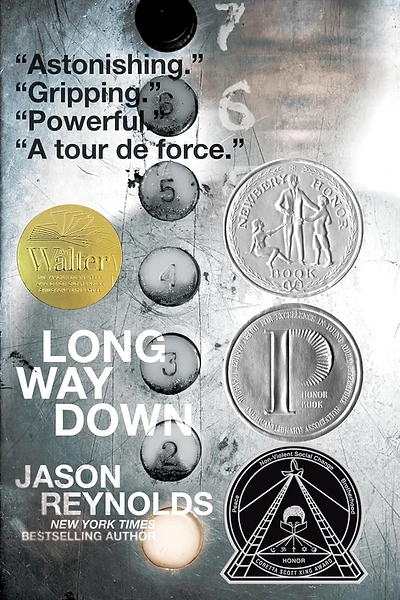
 7-12
7-12V REYNOLDS
Long Way Down
by Jason Reynolds
Pacing MaterialFifteen-year-old Will follows the rules of his neighborhood: no crying, no snitching, and if someone kills someone you love, you get revenge. But in the elevator ride down to avenge his brother's death, ghosts from his past enter at each floor.
Big Idea
A story told in sixty seconds that asks whether the rules of the street are really rules at all.
Discussion Questions
- 1.Why does Will feel he must follow 'The Rules'? Where do these rules come from?
- 2.What does each ghost in the elevator represent to Will?
- 3.How does the novel's verse format mirror Will's emotional state?
- 4.What choice does Will ultimately face, and what does the ending suggest?
Classroom Activity
Sixty-Second Monologue
Students write a one-minute monologue from Will's perspective at a pivotal moment in the elevator, then reflect on how time compression affects storytelling.
Lesson Plan
Learning Goals
- Analyze how verse format creates narrative tension
- Examine the role of ghosts as literary devices
- Discuss the cycle of violence and alternative choices
Standards Connections
- ELA: RL.7.1 — Ask and answer questions about key details
- ELA: RL.7.2 — Retell stories, including key details
- ELA: RL.7.3 — Describe characters, setting, and events
- ELA: RL.8.6 — Acknowledge differences in characters' points of view
- ELA: SL.7.1 — Participate in collaborative conversations about the text
- ELA: W.7.3 — Write narratives recounting events with descriptive details
- SEL: Social Awareness
- SEL: Relationship Skills
Pace-Write-Read Study with Pace-Write It!
Focus question: How can a brief elevator ride hold an entire story? In the original novel in verse, Will rides an elevator after his brother's death. The ride lasts about a minute, but each stop brings a person connected to his past and gives him more to consider. Reynolds uses short lines, repetition, and space on the page to make that small amount of story time feel expansive.
| Element | How to notice or teach it in the novel |
|---|---|
| Pace, plot & concept | Draw two timelines: time passing in the elevator and time Will spends remembering and thinking. Why are they so different? Classroom Activity: Write about a character waiting 30 seconds for a harmless result. Stretch those seconds across ten short lines. |
| Prosody, word pause, performance & rhythm | Read a short verse page aloud. Let line breaks guide your breath. Compare a rapid series of lines with a line that stands alone. Classroom Activity: Mark pauses on an original six-line poem. Perform it twice and explain which version fits the mood. |
| Voice, worldview, point of view & personality | Notice how Will speaks directly and how his understanding shifts as he listens. What can readers know only because Will tells the story? Classroom Activity: Describe one ordinary elevator stop from a first-person viewpoint. Include one thought the character does not say aloud. |
| Setting, place, details & descriptions | The elevator is a confined place with a repeated pattern of stops and doors. Notice which details make a new stop feel different. Classroom Activity: Describe the same small room before and after a visitor enters, changing only three details. |
| Original characters & dialogue | Consider what each visitor adds to Will's understanding. How does a conversation interrupt his thoughts and change the pace? Classroom Activity: Write a brief exchange in which a visitor challenges a character's assumption about an ordinary event. |
| Strong first lines, immediacy & engagement | Examine how the opening establishes Will's voice and creates a reason to listen. Classroom Activity: Write two first lines for a story set during a one-minute wait: one direct, one mysterious. |
| Story scenes, summaries & unique structures | Map the elevator stops as a repeated structure. Find where Will summarizes earlier events and where a present encounter unfolds closely. Classroom Activity: Write a three-stop structure for a story about deciding whether to join a school activity. Give each stop one new perspective. |
| Flashback, flash forward & cliffhangers | Memories bring earlier events into the short elevator ride. A possible future Will imagines is different from a narrated flash forward; check the passage before labeling it. What does a page leave unanswered? Classroom Activity: Insert a three-line memory into a present-time scene, then return to the present with a changed understanding. |
| Tension, suspense, surprise, page turns & chapter breaks | At each stop, readers anticipate who will appear and what Will will learn. Notice where a page turn delays that information. Classroom Activity: End a page just as an elevator door opens. On the next page, reveal a visitor with a surprising but harmless connection to the main character. |
| Pause, poetry, poetic devices, repetition & punctuation | Track a repeated word or idea and how its meaning changes. Reynolds has described using metaphor, repetition, alliteration, and sound within very short passages. Classroom Activity: Write five short lines repeating one phrase. Change the punctuation or spacing on the last line to change how it sounds. |
| Questions, compare–contrast & threes | Compare Will's thinking before, during, and after one encounter. What question becomes harder—or clearer? Classroom Activity: Make a three-column chart: what Will believes / what he hears / what he now questions. |
| Objects | Choose one recurring object or detail and ask what Will associates with it. Keep the discussion on its meaning and the choice he faces. Classroom Activity: Place one ordinary object in a poem three times, giving it a different meaning on each appearance. |
| Whitespace & negative space | Look at how much of a page is left open. Does a brief line make you turn quickly, or stop and think? Reynolds has discussed using space between words and passages to build tension. Classroom Activity: Set the same original sentence in a paragraph, then alone on a page. Compare the reading experience. |
| Art & graphics | In the original verse novel, study typography and page layout. If the class also uses the graphic novel adaptation, compare how Danica Novgorodoff's art and panels pace the same moment. Classroom Activity: Turn one original six-line scene into a three-panel storyboard. Decide where the pause belongs. |
| Humor & emotional contrast | If a selected passage includes a lighter memory or conversational beat, ask how that change in tone affects the scene that follows. Classroom Activity: Add one gentle moment of warmth to a serious original scene; explain its placement. |
| Interactives & gamification | Treat each elevator stop as a point on a pacing map, rather than reenacting the novel's conflict. Classroom Activity: In groups, match teacher-prepared cards for stop, new information, change in Will's thinking, and pace. Support each match with the text. |
Pace-Write It!
Exit ticket: Choose one page and complete: "Only a little story time passes here, but it feels longer because Reynolds uses ______. I paused at ______ because ______." Teaching note: The novel addresses grief and gun violence. Students can study its verse and structure through selected, non-graphic passages and use everyday decisions for their own writing.