
 2-6
2-6GN LATULIPE
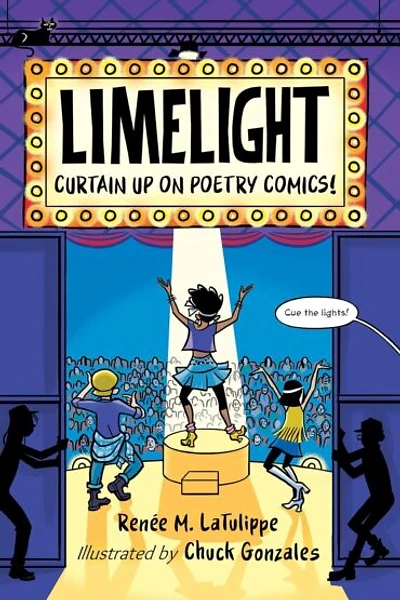
Limelight: Curtain Up on Poetry Comics!
by Renée M. LaTulipe
Pacing MaterialPoems come alive as comics in this creative collection, where each verse steps into the spotlight and takes the stage.
Big Idea
Poetry and comics are both about expression — and when you combine them, words and pictures shine together.
Discussion Questions
- 1.How are poems and comics similar?
- 2.Which poem-comic was your favorite, and why?
- 3.How do the illustrations change how you read the poem?
- 4.What would your poem look like as a comic?
Classroom Activity
Poetry Comic
Write a short poem, then turn it into a comic strip. Use panels to show what the poem looks like when it comes to life.
Lesson Plan
Learning Goals
- Explain how words and pictures work together to express a poem’s meaning and mood in Limelight: Curtain Up on Poetry Comics!
- Write a short original poem using sensory details, vivid verbs, or repetition.
- Sequence a poem across comic panels, choosing images that bring its words to life.
- Share a poetry comic and explain how color, facial expressions, and layout communicate feelings.
Activity Steps
- 1.Read aloud a selected poetry comic from Limelight: Curtain Up on Poetry Comics! Display its pages and discuss: What do the pictures help us notice or feel? How do the panels guide our reading?
- 2.Model turning a brief teacher-written poem into three panels. Think aloud about where to divide the lines and how pictures can add meaning rather than simply repeat the words.
- 3.Invite students to choose a subject that could step into the spotlight, such as a playful pet, a rainy day, or a dancing leaf. Have them write a 4–8-line poem using sensory details, vivid verbs, or repetition. Younger students may dictate or use sentence starters.
- 4.Have students plan a 3–6-panel comic strip. Ask them to place the poem’s lines in captions or speech bubbles and sketch how its action or feelings unfold from panel to panel.
- 5.Students illustrate and revise their poetry comics, checking that every poem line is included and that panel order is clear. Encourage expressive faces, purposeful colors, and details that extend the poem’s meaning.
- 6.Hold a 'Curtain Up!' gallery walk or partner share. Students read their poems aloud, explain one visual choice, and offer a peer specific feedback about how words and pictures shine together.
Standards Connections
- ELA: CCSS.RL.2.7 — Use information from illustrations and words to understand a text.
- ELA: CCSS.RL.5.7 — Analyze how visual elements contribute to a text’s meaning, tone, or beauty.
- ELA: CCSS.W.2.5–W.6.5 — Strengthen writing through developmentally appropriate planning, revising, and editing with support.
- ELA: CCSS.SL.2.1–SL.6.1 — Participate in collaborative discussions, building on others’ ideas and expressing ideas clearly.
- Visual Arts: Creating — Develop and refine artistic work by combining text, images, and sequential panels to communicate meaning.
Pace-Write-Read Study with Pace-Write It!
Focus question: How do poets and comic artists control the speed of a reader’s thinking and feeling? In Limelight: Curtain Up on Poetry Comics! by Renée M. LaTulipe, poems become mini comic performances, with each piece stepping into the spotlight through words and images. The book uses pacing by mixing quick, playful lines, visual beats, page layout, and performance-style pauses so readers slow down for important moments and speed up through energetic ones.
| Element | How to notice or teach it in the novel |
|---|---|
| Pace | Read: Notice how Limelight: Curtain Up on Poetry Comics! moves at different speeds from poem to poem, with some comics feeling zippy and playful and others slowing down for reflection and performance. Watch how Renée M. LaTulipe uses short lines, panel size, and page layout to control how quickly each poem takes the stage. Classroom Activity: Write a 6-line poem comic about stepping onto a stage or sharing an idea, and revise it twice—once to feel fast and once to feel slow. |
| Plot | Read: Even though this is a poetry comic collection, many poems still have tiny plots: a moment begins, something shifts, and the ending lands like a final spotlight cue. Notice how each comic-poem feels like a mini story of self-expression rather than a long narrative. Classroom Activity: Draft a comic-poem with a clear beginning, middle, and end about a small moment when a character finds the courage to speak, sing, or perform. |
| Prosody | Read: Listen to the way the poems in Limelight: Curtain Up on Poetry Comics! sound when read aloud, since the collection is built for performance as much as for reading. Notice how stress, line breaks, and sound patterns help each comic-poem feel theatrical. Classroom Activity: Choose one emotion—proud, nervous, excited, or shy—and write 4 lines that use sound and line breaks to match that emotion. |
| Word pause | Read: Notice how single words or very short lines in Renée M. LaTulipe’s poetry can make a reader stop, breathe, and focus, almost like an actor pausing under a bright stage light. In comics, those pauses can be strengthened by the space around the words and the art beside them. Classroom Activity: Write a short poem about a performer or speaker and include 3 one-word lines to create dramatic pauses. |
| Concept | Read: The big concept of Limelight: Curtain Up on Poetry Comics! is that poems can be performed visually, not just spoken, and that self-expression can happen through both words and art. Notice how the collection turns poetry into something active, staged, and alive. Classroom Activity: Invent a concept for your own poetry comic, such as a poem becoming a dance, a song, a game, or a spotlight speech, and write 5–8 lines to match it. |
| Voice & World View | Read: Notice the expressive, playful, creative voice in Limelight: Curtain Up on Poetry Comics! and how the collection values imagination, individuality, and sharing feelings. Renée M. LaTulipe presents a world where every poem deserves a spotlight and every way of expressing yourself matters. Classroom Activity: Write a poem comic in a bold or shy voice that shows what your speaker believes about being seen or heard. |
| Setting & Place | Read: The title and performance framing suggest a stage-like world, but many comic-poems can also create their own tiny places through art and words. Notice how a poem can feel like it happens under curtains, in a spotlight, or in a completely imagined scene built by the comic panels. Classroom Activity: Create a setting for a poem comic—stage, classroom, playground, bedroom, dream world—and write lines that help readers picture it clearly. |
| Point of View | Read: Notice how a comic-poem can feel different depending on who is speaking or being shown. In Limelight: Curtain Up on Poetry Comics!, point of view helps readers connect personally to each performance moment and can make a poem feel intimate, funny, or dramatic. Classroom Activity: Write one 4-line poem in first person and then rewrite it in third person to compare how the pacing and feeling change. |
| Original Characters | Read: Although this collection centers on poems more than one continuous cast, many comic-poems feel like they introduce fresh stage-ready characters through expression, pose, and voice. Notice how quickly a speaker or performer becomes memorable when words and pictures work together. Classroom Activity: Invent an original character for a poetry comic—such as a nervous singer, a bragging pencil, or a whispering shadow—and write a short poem that introduces them. |
| Dialogue | Read: In poetry comics, dialogue can appear in speech bubbles, captions, or lines that sound spoken directly to an audience. Notice how dialogue in Limelight: Curtain Up on Poetry Comics! can speed up the action and make the poem feel like live theater. Classroom Activity: Write a comic-poem in which two voices speak to each other in alternating lines about whether they are ready to step into the limelight. |
| Details | Read: Notice how small details in Limelight: Curtain Up on Poetry Comics! help each poem feel vivid even when the text is brief. A few carefully chosen words, gestures, or visual clues can do a lot of work in a poetry comic. Classroom Activity: Write 5 lines about a moment of self-expression and include at least 4 precise details, such as hands shaking, curtains swishing, sneakers tapping, or a bright microphone. |
| Descriptions | Read: Renée M. LaTulipe’s collection shows that description does not have to be long to be powerful; in poetry comics, description can be compressed into strong phrases plus expressive art. Notice how the images and the words share the job of describing the scene. Classroom Activity: Describe a character about to perform using only 6 lines and 3 strong describing words or phrases that could guide an illustrator. |
| Strong First Lines | Read: Notice how the opening line of a poem comic needs to grab attention quickly, almost like the curtain rising. In Limelight: Curtain Up on Poetry Comics!, a strong first line can create excitement, surprise, or immediate curiosity. Classroom Activity: Write 3 different opening lines for a poem comic about self-expression, then choose the one that makes readers most want to continue. |
| Immediacy & Engagement | Read: Poetry comics feel immediate because they place readers close to the action through performance energy, expressive visuals, and direct language. Notice how Limelight: Curtain Up on Poetry Comics! invites readers to feel as if the poem is happening right now, right in front of them. Classroom Activity: Write a present-tense poem comic using words like now, here, look, or listen to pull the reader into the moment. |
| Story Scenes & Summaries & Unique Structures | Read: Some comic-poems in Limelight: Curtain Up on Poetry Comics! may zoom in on one dramatic scene, while others summarize a feeling or idea in a more compact structure. Notice how the collection uses the flexibility of poetry and comics to create unusual shapes for meaning. Classroom Activity: Write one version of a poem as a single scene and another version as a summary of the whole feeling, then compare which pacing works better. |
| Flashback & Flash Forward & Cliffhangers | Read: Even in short poetry comics, a writer can hint at before and after—what happened before the spotlight came on or what might happen after the final line. Notice whether any comic-poems in this collection suggest memory, anticipation, or an ending that leaves readers hanging. Classroom Activity: Write a comic-poem that begins with “Before the curtain rose…” or ends with a cliffhanger panel that makes readers wonder what happens next. |
| Tension & Suspense & Surprise | Read: A poem comic can create tension through waiting, suspense through page progression, and surprise through an unexpected final line or image. Notice how Limelight: Curtain Up on Poetry Comics! can make a small moment feel dramatic because the reader expects some kind of reveal. Classroom Activity: Write a 5–8 line poem comic where a speaker is building up to sharing a secret talent, and save the surprise for the last line. |
| Page Turns and Chapter Breaks | Read: In a comic collection, page turns matter because they can hold back an image, a punchline, or an emotional shift until the reader is ready. Even without long chapters, separate poems work like performance breaks between acts in Limelight: Curtain Up on Poetry Comics! Classroom Activity: Plan a 2-page comic-poem and decide what line or image should appear only after the page turn for the biggest effect. |
| Performance | Read: Performance is central to Limelight: Curtain Up on Poetry Comics!, where every poem feels like it is stepping onto a stage. Notice how voice, expression, layout, and rhythm all help the poem act itself out. Classroom Activity: Write a poem meant to be performed aloud, then mark 3 places where the performer should pause, whisper, or speak loudly. |
| Personality | Read: The poems in this collection often burst with personality, whether playful, dramatic, thoughtful, or bold. Notice how personality comes through quickly in both the speaker’s words and the comic art choices. Classroom Activity: Write a poem comic about one object or animal with a huge personality, such as a dramatic backpack or a confident cat, and let that personality drive the pacing. |
| Humor | Read: Comics and poetry together can create humor through timing, expressions, exaggeration, and surprise. Notice how Limelight: Curtain Up on Poetry Comics! may use visual jokes or playful language to keep self-expression joyful and inviting. Classroom Activity: Write a funny 6-line poem comic about something going slightly wrong during a performance, such as a squeaky shoe or a wobbly prop. |
| Pause | Read: Pause is different from speed; it is the intentional moment of silence or stillness that gives a line extra meaning. Notice how Renée M. LaTulipe uses poetic spacing and comic timing so readers rest in important emotional beats. Classroom Activity: Create a poem comic with one key pause before the final line, and show that pause with spacing, punctuation, or a silent panel. |
| Poetry and Poetic Devices | Read: This collection is a strong model for poetic devices because it blends imagery, line breaks, sound play, repetition, and metaphor with comics. Notice how the poetry remains central even when the art adds another layer of meaning. Classroom Activity: Write a poem comic that uses at least two poetic devices, such as alliteration and simile, to show a character expressing themselves. |
| Repetition | Read: Repetition can make a poem feel musical, dramatic, or chant-like, especially in a performance-centered book like Limelight: Curtain Up on Poetry Comics! Notice how repeating a word, phrase, or image can slow readers down or build excitement. Classroom Activity: Write a poem comic that repeats one line three times, changing the meaning each time with a new image or context. |
| Rhythm | Read: Rhythm helps readers know when to move quickly and when to linger. Notice how the lines in Limelight: Curtain Up on Poetry Comics! may bounce, march, or glide depending on the mood of the poem and the comic action. Classroom Activity: Clap out a simple beat, then write 4–6 lines that match that beat for a poem about stepping into the spotlight. |
| Punctuation | Read: In poetry comics, punctuation does pacing work by stopping, stretching, interrupting, or energizing the line. Notice how exclamation points, ellipses, dashes, and question marks can shape the performance style of a poem in this collection. Classroom Activity: Take a short poem you wrote and revise it twice using different punctuation to create a calmer version and a more dramatic version. |
| Questions | Read: Questions can pull readers in and make a poem sound curious, uncertain, or direct, especially in a book about self-expression. Notice whether any comic-poems in Limelight: Curtain Up on Poetry Comics! invite the audience to wonder, respond, or imagine. Classroom Activity: Write a poem comic made of 4–6 questions from a speaker who is deciding whether to share their true voice. |
| Compare-Contrast | Read: A poetry comic can compare feelings, voices, or versions of the self—for example, how someone feels offstage versus onstage. Notice how self-expression in Limelight: Curtain Up on Poetry Comics! can become stronger when differences are made visible in both words and art. Classroom Activity: Write a compare-contrast poem comic using the frame “Before the spotlight… / In the spotlight…” and show how the speaker changes. |
| Objects | Read: In comics and poems, objects can become meaningful props that reveal emotion or identity, such as a microphone, notebook, costume piece, or curtain. Notice how a single object in Limelight: Curtain Up on Poetry Comics! can anchor a whole performance moment. Classroom Activity: Choose one object that helps someone express themselves and write a poem comic in which that object appears in every panel or line. |
| Threes | Read: Patterns of three often feel satisfying in poetry and performance because they build rhythm and expectation. Notice whether lines, images, actions, or repeated beats in Limelight: Curtain Up on Poetry Comics! come in threes to create momentum. Classroom Activity: Write a 3-part poem comic in which a speaker tries three times to share an idea, with the third try being the strongest. |
| Whitespace & Negative Space | Read: Whitespace in poetry and negative space in comics help create silence, emphasis, and room for emotion. Notice how open space in Limelight: Curtain Up on Poetry Comics! can make one word, one image, or one feeling stand out more powerfully. Classroom Activity: Design a poem comic page where one important line is surrounded by lots of empty space to show a pause or big feeling. |
| Art & Graphics | Read: The heart of Limelight: Curtain Up on Poetry Comics! is the combination of poetry and comics, so art and graphics are essential to pacing. Notice how panel shape, character expression, lettering, and visual movement affect how long readers stay on each moment. Classroom Activity: Storyboard a 4-panel poem comic and decide where close-ups, big panels, or bold lettering should appear to control pacing. |
| Interactives & Gamification | Read: Because the collection feels playful and performative, readers can interact with it by reading aloud, acting it out, or noticing how visual clues guide meaning. Notice how Limelight: Curtain Up on Poetry Comics! invites participation through its energetic style and self-expression theme. Classroom Activity: Turn your poem comic into a class performance game by adding simple audience directions such as clap, echo, whisper, or point when certain repeated words appear. |
Pace-Write It!
20-Minute Classroom Flow Read (5 min): Read aloud one or two poem comics from Limelight: Curtain Up on Poetry Comics! by Renée M. LaTulipe. Ask students to listen for places where the poem speeds up, slows down, or pauses like a performance. Notice (5 min): Students turn and talk: What helped control the pacing—the line breaks, repeated words, punctuation, panel size, whitespace, or expressions in the art? Chart student observations under two headings: “Words” and “Pictures.” Write (7 min): Students create a short poem comic about self-expression. Writing frame: “Before I share, I ________. / My hands ________. / The room ________. / Then I ________. / Now my voice is ________.” Encourage students to add one repeated word or phrase, one strong punctuation choice, and one planned pause. Share (3 min): Students read their poem comics aloud to a partner or small group, using performance voices and pauses. Listeners name one pacing choice they noticed. Exit ticket: Finish this sentence on a sticky note: “One way I controlled pacing in my poem comic was ________.”
Pace-Write-Read Connection
Teach this book using the Pace-Write-Read method — Tool 20: Play.
Open the Mastery Manual