 2-6
2-6R BRUNELLE
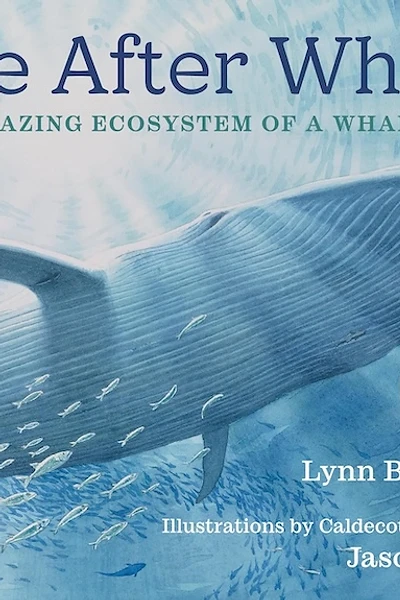
Life After Whale: The Amazing Ecosystem of a Whale Fall
by Lynn Brunelle
Pacing MaterialWhen a whale dies, its body sinks to the ocean floor and becomes a thriving ecosystem that can last for decades — a story of how death feeds life.
Big Idea
In nature, nothing is wasted — even in death, a whale creates new life and sustains a deep-sea community.
Discussion Questions
- 1.What happens to a whale's body after it dies?
- 2.What creatures depend on a whale fall?
- 3.How long can a whale fall ecosystem last?
- 4.What does this teach us about cycles in nature?
- 5.Why is decomposition important?
Classroom Activity
Whale Fall Ecosystem Map
Draw a whale fall ecosystem. Label five creatures and what each one does in the ecosystem.
Lesson Plan
Learning Goals
- Explain how a whale’s body becomes a source of food and habitat after sinking to the ocean floor.
- Identify five members of a whale fall community and describe each organism’s role.
- Create a labeled ecosystem map showing how organisms obtain food from the whale or from one another.
- Use details from the book to explain the big idea that nutrients are reused in nature.
Activity Steps
- 1.Read aloud or revisit key sections of Life After Whale. Ask: What happens after the whale sinks? How does its body support life where sunlight cannot reach?
- 2.Build a class chart of whale fall organisms using the book’s text and illustrations. Discuss five examples: hagfish eat soft tissue; crabs scavenge remains; bone-eating worms access nutrients in bones with help from bacteria; bacteria break down remains and recycle nutrients, with some using chemical energy to make food; snails graze on bacterial mats.
- 3.Draw a whale skeleton on the ocean floor. Add and label the five organisms, placing each near the food or habitat it uses. Clarify that bacteria are microscopic, so their drawings are enlarged symbols.
- 4.Write a short role statement beside each label, such as 'Hagfish: eats the whale’s soft tissue.' Add arrows from each food source to the organism that uses it, and include a key explaining the arrows.
- 5.Share maps with a partner and check labels and roles against the book. Explain that the map combines organisms that may appear at different times as the whale fall changes over years or decades. For grades 4–6, mark early and later arrivals.
- 6.Complete an exit response: 'A whale fall shows that nothing in nature is wasted because…' Support the answer with two examples from the book or map. Younger students may respond orally.
Standards Connections
- ELA: CCSS RI.2.3 — Describe connections among scientific ideas or events, including how a whale’s death supports other organisms.
- ELA: CCSS RI.4.3 — Explain scientific processes using specific information from an informational text.
- Science: NGSS 5-LS2-1 — Develop a model describing the movement of matter among plants, animals, decomposers, and the environment; this activity emphasizes animals and decomposers in a deep-sea system.
- Science: NGSS MS-LS2-3 — Develop a model describing cycling of matter and flow of energy among living and nonliving parts of an ecosystem; a grade 6 extension can distinguish matter cycling from energy flow.
Pace-Write-Read Study with Pace-Write It!
Focus question: How does an author pace nonfiction so readers can follow a slow ocean-floor process and still feel amazed on every page? In Life After Whale: The Amazing Ecosystem of a Whale Fall by Lynn Brunelle, readers learn how a dead whale becomes a living deep-sea ecosystem over many years. The pacing moves step by step through stages of decomposition, using vivid facts, striking illustrations, and carefully timed reveals so the science feels dramatic and alive.
| Element | How to notice or teach it in the novel |
|---|---|
| Pace | Read: Notice how Lynn Brunelle slows down to explain each stage of the whale fall, then speeds up to show how many creatures arrive to feed, live, and change the whale’s body over time. Classroom Activity: Write 4 sentences about one object in nature changing over time, using one slow, detailed sentence and one fast, action-filled sentence to control pace. |
| Plot | Read: Even though this is nonfiction, the book has a clear sequence: the whale dies, sinks, is discovered by scavengers, and becomes a long-lasting ecosystem. Classroom Activity: Create a beginning-middle-end plot sketch for a nonfiction topic, showing how one event leads to the next the way the whale fall transforms the seafloor. |
| Prosody | Read: Listen to how the language sounds when the book describes the heavy sinking whale, the busy feeders, and the quiet deep ocean. The sentence flow helps the science feel grand and dramatic. Classroom Activity: Choose one page idea from the book and rewrite it as 3 read-aloud lines that sound smooth, serious, and ocean-like. |
| Word pause | Read: Notice places where strong content words like whale, sink, bones, scavengers, and ecosystem make readers pause and think about the importance of each stage. Classroom Activity: Write a 5-sentence explanation of decomposition and bold or underline 5 powerful words where a reader should naturally pause. |
| Concept | Read: The big concept is that death in nature can create life, because the whale’s body feeds many organisms for years or even decades. Classroom Activity: Write 3-5 sentences explaining the concept 'one living thing can support many others' using the whale fall as your example. |
| Voice & World View | Read: The book’s voice is curious, respectful, and full of wonder about deep-sea life, helping readers see decomposition not as only sad, but also as part of a larger ecosystem. Classroom Activity: Write a short paragraph in a voice of wonder about something in nature that might seem unpleasant at first, such as rot, mud, or decay. |
| Setting & Place | Read: Notice how the deep ocean floor is presented as dark, cold, distant, and full of surprising life once the whale lands there. Classroom Activity: Write a setting paragraph about the seafloor where the whale falls, including at least 4 sensory details a scientist or sea creature might notice. |
| Point of View | Read: The book is told from an informative nonfiction point of view, but it guides readers closely through the whale’s journey and the creatures that depend on it. Classroom Activity: Rewrite one moment from the book from the point of view of a crab, eel, or bone-eating worm arriving at the whale fall. |
| Original Characters | Read: In this book, the 'characters' are real ocean organisms such as scavengers, worms, and other deep-sea animals that each play a role in the whale fall ecosystem. Classroom Activity: Invent a real-animal character card for one whale-fall creature, including its job, movement, food source, and what it 'notices' first about the whale. |
| Dialogue | Read: The book is informational, so it likely uses little or no dialogue, which keeps the pacing focused on facts and sequence instead of conversation. Classroom Activity: Add 4 lines of imagined dialogue between two sea creatures discovering the whale, while keeping the science accurate. |
| Details | Read: Notice how specific scientific details about decomposition, bones, ocean depth, and feeding creatures make the whale fall ecosystem understandable and memorable. Classroom Activity: Write an information paragraph about the whale fall using at least 5 precise details from the book. |
| Descriptions | Read: Lynn Brunelle uses vivid descriptions to help readers picture the whale’s huge body sinking and the active community that grows around it. Classroom Activity: Describe the moment the whale reaches the ocean floor in 5-6 sentences using size, motion, darkness, and animal activity. |
| Strong First Lines | Read: Notice how the opening quickly introduces the surprising idea that a dead whale can become the start of a whole ecosystem. That strong start creates curiosity right away. Classroom Activity: Write 3 possible opening lines for a nonfiction piece that reveal a surprising fact the way this book does. |
| Immediacy & Engagement | Read: The book keeps readers engaged by revealing what happens next to the whale and by showing unusual deep-sea creatures that depend on it. Classroom Activity: Write 4 sentences that begin with immediate action, such as 'Down it sinks...' or 'Soon the scavengers arrive...' to pull readers into a science topic. |
| Story Scenes & Summaries & Unique Structures | Read: Notice how the book balances scene-like moments, such as the whale sinking or creatures gathering, with summary information about long-term decomposition over years. Classroom Activity: Write one scene paragraph about a single moment at the whale fall and one summary paragraph explaining what happens over a long time. |
| Flashback & Flash Forward & Cliffhangers | Read: The book mainly moves forward in time, but readers can think about the whale’s life before death and the many years after the whale reaches the seafloor. Classroom Activity: Write a short piece with a flashback to the whale swimming alive and a flash forward to the whale bones years later supporting new life. |
| Tension & Suspense & Surprise | Read: There is surprise in learning that a sad event becomes a rich habitat, and suspense comes from wondering which creatures will arrive and what will happen to the whale next. Classroom Activity: Write a 6-sentence nonfiction paragraph that builds suspense before revealing an unexpected science fact about decomposition or ecosystems. |
| Page Turns and Chapter Breaks | Read: Notice how each new section or page turn can reveal a new stage of the whale fall or a new group of organisms, encouraging readers to keep going. Classroom Activity: Plan a 4-page nonfiction booklet where each page turn reveals a new stage in an ecosystem change. |
| Performance | Read: When read aloud, the book invites dramatic performance through slow sinking motions, amazed reactions, and emphasis on big science words. Classroom Activity: Practice reading a passage aloud using a slow deep voice for the sinking whale and a quicker voice for the busy scavengers, then mark your script for expression. |
| Personality | Read: The book’s personality feels fascinated, smart, and adventurous, turning a deep-ocean science topic into an exciting discovery. Classroom Activity: Write an informational paragraph with a clear personality—curious, amazed, and respectful—about an unusual animal habitat. |
| Humor | Read: Even in a serious science topic, some of the strange creatures and unexpected idea of life growing from a whale skeleton can feel surprising or slightly playful. Classroom Activity: Write 3 accurate but lighthearted sentences about a whale-fall creature that make readers smile without making fun of the science. |
| Pause | Read: Notice moments when the information invites readers to stop and think about scale, time, and the idea that the whale supports life for decades. Classroom Activity: Add 3 pause marks such as line breaks, dashes, or short one-sentence paragraphs to a nonfiction explanation so readers have time to think. |
| Poetry and Poetic Devices | Read: The deep sea setting, the drifting descent, and the cycle of death feeding life give the book poetic power even while it teaches facts. Classroom Activity: Write a 6-line poem about the whale fall using personification, imagery, or alliteration while keeping the science connected to the book. |
| Repetition | Read: Notice how the return to the whale body, the bones, and the idea of one life supporting many creatures reinforces the main idea throughout the book. Classroom Activity: Write a paragraph that repeats a key phrase such as 'The whale gives...' or 'After the fall...' to create emphasis. |
| Rhythm | Read: The rhythm of the book can feel slow during sinking, busy during feeding, and reflective during long-term ecosystem change. Classroom Activity: Write 3 sentences with different rhythms: one slow, one quick, and one balanced, all about the whale fall. |
| Punctuation | Read: Notice how punctuation in nonfiction can shape pacing by separating facts, adding dramatic pauses, or highlighting surprising information about decomposition and sea life. Classroom Activity: Rewrite 3 plain sentences about the whale fall using commas, dashes, or a colon to improve pacing and clarity. |
| Questions | Read: The book naturally makes readers ask questions such as who comes first, how long the ecosystem lasts, and why the deep sea needs this food source. Classroom Activity: Write 5 research questions inspired by the whale fall, then answer 1 of them in 2-3 sentences using evidence from the book. |
| Compare-Contrast | Read: Readers can compare the whale’s life above the ocean with its role after death below the ocean, or compare the empty seafloor before and after the whale fall. Classroom Activity: Make a compare-contrast paragraph using the frame 'Before the whale fell..., but after it fell...' |
| Objects | Read: Important objects in the book include the whale’s body, bones, seafloor mud, and the remains that become food and shelter for many organisms. Classroom Activity: Choose one object from the book, such as a bone, and write from its perspective about how its role changes over time. |
| Threes | Read: The science can be organized in threes, such as three stages, three groups of creatures, or three ways the whale supports life. Classroom Activity: Write a nonfiction paragraph organized around 3 ways the whale fall changes the ecosystem. |
| Whitespace & Negative Space | Read: Notice how open space on pages can reflect the vast, dark ocean and make the whale or the creatures stand out more clearly. Classroom Activity: Design a mini page for your own nonfiction writing, leaving intentional blank space to show the emptiness of the deep sea before adding your text and picture. |
| Art & Graphics | Read: The illustrations and graphics help explain the underwater setting, the stages of decomposition, and the many organisms that gather around the whale fall. Classroom Activity: Create a labeled diagram of the whale fall ecosystem showing at least 5 organisms and where they are found around the whale. |
| Interactives & Gamification | Read: This book lends itself to sequencing and discovery because readers can track who arrives first, what each creature does, and how the ecosystem changes over time. Classroom Activity: Make a simple card-sorting game where classmates match whale-fall creatures to their roles, such as scavenger, decomposer, or shelter user. |
Pace-Write It!
20-Minute Classroom Flow\nRead (5 min): Read aloud a section from Life After Whale: The Amazing Ecosystem of a Whale Fall by Lynn Brunelle that shows the whale sinking and the first creatures arriving. Ask students to listen for places where the pacing slows down to explain and speeds up to show action.\nNotice (5 min): On chart paper, make two columns: 'Slow it down' and 'Speed it up.' Students name details from the book that stretch time, such as describing the deep ocean floor, and details that quicken time, such as many scavengers arriving. Briefly discuss how the pacing helps readers understand decomposition as a process.\nWrite (7 min): Students write a short nonfiction paragraph about a natural process using pacing. Writing frame: 'First, ________. Slowly, ________. Soon, ________ arrive/begin. Over time, ________. In the end, ________ becomes/changes into ________.' Encourage students to model their pacing after the whale fall sequence.\nShare (3 min): Partners read their paragraphs aloud and point out one sentence that slows the pace and one sentence that speeds it up. Invite 1-2 volunteers to share with the class.\nExit ticket: Write one sentence answering: 'How did Lynn Brunelle use pacing to make the whale fall both understandable and exciting?'
Pace-Write-Read Connection
Teach this book using the Pace-Write-Read method — Tool 33: Lists.
Open the Mastery Manual