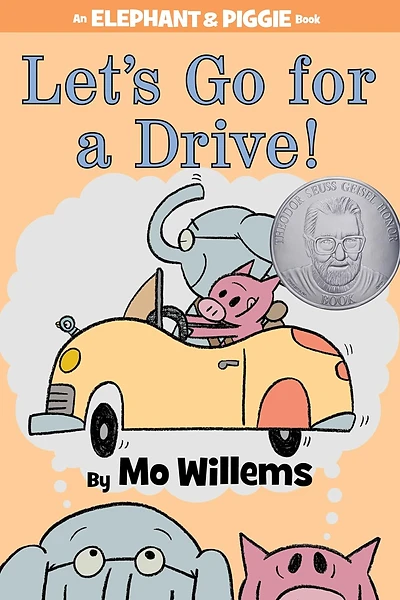
 PreK-2
E WILLEMS
Let's Go for a Drive!
by Mo Willems
Pacing MaterialElephant Gerald plans the perfect drive, gathering everything — except the one thing that matters most.
Big Idea
Plans don't always work out, but being with a good friend makes any adventure worthwhile.
Discussion Questions
- 1.What does Gerald pack for the drive?
- 2.What does Gerald forget?
- 3.How does Piggie help Gerald feel better?
- 4.What do you do when a plan goes wrong?
Classroom Activity
Pack Your Bag
Draw a bag and pack five things you'd bring on an adventure. Label each item and tell why you chose it.
Lesson Plan
Learning Goals
- Identify Gerald and Piggie and explain how forgetting a car changes their plan for a drive.
- Describe how Gerald and Piggie respond when their plan does not work, connecting their friendship to the story’s message.
- Choose and draw five items for an imagined adventure, explaining how each item would help.
- Label adventure items using drawings, dictated words, beginning sounds, or independently written words.
Activity Steps
- 1.Read "Let's Go for a Drive!" aloud, using expressive voices for Gerald and Piggie. Pause as they gather supplies and ask, "Why might they need this?"
- 2.Discuss the missing car: "They packed supplies, but what did they forget? How did their plan change?" Help children notice that the friends can still enjoy being together.
- 3.Introduce "Pack Your Bag." Have children choose an adventure, such as a park picnic or a pretend camping trip, and name a friend they would invite.
- 4.Have children draw a large bag on paper and draw five adventure items inside it. Encourage them to think about what their adventure requires, just as Gerald and Piggie do.
- 5.Help children label each item. PreK children may dictate labels or add beginning sounds; older children can write words and complete the sentence, "I chose ___ because ___."
- 6.Invite partners to share their bags and explain their choices. Ask, "What could you and your friend do if your plan did not work?" Close by connecting their ideas to Gerald and Piggie’s friendship.
Standards Connections
- ELA: RL.K.3 — With prompting and support, identify characters and major events, including Gerald and Piggie’s discovery that they have no car.
- ELA: RL.1.2 — Retell key events and demonstrate understanding of the story’s message about friendship and changing plans.
- ELA: W.K.2 — Use drawing, dictating, and writing to name adventure items and explain their purpose.
- ELA: SL.1.1 — Participate in collaborative conversations about the story and classmates’ adventure choices.
- SEL: Relationship skills and responsible decision-making — Practice sharing ideas, choosing useful supplies, and considering flexible responses when plans change.
Pace-Write-Read Study with Pace-Write It!
Focus question: How does an author slow down and speed up a story to make us laugh and care about what happens next? In Let's Go for a Drive! by Mo Willems, Gerald carefully plans a trip while Piggie eagerly waits, and the story builds through one problem after another. Willems uses short dialogue, repeated patterns, dramatic pauses, and page turns to stretch the waiting, making the friendship and patience theme funny and memorable.
| Element | How to notice or teach it in the novel |
|---|---|
| Pace | Read: Notice how the story moves quickly with short lines like Gerald and Piggie's back-and-forth talk, then slows down each time Gerald realizes they need one more thing for the drive. The pace helps readers feel both Piggie's excitement and Gerald's growing worry. Classroom Activity: Write 4-6 lines about getting ready for a fun trip, using one line to speed up the action and one line to slow it down with a problem. |
| Plot | Read: Notice the simple plot pattern in this book: Gerald has a plan, the friends gather items, and then the biggest missing part changes everything. The plot grows through small steps that lead to the funny final problem that they do not have a car. Classroom Activity: Make a beginning-middle-end chart for a trip story and add one missing item in the middle that creates a final surprise. |
| Prosody | Read: Listen to how the words sound when read aloud, especially Gerald's worried lines and Piggie's cheerful responses. Mo Willems writes dialogue that invites readers to use expression, pauses, and changes in volume. Classroom Activity: Choose three lines for Gerald and three for Piggie and mark them with arrows or symbols to show where your voice should go up, down, louder, or softer, then write one new expressive line for each character. |
| Word pause | Read: Notice how single words and short phrases create pauses, especially when Gerald stops to think about what they still need. These small stops stretch the moment and make the humor stronger. Classroom Activity: Write a 5-line mini-scene in which a character remembers something important, using one single-word line to create a pause. |
| Concept | Read: The big idea in this book is that careful planning matters, but friendship and patience matter too. Gerald thinks about every detail, while Piggie learns to wait through all the delays. Classroom Activity: Write one sentence telling the lesson of the story and then write two more sentences showing how two friends learn that lesson during an activity. |
| Voice & World View | Read: Gerald's voice sounds careful, serious, and anxious, while Piggie's voice sounds trusting, eager, and playful. Their different world views shape the pacing because Gerald sees problems to solve and Piggie sees fun ahead. Classroom Activity: Write two speech bubbles about the same trip problem, one in Gerald's careful voice and one in Piggie's excited voice. |
| Setting & Place | Read: Notice that the setting is very simple and open, so readers focus on the characters, their talk, and the problem. The nearly blank stage-like space makes each pause and each object stand out. Classroom Activity: Write a short scene in a plain setting like a sidewalk or playground and show how a missing object becomes important because there are few other distractions. |
| Point of View | Read: The story is told so readers closely follow Gerald and Piggie through dialogue and action, almost like watching a play. This close focus helps us experience each delay right when the characters do. Classroom Activity: Rewrite one moment from the book's idea as if Piggie is telling it directly: 'I was ready to go, but Gerald said...'. |
| Original Characters | Read: Gerald and Piggie feel original because they are simple animals with very human feelings. Gerald's planning and Piggie's patient excitement create a funny pair that drives the pacing of the story. Classroom Activity: Invent two animal friends with opposite traits for a trip story and write one sentence describing how each one acts. |
| Dialogue | Read: Most of the story is built through dialogue, and each line pushes the action forward or pauses it for effect. Gerald and Piggie's talk creates the humor and shows their friendship without long explanation. Classroom Activity: Write 6 lines of dialogue between two friends getting ready for something fun, making sure one line adds a new problem. |
| Details | Read: Notice the specific things Gerald gathers for the drive and how each detail matters to his plan. These details are not random; they build the pattern and prepare readers for the final missing item. Classroom Activity: Make a list of 5 things a character packs for an activity, then write 3 sentences showing why each detail feels important. |
| Descriptions | Read: Mo Willems keeps descriptions short, but the expressions, objects, and repeated situation help readers picture the scene. The minimal style lets the emotional changes of Gerald and Piggie do the descriptive work. Classroom Activity: Describe a friend's face and body when a plan goes wrong in 3 short sentences instead of writing a long paragraph. |
| Strong First Lines | Read: The opening quickly introduces Gerald's plan to go for a drive, so readers know the goal right away. A strong start helps pacing because the story begins with action and purpose, not delay. Classroom Activity: Write a first line for a story that starts with a clear plan, such as 'Today we will...'. |
| Immediacy & Engagement | Read: The short lines, direct talk, and quick problem-solving make readers feel like they are right there with Gerald and Piggie. We stay engaged because each new need makes us wonder what will happen next. Classroom Activity: Write 4 short lines that make a reader feel in the moment as two friends hurry to start an activity. |
| Story Scenes & Summaries & Unique Structures | Read: This book mostly uses scenes, showing each moment through live dialogue instead of summarizing a lot of time. Its play-like structure with speech bubbles and reactions keeps the pacing tight and clear for young readers. Classroom Activity: Write one scene entirely in dialogue about getting ready for an outing, and do not use a summary sentence like 'Then we got ready'. |
| Flashback & Flash Forward & Cliffhangers | Read: The story does not use flashbacks or flash forwards much, but it does create mini-cliffhangers each time Gerald realizes another thing is needed. Those pauses before the next item keep readers turning pages. Classroom Activity: Write a 5-line scene where a character says, 'Wait!' at the end of a page or line to create a cliffhanger. |
| Tension & Suspense & Surprise | Read: The tension grows as Gerald keeps checking for what they need, and the surprise comes when the most important missing thing is the car itself. The humor works because readers feel the build-up before the final reveal. Classroom Activity: Write a short story ending in a surprise where a character prepares perfectly but forgets the most important thing. |
| Page Turns and Chapter Breaks | Read: Notice how page turns in this picture book act like comedy beats, letting readers pause before the next problem or reaction. There are no chapters, so the page turn becomes a major pacing tool. Classroom Activity: Fold a paper into 4 pages and plan what surprise or reaction happens after each page turn in your own mini-book. |
| Performance | Read: This story begs to be performed because Gerald and Piggie have clear emotions, gestures, and timing. Reading it aloud with dramatic faces and pauses helps students feel how pacing creates meaning. Classroom Activity: With a partner, perform 4 lines from a trip-planning scene and then write one stage direction such as 'gasps' or 'looks worried' for each character. |
| Personality | Read: Gerald's personality is cautious and organized, while Piggie's is upbeat and trusting. Their personalities control the tempo of the book because Gerald keeps stopping the action and Piggie keeps the fun feeling alive. Classroom Activity: Write two sentences showing how different personalities change the pace of the same event. |
| Humor | Read: The humor comes from repetition, Gerald's serious planning, Piggie's sweet patience, and the final forgotten car. The longer Gerald prepares, the funnier the ending becomes. Classroom Activity: Write a funny 3-5 sentence scene where a character gets many things ready but misses one obvious item. |
| Pause | Read: Notice the dramatic pauses when Gerald thinks, worries, or remembers another needed object. Those pauses give readers time to predict and laugh. Classroom Activity: Write a dialogue scene and add an ellipsis or a line break to show one important pause before a character shares bad news. |
| Poetry and Poetic Devices | Read: Even though it is prose, the book uses repeated sounds, repeated structures, and carefully placed short lines that feel musical when read aloud. The pattern of needing one more thing creates a chant-like effect. Classroom Activity: Write 4 patterned lines beginning with 'We need...' to make your own rhythmic planning poem. |
| Repetition | Read: Repetition is a major pacing tool in this book because Gerald keeps naming another thing they need, and Piggie keeps staying ready to go. This repeated pattern builds expectation and comedy. Classroom Activity: Write a repetitive story pattern using the frame 'We were ready, but we still needed ___.' three times. |
| Rhythm | Read: The rhythm of the book comes from short statements, repeated sentence patterns, and quick emotional responses. Gerald's stops and Piggie's responses create a steady beat. Classroom Activity: Clap the rhythm of 4 dialogue lines, then write your own 4-line exchange with a strong beat. |
| Punctuation | Read: Exclamation marks, question marks, and ellipses help show excitement, confusion, and pauses in Gerald and Piggie's talk. In this book, punctuation is part of the pacing and performance. Classroom Activity: Write three lines of dialogue about a delayed trip, using a different end mark in each line to change the feeling. |
| Questions | Read: Readers naturally ask, 'Will they ever go for a drive?' and 'What does Gerald need now?' The story also invites spoken questions during read-aloud because each delay makes us wonder what comes next. Classroom Activity: Write two questions a reader might ask during the middle of your story and then write one line that answers one of them. |
| Compare-Contrast | Read: Compare Gerald and Piggie: Gerald is careful and worried, while Piggie is flexible and patient. Their differences create the story's pacing and show how friendship works even when people act differently. Classroom Activity: Make a T-chart comparing Gerald and Piggie, then write a sentence about how their differences help the story. |
| Objects | Read: Objects matter in this book because each one Gerald gathers adds to the pattern and the joke. The objects are more than props; they are the engine of the plot. Classroom Activity: Draw or list 4 objects for a story about going somewhere, then write one sentence for each object explaining why it matters. |
| Threes | Read: Notice how stories often feel satisfying when ideas come in groups, and this book builds a repeated sequence of needed items and reactions that students can count and track. Patterns like this help young readers follow the pace. Classroom Activity: Write a story plan with 3 things a character remembers before an outing: first, next, last. |
| Whitespace & Negative Space | Read: Mo Willems uses lots of white space so the eye goes straight to Gerald, Piggie, and the important words. The empty space makes pauses feel bigger and emotions feel stronger. Classroom Activity: Write a 6-line mini-story with very short lines and leave space between lines to show pauses. |
| Art & Graphics | Read: The simple art, facial expressions, and body positions tell as much as the words do. Gerald's worried posture and Piggie's eager stance help readers feel the timing of each moment. Classroom Activity: Draw two stick-figure poses for a character before and after a problem, then write one sentence under each drawing. |
| Interactives & Gamification | Read: This book invites students to predict the next missing item, act out the voices, and join in repeated lines. Its pattern makes it easy to turn pacing into a game of guess-and-check. Classroom Activity: Create a class guessing game by writing 3 clue lines about a missing item in a trip story, ending with a final reveal. |
Pace-Write It!
20-Minute Classroom Flow\nRead (5 min): Read Let's Go for a Drive! aloud with strong expression. Pause before each new problem Gerald notices, and invite students to watch how Piggie reacts with patience and excitement.\nNotice (5 min): Ask: 'How does Mo Willems make the story funny by slowing it down?' Chart student ideas such as short dialogue, repeated 'we need' moments, page-turn surprises, punctuation, and the final forgotten car.\nWrite (7 min): Students write their own mini 'getting ready' scene about two friends planning something fun but forgetting one important thing. Writing frame: 'We are going to ____. We got ____, ____, and ____. Then ____ said, "Wait! We need ____." We got it. Then ____ said, "Oh no! We forgot ____."' Encourage students to use at least one exclamation mark, one pause, and one repeated line.\nShare (3 min): Partners read their scenes aloud in two voices, one careful like Gerald and one excited like Piggie. Invite 2-3 pairs to perform for the class and ask listeners to notice where the pacing slowed down for humor.\nExit ticket: Write one sentence answering: 'How did repetition or pauses make your story better?'
Pace-Write-Read Connection
Teach this book using the Pace-Write-Read method — Tool 26: Repetition.
Open the Mastery Manual