 K-3
K-3P ROBINSON
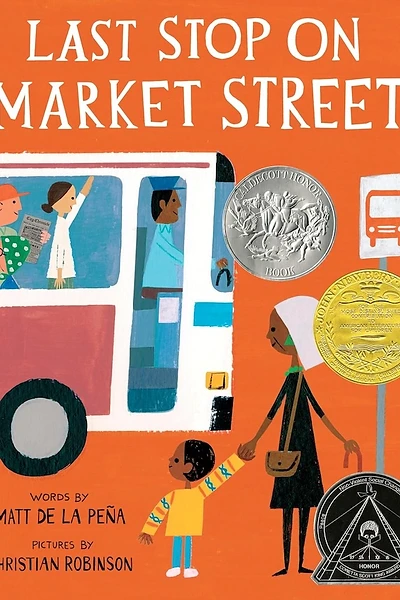
Last Stop on Market Street
by Matt de la Peña, pictures by Christian Robinson
Pacing MaterialA young boy and his grandmother ride the bus across town, and Nana helps him see the beauty in the city and the people around them.
Big Idea
Beauty is everywhere — if you know how to look — and gratitude for the ordinary can transform how we see the world.
Discussion Questions
- 1.What does CJ complain about, and how does Nana respond?
- 2.What 'beautiful' things does CJ notice by the end?
- 3.How can we find beauty where we live?
- 4.What are you grateful for that you usually overlook?
Classroom Activity
Beauty Walk
Students take a 'beauty walk' around the school or neighborhood, listing beautiful things they notice that others might miss.
Lesson Plan
Learning Goals
- Recognize beauty in everyday surroundings.
- Practice gratitude through observation.
- Compare different perspectives on the same experience.
- Express observations through writing and drawing.
Activity Steps
- 1.Read the book, noting how Nana helps CJ see beauty in everyday things.
- 2.Discuss what it means to 'look with new eyes.'
- 3.Take a beauty walk and have students list 5 things.
- 4.Share lists and create a class 'Beauty Map.'
Standards Connections
- ELA: RL.K.1 — Ask and answer questions about key details
- ELA: RL.K.2 — Retell stories, including key details
- ELA: RL.K.3 — Describe characters, setting, and events
- ELA: RL.3.6 — Acknowledge differences in characters' points of view
- ELA: SL.K.1 — Participate in collaborative conversations about the text
- ELA: W.K.3 — Write narratives recounting events with descriptive details
- SEL: Social Awareness
- SEL: Relationship Skills
- Art: VA:Re7 — Perceive and analyze artistic work
Pace-Write-Read Study with Pace-Write It!
Focus question: How does an author slow down a simple bus ride so readers can notice beauty, feelings, and meaning along the way? In Last Stop on Market Street by Matt de la Peña, a young boy named CJ rides the bus with Nana and learns to see his city with gratitude and wonder. The pacing moves step by step through their walk, the bus ride, and the final stop, using dialogue, repeated questions, and carefully chosen moments to help readers pause and notice perspective.
| Element | How to notice or teach it in the novel |
|---|---|
| Pace | Read: Notice how the story moves at a calm, steady pace from church to the bus stop to the last stop, matching CJ and Nana’s journey. Some moments are quick, but Matt de la Peña slows the pacing when Nana helps CJ notice beauty in everyday city life. Classroom Activity: Write 4-5 sentences about a short trip you take, slowing down one moment when someone helps you see something in a new way. |
| Plot | Read: Notice that the plot is simple—a bus ride across town—but each stop and conversation changes CJ’s thinking. The action is small, yet the meaning grows as Nana guides him toward gratitude and perspective. Classroom Activity: Write a beginning, middle, and end for a small trip story in which the character learns an important lesson by the final stop. |
| Prosody | Read: Listen to how the text sounds when read aloud, especially Nana’s warm voice and CJ’s wondering questions. The smooth flow and expressive rhythm help the story feel gentle and reflective. Classroom Activity: Choose 3 lines from your own writing and revise them so they sound good when read aloud with expression. |
| Word pause | Read: Notice where the author uses short phrases and sentence breaks to create little pauses, especially after CJ asks a question or Nana gives a thoughtful answer. These pauses give readers time to think about the message. Classroom Activity: Write 3 sentences in which a character asks a question, then add a pause before the answer to make the moment feel thoughtful. |
| Concept | Read: Notice that the big concept in this story is gratitude—finding beauty and value in places and people others might overlook. CJ begins by noticing what he does not have, while Nana helps him notice what he does have. Classroom Activity: Write about one ordinary place and show how a character changes from complaining to appreciating it. |
| Voice & World View | Read: Notice the caring, observant voice of the story and the hopeful world view Nana shares with CJ. The book suggests that beauty lives in community, kindness, music, and seeing others with respect. Classroom Activity: Write 4-6 sentences in a hopeful voice about your neighborhood or school, showing what makes it special. |
| Setting & Place | Read: Notice how the rainy city streets, bus stop, bus, and final destination shape the story. Christian Robinson’s art and de la Peña’s words make the city feel lively, busy, and full of hidden beauty. Classroom Activity: Describe a place you know well using details about weather, sounds, people, and movement. |
| Point of View | Read: Notice that readers mostly experience the trip through CJ’s questions and observations, even though the story is told in third person. This keeps us close to CJ’s changing feelings while also letting us watch Nana’s wisdom. Classroom Activity: Write about a short trip from the point of view of a child who does not understand something at first. |
| Original Characters | Read: Notice how CJ, Nana, and the bus riders each feel distinct and memorable. Nana is gentle but strong, CJ is curious and honest, and even the side characters add to the story’s message about community. Classroom Activity: Invent 2 characters for a bus or train ride—one curious and one wise—and write how they act differently during the trip. |
| Dialogue | Read: Notice how much of the story’s pacing comes through conversation between CJ and Nana. CJ’s questions move the story forward, and Nana’s answers deepen the meaning without stopping the action. Classroom Activity: Write a short dialogue where one character complains and another character answers in a way that changes how the first character sees the situation. |
| Details | Read: Notice the small details, like the rain, the passengers, the guitar music, and the city sights, that make the trip feel real. These details help readers understand the theme without long explanation. Classroom Activity: Make a list of 5 tiny details from a place you know, then use at least 3 of them in a short scene. |
| Descriptions | Read: Notice how the descriptions are brief but vivid, letting readers picture the bus ride and the neighborhood while keeping the story moving. The words and illustrations work together to show warmth, motion, and beauty. Classroom Activity: Write 3 descriptive sentences about a ride or walk, using color, sound, and movement. |
| Strong First Lines | Read: Notice how the opening quickly places CJ and Nana in a moment right after church, with rain and CJ’s first complaint setting up the story right away. The beginning introduces the conflict and tone without delay. Classroom Activity: Write an opening line for a story that begins with a child noticing something unfair or disappointing. |
| Immediacy & Engagement | Read: Notice how the story feels immediate because readers step into the action right away and hear CJ’s concerns almost at once. His questions make readers want to keep going to see what Nana will say next. Classroom Activity: Start a story in the middle of a walk or ride, with a character speaking on the first line. |
| Story Scenes & Summaries & Unique Structures | Read: Notice that the book is built mostly from short scenes—the walk, the waiting, the bus ride, the last stop—instead of long summary. This scene-by-scene structure helps pacing feel steady and meaningful. Classroom Activity: Plan a story in 4 small scenes from one trip, and write one sentence for each scene. |
| Flashback & Flash Forward & Cliffhangers | Read: Notice that this story does not use flashbacks or cliffhangers; instead, it stays in the present moment from stop to stop. That choice keeps readers focused on what CJ is learning right now. Classroom Activity: Write a present-time scene with no flashback, keeping all the action in one trip from one place to another. |
| Tension & Suspense & Surprise | Read: Notice that the tension is emotional, not scary—CJ wonders why he does not have what others have, and readers wait to see how Nana will answer. The surprise comes when the final stop reveals their destination and the purpose of the trip. Classroom Activity: Write a short scene where a character keeps asking why, and save the answer for the end. |
| Page Turns and Chapter Breaks | Read: Notice how page turns create small moments of anticipation, especially when CJ asks a question or when readers are about to see a new passenger or place. As a picture book, it has no chapters, so page turns help control pacing. Classroom Activity: Fold a paper into 4 pages and plan what surprise or new detail the reader will discover on each page turn. |
| Performance | Read: Notice how this book invites expressive reading aloud—CJ’s wondering voice, Nana’s calm replies, and the sounds of the city and music on the bus. Performance helps the pacing feel warm and alive. Classroom Activity: Practice reading a short dialogue you wrote using different voices for a child and a grandparent or elder. |
| Personality | Read: Notice how Nana’s personality—patient, wise, and joyful—shapes the mood of the whole story, while CJ’s honest questions make the story feel real. Their personalities create the rhythm of complaint, response, and new understanding. Classroom Activity: Write 4 sentences showing a character’s personality through what they notice and how they speak. |
| Humor | Read: Notice the gentle humor in CJ’s questions and in Nana’s affectionate responses, which keeps the story light even when it explores serious ideas. The humor helps pacing stay inviting instead of heavy. Classroom Activity: Add one funny or playful line to a thoughtful scene between two characters on a trip. |
| Pause | Read: Notice the larger pauses in the story when CJ looks, listens, or thinks, especially during the bus ride and the music scene. These pauses help readers absorb Nana’s message about gratitude and perspective. Classroom Activity: Write a scene with one full sentence that shows a character stopping to look or listen before speaking again. |
| Poetry and Poetic Devices | Read: Notice the poetic language in Nana’s comparisons and the musical feeling of the text, especially when beauty is described in the city and in the bus music. The book uses imagery and metaphor to make ordinary things feel special. Classroom Activity: Write one simile or metaphor about a sound or sight from your neighborhood. |
| Repetition | Read: Notice how CJ’s repeated wondering and questioning pattern gives the story a steady structure. Nana’s repeated way of answering him builds the theme little by little. Classroom Activity: Write 3 question-and-answer pairs that repeat a pattern, such as 'How come...?' and 'Sometimes...' or your own version. |
| Rhythm | Read: Notice the rhythm created by walking, waiting, riding, talking, and listening. The repeated motion of the bus and the back-and-forth between CJ and Nana create a smooth beat across the story. Classroom Activity: Write 5 short lines about a trip, making each line match a beat or movement such as step, stop, bump, turn, or sway. |
| Punctuation | Read: Notice how question marks are especially important because CJ asks so many questions, and commas and dialogue punctuation help the reading sound natural. The punctuation supports the pacing of wondering, pausing, and answering. Classroom Activity: Write a 4-line dialogue with at least 2 question marks and correct quotation marks. |
| Questions | Read: Notice that questions drive the whole story. CJ’s questions reveal what he values at first, and Nana’s answers teach him to see the world differently. Classroom Activity: Write 3 questions a child might ask on a bus ride, then answer them in the voice of a wise adult. |
| Compare-Contrast | Read: Notice the comparisons between what CJ thinks he is missing and what Nana helps him notice instead—cars versus the bus, possessions versus community, appearances versus inner beauty. These contrasts shape the theme of perspective. Classroom Activity: Make a T-chart comparing what a character wants with what the character truly needs to notice. |
| Objects | Read: Notice how everyday objects—the umbrella, the bus, the guitar, sunglasses, and other small items—help tell the story and reveal character. Objects in this book are ordinary, but they carry meaning. Classroom Activity: Choose one object from a trip and write 3 sentences showing how it reveals something about a character. |
| Threes | Read: Notice groups of three you can find in the story structure and details, such as repeated questions, several passengers to notice, or a beginning-middle-end journey. Patterns of three help young readers follow the pacing. Classroom Activity: Write 3 moments from a ride—what the character sees, hears, and feels. |
| Whitespace & Negative Space | Read: Notice how the picture book format leaves room on the page for readers to pause and think, and how the illustrations use space to highlight characters and mood. This visual breathing room slows the pace in meaningful places. Classroom Activity: Create a mini picture-book page by writing 1-2 sentences and leaving space for an illustration that shows the quiet feeling. |
| Art & Graphics | Read: Notice how Christian Robinson’s illustrations add pacing by showing the energy of the city, the warmth of the bus riders, and the emotional changes in CJ. The art often gives extra information that the words do not say directly. Classroom Activity: Draw one scene from your writing and add labels showing 3 details the picture reveals beyond the words. |
| Interactives & Gamification | Read: Notice how readers can interact with this story by spotting changes in CJ’s feelings, noticing bus passengers, or finding moments when Nana teaches perspective. The book naturally invites discussion and prediction. Classroom Activity: Create a 'gratitude hunt' list with 5 things a reader could spot on a trip that show beauty, kindness, or community, then write a sentence about one of them. |
Pace-Write It!
20-Minute Classroom Flow Read (5 min): Read Last Stop on Market Street aloud, pausing to emphasize CJ’s questions and Nana’s answers. Ask students to listen for moments when the story slows down so we can notice beauty, people, or feelings. Notice (5 min): Chart 3 places where the pacing slows: at the bus stop, during the ride, and at the last stop. Discuss: What does CJ notice first? What does Nana help him notice next? How do the words and pictures help us pause? Write (7 min): Students write a short 'small trip' scene where one character learns to see something ordinary in a new way. Writing frame: 'I was going to ______ with ______. At first, I thought ______. Then I saw/heard ______. ______ said, “______.” After that, I noticed ______. By the end, I felt ______ because ______.' Encourage students to include one question, one answer, and one detail about the setting. Share (3 min): Partners read their scenes aloud with expression. Listeners name one place where the writer slowed down the moment well. Exit ticket: Write one sentence answering: How did Nana help CJ change his perspective, and how did the author slow the story down to help readers notice that change?