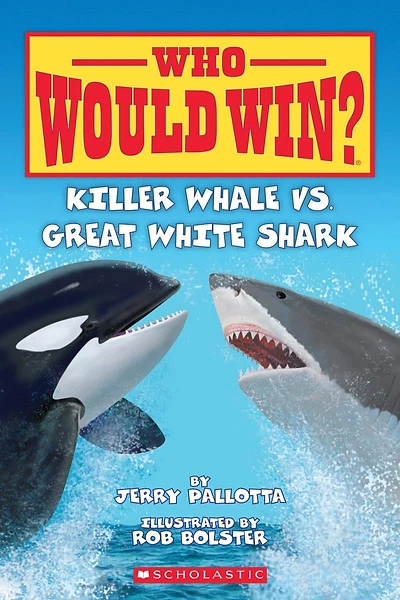
R WHO WOULD WIN
Killer Whale vs. Great White Shark
by Jerry Pallotta, illustrated by Rob Bolster
Pacing MaterialThis nonfiction easy reader pits two apex predators against each other in a head-to-head comparison. Jerry Pallotta presents fascinating facts about killer whales (orcas) and great white sharks—covering their size, teeth, speed, hunting strategies, and natural defenses—before imagining what might happen if these two ocean giants ever met in a fictional showdown. Rob Bolster's dynamic illustrations bring both creatures to life on the page.
Big Idea
Comparing and contrasting real scientific facts can help us understand and appreciate the natural world, even when we're having fun imagining hypothetical scenarios.
Discussion Questions
- 1.What are three facts you learned about killer whales that surprised you?
- 2.What are three facts you learned about great white sharks that surprised you?
- 3.Why do you think the author chose to compare these two specific animals?
- 4.Do you think this matchup could really happen in nature? Why or why not?
- 5.Which animal do you think has the advantage, and what evidence from the book supports your opinion?
- 6.How do the illustrations help you understand the size and power of each animal?
Classroom Activity
Create Your Own Animal Showdown
Students choose two animals they find fascinating (not necessarily predators) and create their own 'Who Would Win?' comparison page. They must research at least four factual categories (size, speed, defense, special ability) for each animal, write these facts in complete sentences, draw both animals to scale if possible, and write a short paragraph predicting and explaining a hypothetical encounter using evidence from their research.
Lesson Plan
Learning Goals
- Compare orcas and great white sharks using factual information about their size, speed, defenses, and hunting abilities.
- Distinguish the book’s scientific facts from its imagined showdown and explain why a prediction is not a proven fact.
- Research two chosen animals and record at least one accurate fact in each of four categories: size, speed, defense, and special ability.
- Create a comparison page with complete factual sentences, labeled illustrations, and an evidence-based prediction about a hypothetical encounter.
Activity Steps
- 1.Read Jerry Pallotta’s "Killer Whale vs. Great White Shark" aloud and examine Rob Bolster’s illustrations. Ask: What makes each animal an effective ocean predator? Which parts report facts, and which parts imagine an encounter?
- 2.Model a comparison chart for the orca and great white shark with four headings: size, speed, defense, and special ability. Add facts from the book, noting that orcas are mammals and sharks are fish. Discuss how habitat and circumstances can affect any predicted outcome.
- 3.Have students choose two animals, including nonpredators if they wish. Using teacher-approved books or websites, research all four categories for each animal. Record source titles; use adult-supported research and sentence frames for K–2, and more independent research for grades 3–5.
- 4.Create a "Who Would Win?" comparison page containing at least eight complete factual sentences—one per category for each animal. Draw and label both animals, showing their relative sizes when possible; older students can use a simple scale.
- 5.Write a short paragraph predicting a hypothetical encounter and supporting the prediction with at least two researched facts. Define the setting and challenge, such as swimming, escaping danger, or finding food, rather than assuming a fight. K–2 students may dictate or use sentence frames.
- 6.Share comparison pages with a partner. Partners identify one similarity, one difference, and the evidence supporting the prediction. Revise unsupported claims and explain how the project, like the book, combines real facts with an imagined scenario.
Standards Connections
- ELA: CCSS RI.K.3–RI.5.3 — With grade-appropriate support, describe connections and relationships among scientific ideas and information.
- ELA: CCSS W.K.2–W.5.2 — Write informative texts that communicate researched animal facts.
- ELA: CCSS W.K.7–W.5.7 — Participate in shared or independent research projects using appropriate sources.
- ELA: CCSS SL.K.1–SL.5.1 — Participate in collaborative discussions, compare findings, and respond to others’ ideas.
- Science: NGSS Science and Engineering Practices — Obtain, evaluate, and communicate information; construct explanations and support claims with evidence.
Pace-Write-Read Study with Pace-Write It!
This guide breaks down the craft techniques Pallotta and Bolster use to make nonfiction animal facts feel as thrilling as a fictional battle. Use these pacing elements to help young readers and writers see how factual writing can still be fast-paced, engaging, and dramatic.
| Element | How to notice or teach it in the novel |
|---|---|
| Pace | Read: Notice how each two-page spread delivers one bite-sized fact before moving to the next, keeping the pace brisk for young readers. Classroom Activity: Have students write a nonfiction fact-page about an animal using only 1-2 sentences per page, mimicking this quick pace. |
| Plot | Read: Notice how the book builds toward the imagined battle as its climax, using earlier facts as setup. Classroom Activity: Ask students to outline a simple plot structure (setup, rising facts, climax event) for their own animal comparison book. |
| Prosody | Read: Notice the punchy, rhythmic sentence patterns like 'Killer whales are fast. Great white sharks are fast too.' Classroom Activity: Have students write three sentences about an animal using the same short, parallel sentence structure. |
| Word pause | Read: Notice how bold or italicized words (like teeth measurements) create a pause for emphasis. Classroom Activity: Students choose one surprising fact and format it with bold text to make readers pause and take notice. |
| Concept | Read: Notice how the entire book is built around one simple, kid-friendly concept: comparing two animals fact by fact. Classroom Activity: Have students brainstorm three other animal pairs that would make an interesting comparison concept. |
| Voice & World View | Read: Notice the playful, enthusiastic voice that treats scientific facts like exciting news. Classroom Activity: Students rewrite a boring fact from a textbook using an excited, kid-friendly voice like Pallotta's. |
| Setting & Place | Read: Notice how the ocean setting is established through illustrations of open water, showing scale and environment. Classroom Activity: Have students draw or describe the natural habitat of their chosen animal in one descriptive paragraph. |
| Point of View | Read: Notice the book stays in an objective, third-person informational point of view throughout. Classroom Activity: Ask students to write a fact from the point of view of the animal itself, in first person. |
| Original Characters | Read: Notice how the killer whale and great white shark are treated almost like characters with personalities and 'skills.' Classroom Activity: Have students create a fact-based 'character profile' for an animal, listing its special abilities and traits. |
| Dialogue | Read: Notice this nonfiction book contains no dialogue, relying instead on narration and facts. Classroom Activity: Challenge students to add one imagined line of dialogue for their animal, based on real behavior (e.g., a warning sound). |
| Details | Read: Notice the specific numerical details, like tooth count and swimming speed, that make facts feel concrete. Classroom Activity: Have students research and include three specific numbers (size, speed, weight) about their animal. |
| Descriptions | Read: Notice how physical descriptions use comparisons kids understand, like comparing size to a school bus. Classroom Activity: Students write a description of their animal's size using a comparison to something familiar. |
| Strong First Lines | Read: Notice how the book opens with a bold question or statement that hooks readers immediately. Classroom Activity: Have students write three different strong opening lines for their animal report and choose the best one. |
| Immediacy & Engagement | Read: Notice how direct questions to the reader ('Would you want to meet one of these animals?') create engagement. Classroom Activity: Students add one direct question to their reader within their animal fact page. |
| Story Scenes & Summaries & Unique Structures | Read: Notice the alternating structure—one page for killer whale facts, one page for shark facts—before the final showdown scene. Classroom Activity: Have students organize their comparison using the same alternating structure. |
| Flashback & Flash Forward & Cliffhangers | Read: Notice how the book builds anticipation for the final battle by delaying it until the facts are established. Classroom Activity: Students write a one-sentence cliffhanger to end their fact page and make readers want more. |
| Tension & Suspense & Surprise | Read: Notice how comparing strengths and weaknesses creates suspense about who might win. Classroom Activity: Have students list one surprising strength and one surprising weakness for their chosen animal to build suspense. |
| Page Turns and Chapter Breaks | Read: Notice how each page turn reveals a new fact or comparison, encouraging readers to keep going. Classroom Activity: Students design a page-turn moment where the last line makes readers want to turn the page. |
| Performance | Read: Notice how the text is written to be read aloud with excitement and emphasis on key facts. Classroom Activity: Have students practice reading their animal facts aloud with dramatic emphasis, like a nature show host. |
| Personality | Read: Notice how each animal is given a distinct 'personality' through its described hunting style and behavior. Classroom Activity: Students write two sentences describing their animal's personality based on its real behaviors. |
| Humor | Read: Notice small humorous asides, like comparing shark teeth to steak knives. Classroom Activity: Have students write one funny comparison to describe a feature of their animal. |
| Pause | Read: Notice how short sentences and white space create natural pausing points for young readers. Classroom Activity: Students format their fact page with short sentences and line breaks to create reading pauses. |
| Poetry and Poetic Devices | Read: Notice the alliteration in phrases like 'killer whale' itself, and rhythmic fact delivery. Classroom Activity: Have students find or create one alliterative phrase for their animal (e.g., 'speedy shark'). |
| Repetition | Read: Notice the repeated sentence structure comparing each animal's trait side by side. Classroom Activity: Students write three repeated-structure sentences comparing two animals, like 'The lion has claws. The tiger has claws too.' |
| Rhythm | Read: Notice the steady rhythm created by consistent sentence length throughout each section. Classroom Activity: Have students read their fact page aloud and revise sentence lengths to create a steady rhythm. |
| Punctuation | Read: Notice the frequent use of exclamation points to convey excitement about facts. Classroom Activity: Students add exclamation points strategically to two sentences to increase excitement. |
| Questions | Read: Notice rhetorical questions like 'Who would win?' used as a framing device. Classroom Activity: Have students write a title question for their own animal comparison, framed like 'Who Would Win?' |
| Compare-Contrast | Read: Notice the entire book structure is built on comparing and contrasting two animals point by point. Classroom Activity: Students create a Venn diagram or T-chart comparing two animals of their choice. |
| Objects | Read: Notice how objects like teeth, fins, and blubber are treated as important 'tools' each animal uses. Classroom Activity: Have students list three physical 'tools' their animal uses to survive. |
| Threes | Read: Notice how facts are often grouped in sets of three for memorability (size, speed, teeth). Classroom Activity: Students organize their animal facts into three clear categories. |
| Whitespace & Negative Space | Read: Notice how generous white space around text and images keeps the page from feeling cluttered for young readers. Classroom Activity: Have students design their fact page layout with balanced text and white space. |
| Art & Graphics | Read: Notice how Bolster's illustrations show scale, teeth, and movement to reinforce the facts visually. Classroom Activity: Students illustrate their animal with at least one label pointing to a key feature. |
| Interactives & Gamification | Read: Notice how the 'Who Would Win?' format itself is a game-like structure that invites reader prediction. Classroom Activity: Have students create a simple prediction quiz question for classmates based on their animal facts. |
Pace-Write It!
Gather students in a circle with the book. Read aloud one spread about the killer whale and one about the great white shark, pausing to note the parallel sentence structure and quick pace. Ask: 'How does the author make facts feel exciting?' Chart student observations about short sentences, exclamation points, and comparisons. Then introduce the culminating writing activity, modeling how to research and format facts using the same techniques. Circulate as students draft their own animal comparison pages, encouraging them to read their work aloud to a partner to check pacing and excitement before finalizing their illustrations.