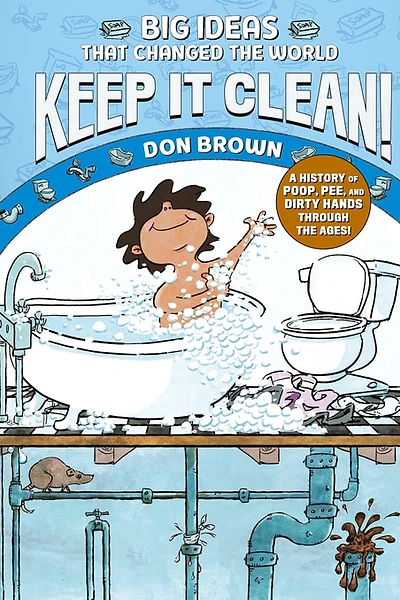
 3-7
3-7GN BROWN
Keep It Clean!
by Don Brown
Pacing MaterialA graphic novel history of sanitation and public health, from ancient Roman aqueducts through the Black Death, the discovery of germs, and modern water treatment and hygiene.
Big Idea
Clean water and sanitation are among the most important public health achievements in human history.
Discussion Questions
- 1.How did ancient civilizations handle sanitation, and what can we learn from them?
- 2.What was the connection between sanitation and the spread of disease?
- 3.How did the discovery of germs change public health?
- 4.Why is access to clean water still a global challenge today?
Classroom Activity
Water Filtration Experiment
Students build simple water filters and learn how modern water treatment plants make water safe to drink.
Lesson Plan
Learning Goals
- Understand the history of sanitation and its impact on public health
- Identify key discoveries in the science of germs and disease prevention
- Build a simple water filtration system
- Appreciate the importance of clean water access worldwide
Activity Steps
- 1.Introduce historical sanitation challenges: cholera, Black Death, miasma theory
- 2.Discuss John Snow's discovery of waterborne disease transmission
- 3.Have students build water filters using gravel, sand, and charcoal
- 4.Test the filters with dirty water and observe results
- 5.Discuss modern water treatment and global access to clean water
Standards Connections
- ELA: RL.3.1 — Ask and answer questions about key details
- ELA: RL.3.2 — Retell stories, including key details
- ELA: RL.3.3 — Describe characters, setting, and events
- ELA: RL.7.6 — Acknowledge differences in characters' points of view
- ELA: SL.3.1 — Participate in collaborative conversations about the text
- ELA: W.3.3 — Write narratives recounting events with descriptive details
- SEL: Responsible Decision-Making
- Art: VA:Re7 — Perceive and analyze artistic work
Pace-Write-Read Study with Pace-Write It!
Focus question: How does an author speed up and slow down a nonfiction graphic novel to help readers understand big scientific ideas? In Keep It Clean! by Don Brown, readers move through the history of sanitation and public health from ancient Rome to modern water treatment. Brown uses graphic-novel pacing, quick scene changes, striking visuals, and carefully timed explanations to make complex science and history feel urgent, clear, and engaging.
| Element | How to notice or teach it in the novel |
|---|---|
| Pace | Read: Notice how Don Brown moves quickly across centuries but slows down for major moments such as the Black Death, the discovery of germs, and modern clean-water systems. Classroom Activity: Write a 6-sentence mini-history of a school health rule, using 3 fast summary sentences and 3 slower close-up sentences. |
| Plot | Read: Notice that this biography-like history has a problem-solution plot: dirty cities and disease create danger, and human discovery gradually leads to sewers, hygiene, and water treatment. Classroom Activity: Make a beginning-middle-end plot map showing one sanitation problem and one scientific solution, then turn it into a short paragraph. |
| Prosody | Read: Listen for how the words in Keep It Clean! would sound aloud during dramatic moments like outbreaks of disease and hopeful moments of discovery. Classroom Activity: Choose one page idea from the book and rewrite it as a read-aloud script with stage directions for where your voice should speed up, slow down, get louder, or pause. |
| Word pause | Read: Notice where short phrases and important science words, like germs, sewage, or sanitation, make readers pause and think. Classroom Activity: Write 4 sentences about clean water and underline the one word in each sentence that should make the reader pause. |
| Concept | Read: Notice the big concept that public health changes communities, not just individuals, across time. Classroom Activity: Write a 3-part explanation of the concept 'clean systems save lives' using one example from ancient Rome, one from the germ era, and one from today. |
| Voice & World View | Read: Notice Don Brown’s informative but urgent voice that shows sanitation as a human-rights and science issue affecting everyone. Classroom Activity: Write a short informational paragraph in a serious, concerned voice explaining why public health matters in your town or school. |
| Setting & Place | Read: Notice how the book travels through places such as ancient Roman water systems, crowded medieval cities during the Black Death, and modern treatment plants. Classroom Activity: Choose one setting from the book and write a setting paragraph showing how that place helped or harmed people’s health. |
| Point of View | Read: Notice that Brown mostly uses an all-knowing nonfiction point of view, but the art helps readers imagine what life felt like for ordinary people living with dirty water and disease. Classroom Activity: Rewrite one historical moment from the point of view of a child living in a crowded city before modern sanitation. |
| Original Characters | Read: Notice that this graphic novel does not center on one made-up hero; instead, inventors, doctors, city leaders, and ordinary citizens all matter in the history of sanitation. Classroom Activity: Create an original character who lives in one era from the book and write a journal entry about one sanitation problem that character faces. |
| Dialogue | Read: Notice how speech bubbles or imagined spoken lines can make historical information feel immediate and alive in a graphic nonfiction book. Classroom Activity: Write 6 lines of dialogue between a city doctor and a town leader arguing about whether to invest in cleaner water. |
| Details | Read: Notice the precise details about aqueducts, germs, waste, disease spread, and water cleaning that make the science understandable. Classroom Activity: Write an explanatory paragraph about handwashing or water treatment using at least 5 accurate details. |
| Descriptions | Read: Notice how Don Brown describes filthy streets, spreading illness, and cleaner modern systems to create strong contrasts. Classroom Activity: Write two descriptions of the same town—one before sanitation improvements and one after. |
| Strong First Lines | Read: Notice how a nonfiction graphic novel needs an opening that quickly hooks readers into a big topic like hygiene, disease, or invention. Classroom Activity: Write 3 possible first lines for a comic page about the moment people begin to understand germs. |
| Immediacy & Engagement | Read: Notice how the mix of short text, urgent facts, and vivid images makes old history feel important right now. Classroom Activity: Write a 5-sentence passage that makes a past sanitation problem feel immediate by connecting it to choices people still make today. |
| Story Scenes & Summaries & Unique Structures | Read: Notice how Keep It Clean! blends scene-like moments, such as disease outbreaks, with quick summaries covering long periods of history. Classroom Activity: Write one short scene about a family fetching dirty water and one summary sentence that jumps ahead to a scientific solution. |
| Flashback & Flash Forward & Cliffhangers | Read: Notice how the book’s historical structure naturally moves backward and forward across time, showing causes in one era and results in another. Classroom Activity: Write 3 linked comic captions: one flashback to ancient sanitation, one present problem, and one flash-forward to a healthier future. |
| Tension & Suspense & Surprise | Read: Notice the tension created when people do not yet know what causes disease, and the surprise when scientific discoveries about germs change public health. Classroom Activity: Write a suspenseful paragraph that ends with the discovery that invisible germs, not bad smells alone, can spread sickness. |
| Page Turns and Chapter Breaks | Read: Notice how page turns in a graphic novel can reveal a new era, a shocking disease event, or a solution such as water treatment. Classroom Activity: Plan a 4-panel or 2-page comic and mark where the page turn should happen for the biggest surprise. |
| Performance | Read: Notice how this book could be performed with dramatic narration, scientist voices, and crowd reactions during moments like epidemics or public reform. Classroom Activity: Turn one section into a 1-minute performance script with a narrator and two historical speakers. |
| Personality | Read: Notice that even in nonfiction, Brown’s style has personality—curious, urgent, clear, and sometimes wry about human mistakes. Classroom Activity: Write an informational paragraph about soap, sewers, or clean water with a strong author personality that sounds curious and persuasive. |
| Humor | Read: Notice how a book about waste and hygiene can use light humor or visual irony to keep readers engaged while teaching serious history. Classroom Activity: Write 3 comic captions that use gentle humor to teach one clean-habits lesson without making fun of sick people. |
| Pause | Read: Notice where readers need to pause after big ideas, such as the scale of the Black Death or the importance of germ theory. Classroom Activity: Write a short nonfiction passage and add slash marks where a reader should pause for meaning. |
| Poetry and Poetic Devices | Read: Notice that even informational writing can use alliteration, imagery, and strong repeated sounds to make facts memorable. Classroom Activity: Write 4 lines of free verse about water, germs, or soap using at least two poetic devices. |
| Repetition | Read: Notice how repeated ideas—dirty water causes danger, clean systems protect people—help unify the book across many time periods. Classroom Activity: Write a paragraph about public health that repeats one key phrase 3 times for emphasis. |
| Rhythm | Read: Notice the rhythm created by short bursts of facts, image-based moments, and transitions from problem to solution. Classroom Activity: Write 6 sentences with a deliberate rhythm pattern: short, short, long, short, long, short. |
| Punctuation | Read: Notice how punctuation in graphic nonfiction can sharpen urgency, surprise, and explanation, especially in captions and speech bubbles. Classroom Activity: Rewrite a dull 4-sentence passage about sanitation using dashes, colons, commas, and exclamation points to improve pace. |
| Questions | Read: Notice how the topic invites questions such as how people lived before modern plumbing and how scientists proved germs exist. Classroom Activity: Write 5 inquiry questions a reader might ask during Keep It Clean!, then answer one in 2-3 sentences. |
| Compare-Contrast | Read: Notice how the book compares dirty and clean systems, old beliefs and new science, and ancient and modern public health solutions. Classroom Activity: Write a compare-contrast paragraph about life before and after germ theory. |
| Objects | Read: Notice how objects such as aqueducts, pipes, soap, drains, and treatment equipment carry important meaning in the history of sanitation. Classroom Activity: Choose one object from the book and write a personified monologue beginning with 'I help keep people safe because...' |
| Threes | Read: Notice how ideas can be grouped in threes, such as problem, discovery, solution, to make information easier to follow. Classroom Activity: Write a 3-part explanation of one public-health advance using this frame: 'First... Next... Finally...' |
| Whitespace & Negative Space | Read: Notice how empty space on a comics page can slow readers down and make a fact, image, or warning stand out. Classroom Activity: Sketch a simple comic layout for a sanitation topic and label where you would leave extra white space for emphasis. |
| Art & Graphics | Read: Notice how Don Brown’s graphic style helps explain invisible ideas like germs and huge ideas like citywide sanitation systems. Classroom Activity: Create a labeled infographic-comic panel that teaches one step in cleaning water or preventing disease. |
| Interactives & Gamification | Read: Notice how the book’s problem-solution structure could inspire timelines, quizzes, and choose-a-solution activities about public health. Classroom Activity: Design a 5-question classroom quiz or a mini board game in which players solve sanitation challenges from different historical periods. |
Pace-Write It!
20-Minute Classroom Flow\nRead (5 min): Read aloud a short section from Keep It Clean! that moves from a sanitation problem to a scientific discovery, such as the Black Death, germ theory, or modern water treatment. Ask students to listen for where the text speeds up across time and where it slows down for an important moment.\nNotice (5 min): On the board, make two columns: 'Fast summary' and 'Slow scene.' Have students name one example of each from the reading. Discuss how Don Brown uses graphic-novel structure, captions, and images to pace information and keep readers engaged with science and history.\nWrite (7 min): Students write a short historical-science passage that uses both summary and scene. Writing frame: 'At first, people __________. For many years, __________. Then one day, __________. In that moment, __________. Because of this discovery, __________. Today, __________.' Encourage students to include one sanitation problem, one discovery, and one solution.\nShare (3 min): Partners read their pieces aloud and identify where the writing speeds up and where it slows down. Invite 1-2 students to share a strong example with the class.\nExit ticket: In one sentence, answer: How did pacing help Don Brown teach readers about sanitation and public health in Keep It Clean!?