 2-5
2-5GN VENABLE
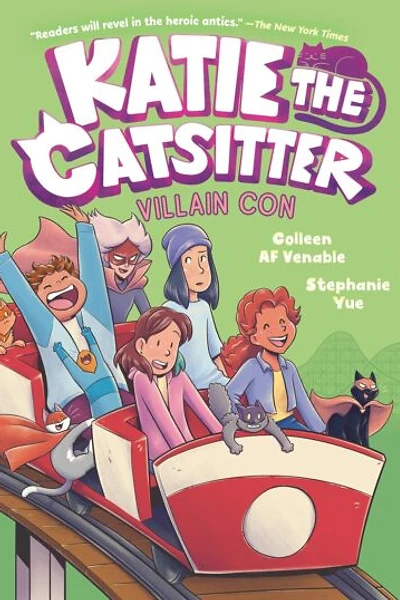
Katie the Catsitter: Villain Con
by Colleen AF Venable
Pacing MaterialKatie and her feline friends head to Villain Con, where the line between heroes and villains blurs in this action-packed graphic novel adventure.
Big Idea
True heroism isn't about costumes and powers — it's about doing the right thing, even when it's hard.
Discussion Questions
- 1.What makes someone a hero versus a villain?
- 2.How does Katie use her catsitting skills to solve problems?
- 3.What surprised you most about the characters at Villain Con?
- 4.When have you had to make a tough choice between right and wrong?
Classroom Activity
Hero vs. Villain
Design your own superhero or villain. Draw their costume, name their special power, and write one sentence about whether they'd be a hero or villain.
Lesson Plan
Learning Goals
- Describe how Katie and her feline friends’ choices at Villain Con help readers think about what makes someone a hero or villain.
- Use details from dialogue and illustrations to explain a character’s actions.
- Design an original costumed character with a name and special power.
- Write a sentence explaining whether the character acts as a hero or villain, focusing on choices rather than appearance or powers.
Activity Steps
- 1.Introduce “Hero vs. Villain” by asking: “Can someone look like a villain but do something heroic?” Explain that Katie’s adventure at Villain Con invites readers to question these labels.
- 2.Read or revisit selected panels featuring Katie and her feline friends at Villain Con. Have students identify a character’s choice and point to dialogue or an illustration that helps explain it.
- 3.Discuss the big idea: true heroism means doing the right thing, even when it is hard. Create a class chart of helpful and harmful choices, keeping costumes and powers separate from actions.
- 4.Invite students to imagine a new character attending Villain Con. On paper, draw the character’s costume, write their name, and label their special power.
- 5.Have students write one sentence using this frame: “My character is a hero/villain because they choose to ___, even when ___.” Encourage students to explain how the character uses their power to help or harm others.
- 6.Hold a brief gallery walk or partner share. Ask students to explain their character’s choice and discuss whether a different choice could change the hero or villain label.
Standards Connections
- ELA: CCSS RL.2.3 / RL.3.3 — Describe characters’ responses, traits, motivations, and actions.
- ELA: CCSS RL.4.3 / RL.5.3 — Analyze characters using specific details from the text.
- ELA: CCSS RL.2.7 / RL.3.7 — Use illustrations and words together to understand characters and story events.
- ELA: CCSS SL.2.1–SL.5.1 — Participate in collaborative discussions and build on others’ ideas.
- SEL: Responsible decision-making — Consider how choices affect others and distinguish helpful from harmful actions.
Pace-Write-Read Study with Pace-Write It!
Focus question: How does a graphic novel speed up and slow down a story to show action, feelings, and friendship? In Katie the Catsitter: Villain Con by Colleen AF Venable, Katie and her super-cats enter a flashy convention where danger, jokes, and surprising choices keep the story moving. The book uses pacing through quick panel action, page turns, dialogue, and pauses in both words and pictures so readers can feel excitement while also noticing kindness and friendship.
| Element | How to notice or teach it in the novel |
|---|---|
| Pace | Read: Notice how the story races during convention action scenes with Katie and the cats, then slows down for moments when Katie thinks about loyalty, trust, and doing the right thing. Classroom Activity: Write two short comic-style scenes about a trip to a convention or fair—one fast scene with action and one slower scene with reflection. |
| Plot | Read: Track how Katie’s trip to Villain Con moves from excitement to confusion to big choices as the line between heroes and villains blurs. Classroom Activity: Make a 5-box plot map labeled beginning, problem, surprise, choice, and ending, then write a new mini-plot for Katie and one cat at a different event. |
| Prosody | Read: Listen to how the dialogue sounds when read aloud—some lines feel snappy and playful, while others sound tense or secretive, matching the shifting mood at Villain Con. Classroom Activity: Choose a short imagined exchange between Katie and one cat and rewrite it three ways: excited, nervous, and relieved. |
| Word pause | Read: Notice places where a single word, a broken line of dialogue, or a panel beat makes you stop before the next action. Classroom Activity: Write a 6-line comic script where Katie discovers something surprising, using one one-word line to create a pause. |
| Concept | Read: Think about the big idea that heroes and villains are not always easy to separate, and how friendship and kindness can guide choices. Classroom Activity: Write a paragraph explaining what makes someone seem like a hero or villain, using Katie and the cats as examples. |
| Voice & World View | Read: Notice Katie’s lively, observant voice and how her view of people—and cats—shapes what feels funny, risky, or important. Classroom Activity: Write a diary entry from Katie’s point of view about the weirdest and kindest thing she saw at Villain Con. |
| Setting & Place | Read: Study how Villain Con feels crowded, flashy, dramatic, and full of surprises, making the setting add speed and excitement to the story. Classroom Activity: Describe a convention hall, clubhouse, or festival in 5 vivid sentences that make it feel busy and alive. |
| Point of View | Read: Notice how the story centers Katie’s experience, so readers discover confusing clues, danger, and friendship choices when she does. Classroom Activity: Rewrite one convention moment from the point of view of one of the cats instead of Katie. |
| Original Characters | Read: Pay attention to how Katie and her feline friends each bring distinct energy, and how side characters at Villain Con help make the world feel inventive. Classroom Activity: Invent a new cat character for Katie’s team, including a name, power, personality, and one problem the cat causes at the convention. |
| Dialogue | Read: Notice how dialogue helps scenes move quickly, reveals character relationships, and balances humor with tension. Classroom Activity: Write 8 lines of dialogue between Katie and a cat who disagree about whether to trust someone at Villain Con. |
| Details | Read: Look for small visual and word details that reveal clues, jokes, and emotions, especially in busy convention scenes. Classroom Activity: Make a list of 6 tiny details Katie might notice at Villain Con, then use at least 3 in a short scene. |
| Descriptions | Read: Notice how descriptions in words and pictures help readers imagine dramatic costumes, expressive cats, and the convention atmosphere without slowing the story too much. Classroom Activity: Write a description of a villain costume or cat gadget using color, shape, and movement words. |
| Strong First Lines | Read: Think about how an opening in a graphic novel needs to hook readers quickly by promising action, humor, or trouble for Katie. Classroom Activity: Write three possible first lines for a new Katie the Catsitter adventure, each with a different mood: funny, mysterious, and action-packed. |
| Immediacy & Engagement | Read: Notice how readers feel pulled into the middle of events because the panels, expressions, and quick exchanges make everything feel like it is happening right now. Classroom Activity: Write a present-tense action paragraph that begins, “Katie pushes through the crowd at Villain Con and suddenly…” |
| Story Scenes & Summaries & Unique Structures | Read: Notice when the book shows a full scene moment-by-moment and when it skips ahead to summarize time, helping the story move efficiently. Classroom Activity: Write one detailed scene of Katie entering a room, then add two summary sentences that move the story ahead to the next problem. |
| Flashback & Flash Forward & Cliffhangers | Read: Watch for moments when the story hints at earlier events, future trouble, or ends a section with a question that makes you turn the page. Classroom Activity: End a comic scene with a cliffhanger sentence about what Katie sees behind a door or booth curtain. |
| Tension & Suspense & Surprise | Read: Notice how secrets, shifting trust, and unexpected reveals at Villain Con create suspense even in funny scenes. Classroom Activity: Write a short suspense scene where Katie hears a strange noise and has to decide whether to investigate alone. |
| Page Turns and Chapter Breaks | Read: Pay attention to how page turns and breaks can hide a reveal, increase a joke, or build excitement before the next event. Classroom Activity: Plan a 4-panel comic and mark where the page turn would happen for the biggest surprise. |
| Performance | Read: Notice how characters often seem to perform versions of themselves at a convention, where costumes, poses, and dramatic entrances matter. Classroom Activity: Write a short monologue for a character introducing themselves on a Villain Con stage. |
| Personality | Read: Notice how Katie’s caring but bold personality affects her choices, and how each cat’s personality adds humor, conflict, or support. Classroom Activity: Write a character sketch of Katie or one cat, including what that character wants, fears, and does when stressed. |
| Humor | Read: Look for how jokes, visual gags, cat behavior, and exaggerated convention moments keep the story playful even when the stakes rise. Classroom Activity: Write a funny 3-panel scene in which a cat causes a problem at Villain Con by misunderstanding a rule. |
| Pause | Read: Notice the quiet beats between action moments when Katie reacts, thinks, or notices a friend’s feelings. Classroom Activity: Write a scene with one action sentence, then one pause sentence showing what Katie notices or feels before the next action. |
| Poetry and Poetic Devices | Read: Notice places where sound words, repeated phrases, or strong imagery make comic moments feel vivid and dramatic. Classroom Activity: Write 4 lines describing Villain Con using alliteration or onomatopoeia, such as clatter, swoosh, or zap. |
| Repetition | Read: Notice how repeated words, repeated cat behaviors, or repeated visual patterns can build humor and help readers remember important ideas. Classroom Activity: Write a short comic script in which a repeated phrase by Katie or a cat becomes funnier or more meaningful each time. |
| Rhythm | Read: Feel the rhythm created by quick panels, short dialogue bursts, and then longer pauses for reactions or reveals. Classroom Activity: Write 6 sentences that alternate short-long-short-long to create a lively rhythm in an action scene. |
| Punctuation | Read: Notice how question marks, dashes, ellipses, and exclamation points shape the speed and feeling of dialogue in tense or funny moments. Classroom Activity: Rewrite one line Katie says in three ways by changing the punctuation to show surprise, worry, and excitement. |
| Questions | Read: Think about the questions readers ask while reading: Who can Katie trust? What are the cats planning? Are villains always bad? Classroom Activity: Write 5 reader questions that could come up during a Villain Con chapter, then answer one from Katie’s point of view. |
| Compare-Contrast | Read: Compare the public image of heroes and villains in the book with what characters are really like underneath. Classroom Activity: Make a T-chart comparing a hero-like character and a villain-like character, then write 3 sentences about what they have in common. |
| Objects | Read: Notice how costumes, badges, gadgets, and convention items can become clues, jokes, or tools that move the plot. Classroom Activity: Choose one object Katie carries or finds and write a mini-scene showing how it solves a problem unexpectedly. |
| Threes | Read: Look for groups of three in actions, jokes, or details, because three beats often make a moment satisfying or funny. Classroom Activity: Write a sentence or short scene that lists three sights, three sounds, or three problems Katie notices at Villain Con. |
| Whitespace & Negative Space | Read: Notice how open space between panels or around a single reaction can slow the pace and make a feeling or reveal stand out. Classroom Activity: Plan a comic page with one crowded panel and one nearly empty panel, then explain why the empty space matters. |
| Art & Graphics | Read: Study how expressions, panel size, motion lines, and busy backgrounds help tell the story of Katie and the cats even without many words. Classroom Activity: Sketch or describe 3 panels that show rising action at Villain Con using facial expressions and panel size changes. |
| Interactives & Gamification | Read: Think about how the convention setting feels game-like, with clues to notice, dramatic reveals, and characters making strategic choices. Classroom Activity: Design a simple “Villain Con Challenge” for classmates with 3 tasks Katie would have to complete to prove kindness, teamwork, or bravery. |
Pace-Write It!
20-Minute Classroom Flow\nRead (5 min): Read a short section from Katie the Catsitter: Villain Con that includes fast action, funny cat behavior, and a moment when Katie has to think before acting. Ask students to notice where the story speeds up and where it slows down.\nNotice (5 min): Discuss: How do the panels, dialogue, and page turns change the pacing? What clues show friendship and kindness even during tense convention scenes? Chart student observations under two headings: “Fast Pace” and “Slow Pause.”\nWrite (7 min): Students write a short comic-style scene inspired by the book. Writing frame: “Katie and ___ race through Villain Con because ___. First, ___. Then, ___. Suddenly, ___. Katie pauses and thinks, ‘___.’ In the end, kindness helps when ___.” Encourage students to include one fast action line, one pause line, and one surprising detail.\nShare (3 min): Partners read their scenes aloud with expression. Listeners name one place where the pacing felt fast and one place where the pause made the scene stronger.\nExit ticket: Write one sentence answering: How does slowing down a scene help readers understand Katie’s feelings or choices?